Cancer drug price cap: 30% margin limit on 110 drugs could cut prices by up to 70%
By Shamyak
Published
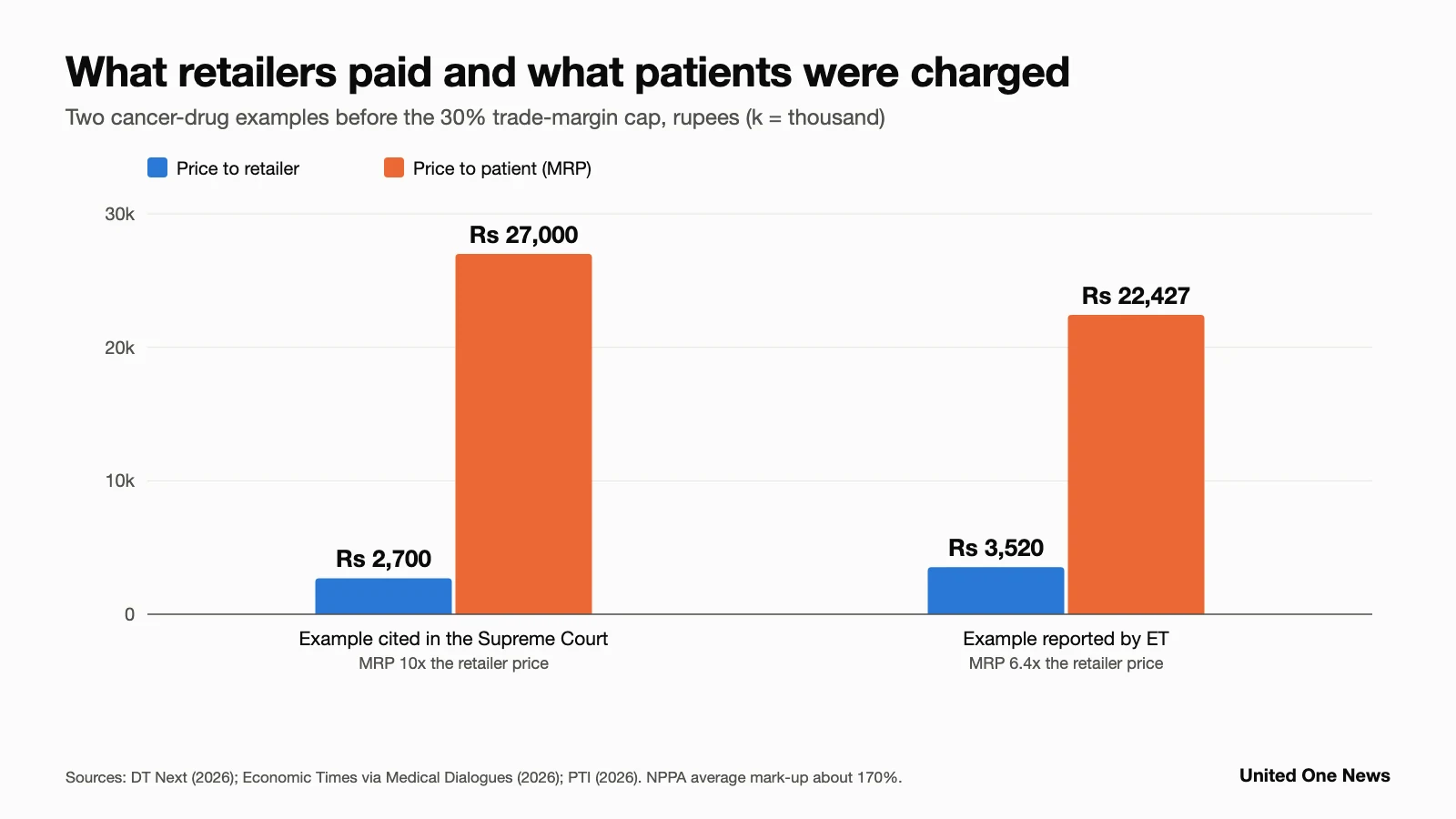
One cancer drug sold to retailers at Rs 2,700 carried an MRP of Rs 27,000. The Centre's cap is expected to save patients Rs 2,500 crore a year, but the drug list and start date are still to come.
Original report
On 8 October 2026, the Centre decided to cap trade margins on non-scheduled anti-cancer drugs at 30% of their maximum retail price (MRP), covering 110 drugs, PTI reported (PTI, 2026). The government expects MRPs to fall by 20% to 70%, depending on each drug's current mark-up, and estimates patients will save about Rs 2,500 crore a year (PTI, 2026).
The gap it targets is wide. In one example before the Supreme Court, a drug supplied to retailers at Rs 2,700 carried an MRP of Rs 27,000, DT Next reported on 8 October (DT Next, 2026). That MRP is 10 times the retailer's price.
What the cancer drug price cap covers
The cap applies to all non-scheduled anti-cancer drugs: branded and generic, made in India and imported, patented and not (Business Today, 2026; PTI, 2026). Of the 110 drugs, 35 are patented (PTI, 2026).
The National Pharmaceutical Pricing Authority (NPPA) approved the proposal "in principle" at its 8 October meeting, under Paragraph 19 of the Drugs (Prices Control) Order 2013, subject to finalising the list (PTI, 2026). An expert committee under the Directorate General of Health Services (DGHS) will draw up that list, and the NPPA will then notify it (MedBound Times, 2026). Scheduled drugs are already price-controlled: 131 anti-cancer drugs were under ceiling prices as of March 2026 (PTI, 2026). The mark-ups on the rest explain the push.
The mark-ups the cap is aimed at
The NPPA found an average mark-up of about 170% on non-scheduled anti-cancer drugs, and 700% or more in some cases, PTI reported (PTI, 2026). The court heard two examples:
- Supplied to retailers at Rs 2,700, sold at an MRP of Rs 27,000 (DT Next, 2026).
- Supplied to retailers at Rs 3,520, sold to patients at Rs 22,427, as reported by The Economic Times and cited by Medical Dialogues (Medical Dialogues, 2026). That is about 6.4 times the retailer's price.
Government sources say the main aim is to stop high-margin drugs being mis-sold, and that the move has been in the works since 2019 (DT Next, 2026). So what could a 30% cap do to those prices?
What a 30% cap could mean in rupees
No source we read gives a price for any drug after the cap. As an illustration only: if a retailer's margin can be no more than 30% of the MRP, the retailer's price must be at least 70% of it. On the Rs 2,700 example, with the retailer's price unchanged, the MRP could be no more than about Rs 3,857 (2,700 divided by 0.7), against Rs 27,000 today. That is our arithmetic, not an official figure.
India has done this before. In 2019 the NPPA capped margins on 42 non-scheduled cancer drugs at 30%; the MRPs of 526 brands fell by about 50% on average, saving about Rs 984 crore a year (Business Today, 2026). This time the cap covers 110 drugs, and the expected saving is about 2.5 times larger. The Supreme Court had pushed for an even lower figure.
What the Supreme Court said
On 29 September, Justices Vikram Nath and Sandeep Mehta called steep mark-ups on cancer drugs "carnage" and floated a uniform 16% margin, but did not order a nationwide 16% cap (Business Today, 2026; Medical Dialogues, 2026). "This is carnage. Plain and simple," the bench told the Solicitor General (DT Next, 2026).
Solicitor General Tushar Mehta asked for "some way that balances equities" (Medical Dialogues, 2026). The court also questioned corporate hospitals that push patients to their in-house pharmacies (News On AIR, 2026). Government sources say the 30% decision is not linked to the case (DT Next, 2026). The next hearing was listed for 12 October; we found no report of its outcome.
How the coverage split
- Business Today led with cancer drugs getting cheaper under Supreme Court pressure (Business Today, 2026).
- DT Next, carrying PTI, led with sources saying the cap is not tied to the court case (DT Next, 2026).
- The Federal, carrying PTI, led with the official figures, including the Rs 2,500 crore saving (PTI, 2026).
- Medical Dialogues led with the court asking why margins should not be capped at 16% (Medical Dialogues, 2026).
What happens next
The NPPA is expected to notify the cap and the drug list later in October 2026, PTI reported (PTI, 2026). A Department of Pharmaceuticals source told The Indian Express it would take effect within about 10 days, as cited by MedBound Times (MedBound Times, 2026). The names of the 110 drugs, the exact start date, and whether the court accepts 30% rather than 16% are not yet known.
Questions people are asking
Which cancer drugs are covered, and are patented ones included?
110 non-scheduled anti-cancer drugs, of which 35 are patented; the names are still to be finalised by a DGHS expert committee (PTI, 2026; MedBound Times, 2026).
When does the cancer drug price cap start?
"Later this month", meaning October 2026, PTI reported; a Department of Pharmaceuticals source put it at within about 10 days (PTI, 2026; MedBound Times, 2026). The exact date is not yet known.
How much will my medicine cost?
The MRP is expected to fall by 20% to 70%, depending on the drug's current mark-up (PTI, 2026). Prices for individual drugs have not yet been published.
Why does the cap apply only to costly cancer drugs?
Anti-cancer drugs cost more than most, so high margins drive mis-selling, sources told DT Next (DT Next, 2026). Scheduled drugs, including 131 anti-cancer drugs as of March 2026, already have ceiling prices (PTI, 2026).
Is this the 16% margin the Supreme Court wanted?
No. The cap is 30%. The court floated 16% on 29 September but did not order it (Business Today, 2026).
References
- Business Today (2026) Cancer drugs may get cheaper as govt set to cap trade margins at 30%. BusinessToday, 8 October. Available at: Cancer drugs may get cheaper as govt set to cap trade margins at 30% (Accessed: 12 October 2026).
- DT Next (2026) Govt to cap trade margins at 30 pc of MRP for anti-cancer drugs, say sources. DT Next, 8 October. Available at: Govt to cap trade margins at 30 pc of MRP for anti-cancer drugs, say sources (Accessed: 12 October 2026).
- MedBound Times (2026) Govt. Caps Cancer Meds Trade Margin by 30%. MedBound Times, 9 October. Available at: Govt. Caps Cancer Meds Trade Margin by 30% (Accessed: 12 October 2026).
- Medical Dialogues (2026) Why Not Cap Retail Margins at 16%? SC Seeks Govt Response on Steep Cancer Drug Markups. Medical Dialogues, 30 September. Available at: Why Not Cap Retail Margins at 16%? SC Seeks Govt Response on Steep Cancer Drug Markups (Accessed: 12 October 2026).
- News On AIR (2026) SC raises concern over steep markups on cancer medicines by private hospitals. Akashvani News, 29 September. Available at: SC raises concern over steep markups on cancer medicines by private hospitals (Accessed: 12 October 2026).
- PTI (2026) Govt to cap trade margins on anti-cancer drugs at 30 pc of maximum retail price. The Federal, 9 October. Available at: Govt to cap trade margins on anti-cancer drugs at 30 pc of maximum retail price (Accessed: 12 October 2026).
How we did this
We compared how Business Today, The Federal, DT Next, Medical Dialogues, MedBound Times and News On AIR reported the decision and the Supreme Court hearings between 29 September and 9 October 2026. The price multiples, the illustrative capped MRP and the comparison with 2019 are our arithmetic on the figures those outlets reported. Reader questions came from public discussion on Reddit and X; every answer comes from the sources listed above.
This story was produced, reviewed, edited and verified by the reporter before publication, with AI assistance where required.
Covered by 6 outlets across the spectrum: 33% left, 50% center, 17% right.
Who is covering this story
- Left-leaning (2): The Federal, DT Next
- Center (3): Medical Dialogues, Business Today, MedBound Times
- Right-leaning (1): All India Radio / newsonair
Sources
- Why Not Cap Retail Margins at 16%? SC Seeks Govt Response on Steep Cancer Drug Markups — Medical Dialogues (center) ·
- SC raises concern over steep markups on cancer medicines by private hospitals — All India Radio / newsonair (right-leaning, AI-estimated) ·
- Govt to cap trade margins on anti-cancer drugs at 30 pc of maximum retail price — The Federal (left-leaning) ·
- Cancer drugs may get cheaper as govt set to cap trade margins at 30% - BusinessToday — Business Today (center) ·
- Govt to cap trade margins at 30 pc of MRP for anti-cancer drugs, say sources — DT Next (left-leaning) ·
- Govt Plans 30% Trade Margin Cap on Anti-cancer Drugs, Cancer Medicine Prices Likely to Fall by 70%; Press Release — MedBound Times (center) ·