India's US-Russia balancing act in numbers: oil, tariffs, Pakistan, NGOs and China
By Shamyak
Published
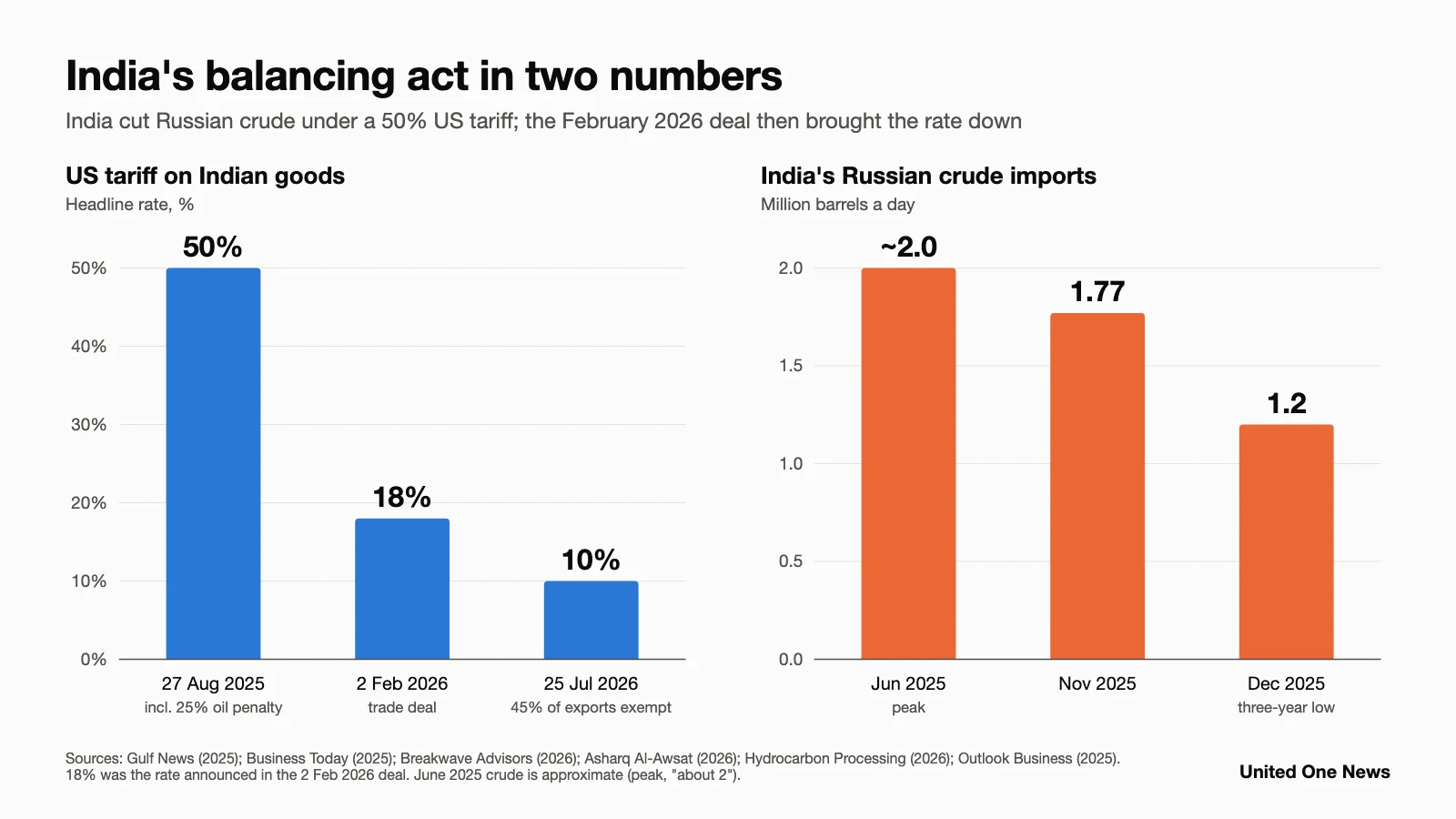
The US cut its tariff on Indian goods from 50% to 10% as India trimmed Russian crude, then made its own Russian diesel deal. One dated ledger of six threads, from oil and Pakistan to NGO licences and China, read from Delhi and Washington.
Original report
Data as of 12 October 2026, 08:00 IST
On 12 October 2026, India's US-Russia balancing act comes down to one contrast. Washington cut its tariff on Indian goods from 50% to 18% on 2 February in return for India curbing Russian crude, and on about 9 October Donald Trump said he had agreed with Vladimir Putin to import Russian diesel into the US (Breakwave Advisors, 2026; NPR, 2026).
India was penalised for buying Russian energy in 2025. In 2026, the US plans to buy some for itself. That is the backdrop for a policy India calls strategic autonomy: keeping working ties with every major power at once, and choosing for itself which bills to pay.
This explainer puts six threads on one dated ledger: Russian oil and arms, the US trade deal, Washington's public meetings with Pakistan, the cost of tariffs, fights over foreign influence at home, and China. Where our sources give one, we set the Indian reading and the US reading side by side.
The ledger at a glance
- Russian crude: about 2 million barrels a day at the June 2025 peak, 1.2 million in December 2025, a three-year low (Hydrocarbon Processing, 2026).
- Russia's share of India's 2025 oil imports: 30%, 35% or 42%, depending on the source (Breakwave Advisors, 2026; Hydrocarbon Processing, 2026; Gulf News, 2025).
- US tariff on Indian goods: 50% from 27 August 2025, 18% under the February 2026 deal, 10% from 25 July 2026 (Gulf News, 2025; Breakwave Advisors, 2026; Asharq Al-Awsat, 2026).
- US and Pakistan: two White House meetings with Pakistan's army chief in 2025, on 18 June and 25-26 September (Asia News Network, 2025; Daily Times, 2025).
- NGO licences: 21,933 organisations had lost their foreign-funding licence by 26 March 2026, Amnesty International said (Amnesty International, 2026).
- China: $151bn of trade in the year to March 2026, and a record $112bn deficit (ChannelIAM, 2026).
Each line has a story behind it, and the oil line explains most of the others.
Russian oil fell fast, but the link with Moscow held
India's Russian crude imports fell from about 2 million barrels a day in June 2025 to 1.2 million in December 2025, Hydrocarbon Processing reported. The February trade deal aimed to push them below 1 million (Hydrocarbon Processing, 2026).
Cheap oil drew India in. Signal Ocean, quoted by Breakwave Advisors, said large discounts on Russian crude were the driving factor (Breakwave Advisors, 2026). None of the sources we read gave the size of that discount. India imported 2.1bn barrels of oil in all in 2025, Breakwave reported. Roughly a third of that is about 700m barrels: 2.1bn ÷ 3.
The fall was not smooth. Reuters, republished by The Moscow Times, put the January-September 2025 average at 1.7 million barrels a day (Reuters, 2025). Outlook Business put November at 1.77 million (Outlook Business, 2025a).
- October 2025: US sanctions hit Rosneft and Lukoil, Russia's big oil companies, with a wind-down deadline of 21 November. A refinery source told Reuters: "There will be a massive cut" (Reuters, 2025).
- November 2025: Reliance, which holds a 500,000-barrel-a-day term deal with Rosneft, got a one-month US concession and took about 15 Rosneft cargoes after 22 November (Outlook Business, 2025a).
- January 2026: India asked refiners for weekly data on Russian and US oil imports as it sought the trade deal (Hydrocarbon Processing, 2026).
- March 2026: amid an energy shock from the Iran war, a US Treasury waiver let stranded Russian oil loaded by 5 March go to India, until 3 April (The Moscow Times, 2026).
On that waiver, the two capitals read the same oil differently:
- Indian reading: supply security.
- US reading: price relief. Scott Bessent, speaking for the US Treasury, said the aim was to keep oil flowing into the global market (The Moscow Times, 2026).
Moscow's view, as Russia's Novak put it: "If they buy, we'll sell." China and India take about 80% of Russian oil exports (The Moscow Times, 2026).
India's foreign minister, S Jaishankar, has long defended the trade on fairness: "Nobody forced you to buy it – but Europe buys, America buys" (Gulf News, 2025).
Arms tie India to Moscow too. India signed a $5.43bn contract for five S-400 air-defence systems in 2018, and two are still pending. The Kremlin says deliveries finish in 2026 (IANS, 2026). India's Defence Acquisition Council approved more S-400 purchases on 27 March 2026. Narendra Modi and Putin were due to meet at the 18th BRICS summit in New Delhi on 12 September 2026, with a BrahMos missile upgrade on the agenda (IANS, 2026). We found no published outcome of that meeting.
Oil was also the price of the tariff relief, which is the next line of the ledger.
The trade deal took the US tariff from 50% to 10%
From 27 August 2025, Indian goods faced a 50% US tariff: a 25% "reciprocal" rate plus a 25% penalty for buying Russian oil (Gulf News, 2025; Business Today, 2025). For Indian readers, the reciprocal rate is the country-by-country tariff the Trump administration set on imports.
Put simply, a $100 shipment of Indian goods paid $50 in US duty under that regime. The 2 February 2026 deal cut the rate to 18% and removed the oil penalty, so the same shipment paid $18 (Breakwave Advisors, 2026; ETV Bharat, 2026). From 25 July 2026 the US rate is 10%, so $10, below the 12.5% proposed in June (Asharq Al-Awsat, 2026).
About 45% of India's exports fall outside the 10% tariff, Asharq Al-Awsat reported. Generic medicines, smartphones, steel, aluminium and auto parts are exempt. India says it will keep working on a bilateral trade agreement, with no deadline set (Asharq Al-Awsat, 2026). Our sources do not explain what became of the 18% rate between February and July.
The deal split Indian politics:
- Government reading: Piyush Goyal said "adequate safeguards are in place" for farmers and industry (ETV Bharat, 2026).
- Opposition reading: Congress's Jairam Ramesh accused ministers of contradicting each other on Russian oil. Congress says India committed to buy $500bn of US energy over five years, a claim we found in one source only (ETV Bharat, 2026).
Then came the diesel deal. On about 9 October 2026, Trump said he had agreed by phone with Putin to import Russian diesel: 300,000 tonnes at once, rising to 3m tonnes. A US Treasury licence runs to 7 April 2027 (NPR, 2026).
- US reading: with US diesel averaging $6.23 a gallon, Trump said: "Lower prices for Americans... is my Greatest Priority" (NPR, 2026). For Indian readers, the US midterm elections for Congress fall on 3 November 2026.
- Critics in Washington: Representative Don Beyer said Trump cannot be trusted on Russia (NPR, 2026).
- Indian reading: none on record in the sources we read. We have covered the diesel move separately: Trump Russia oil deal: US eases diesel sanctions while India's Russian crude falls.
While Washington negotiated with Delhi over oil, it was also opening its doors to Islamabad.
Washington courts Pakistan in public
On 18 June 2025, Trump hosted Pakistan's army chief, Asim Munir, for a private White House lunch of about an hour, Asia News Network reported. Pakistan's spy chief, Lieutenant General Asim Malik of the Inter-Services Intelligence agency, came with him (Asia News Network, 2025).
India's opposition read it as a setback. "This is a huge blow to Indian diplomacy," said Jairam Ramesh of Congress (Asia News Network, 2025).
The second meeting was bigger. On 25-26 September 2025, Prime Minister Shehbaz Sharif and Munir spent 80 minutes in the Oval Office, the US president's office, with the press excluded. Vice-President JD Vance and Marco Rubio were present (Daily Times, 2025).
- Stated topics: regional security, trade and strategic cooperation (Daily Times, 2025).
- Money: US companies committed hundreds of millions of dollars to Pakistan's mining sector (Daily Times, 2025).
- Trump's claim: that he brokered the May 2025 ceasefire (Daily Times, 2025).
- Pakistani reading: a strategic reset. Indian reading: a diplomatic setback (Daily Times, 2025; Asia News Network, 2025).
Why Washington does this in public is not settled by the record we read. The sources show the meetings and the mining money; none sets out a fuller US motive, and we found no confirmed US-Pakistan meetings in 2026.
The ceasefire claim and the tariffs both carry costs, and the tariff costs are easier to count.
What tariffs cost India now, and later
Moody's said in August 2025 that the 50% tariff could cut India's growth by about 0.3 percentage points, from a 6.3% forecast for the year to March 2026 (Hargreaves Lansdown, 2025). Gulf News reported estimates of a 70-100 basis-point hit to GDP; for US readers, 100 basis points is 1 percentage point (Gulf News, 2025).
India sold the US $87bn of goods in 2024, Gulf News reported. Business Today, citing Commerce Ministry data, said $48.2bn of exports would be hit (Business Today, 2025):
- Textiles: $10.8bn
- Jewellery: $10bn
- Machinery: $6.7bn
- Shrimp: $2.4bn
About 30% of exports, $27.6bn, stayed duty-free, Business Today reported. The tariff "will severely disrupt the flow of Indian goods", said S C Ralhan, president of the Federation of Indian Export Organisations (Business Today, 2025). Nomura likened the tariffs to a trade embargo. Gulf News also reported a $2.8bn support package and a push into 50 new export markets (Gulf News, 2025).
The long-term cost is harder to see. Moody's warned that a tariff gap against Asia-Pacific rivals would "severely curtail India's ambitions to develop its manufacturing sector", in electronics and higher-value goods (Hargreaves Lansdown, 2025).
- Indian exporters' reading: disrupted trade and lost jobs; Business Today reported jewellery job cuts were expected (Business Today, 2025).
- US position: the 25% penalty was tied directly to Russian oil, and the February deal removed it once India agreed to curb Russian crude (Breakwave Advisors, 2026).
The fight was not only about trade. It also reached arguments over who funds Indian civil society.
Outside influence: NGO licences, oil and Parliament
By 26 March 2026, 21,933 organisations had lost their FCRA licences, Amnesty International said (Amnesty International, 2026). For US readers, the Foreign Contribution (Regulation) Act, or FCRA, is the Indian law under which charities and NGOs need a government licence to receive money from abroad.
Deccan Chronicle reported about 14,400 active licence holders, more than 22,000 cancelled and more than 15,000 expired. There were 16,301 valid licences in July 2023, and more than 6,600 were cancelled in five years (Deccan Chronicle, 2026).
The FCRA Amendment Bill 2026 went to a 31-member Joint Parliamentary Committee, a panel of MPs that examines a bill in detail. It tightens scrutiny of donors and accounts, gives existing associations one year to file information, and had its rules notified on 22 June 2026 (Deccan Chronicle, 2026).
- Government reading: compliance and transparency (Deccan Chronicle, 2026).
- Critics' reading: Amnesty says the bill would give authorities power over the assets of NGOs that lose their licences. Aakar Patel, chair of Amnesty India's board, called it a "blatant abuse of this legislation" (Amnesty International, 2026).
Foreign pressure also reached Parliament through oil and trade. Congress attacked the government over the Munir lunch and over ministers' remarks on Russian oil (Asia News Network, 2025; ETV Bharat, 2026).
US statements on Indian democracy are the gap in this thread. We did not find one in the sources we read, so we do not report one.
The last thread is the one where India's numbers move fastest.
China became India's top trading partner
China overtook the US as India's largest trading partner in the year to March 2026, with $151bn of trade and a record $112bn deficit, ChannelIAM reported. Exports to China rose 36% and imports 16% (ChannelIAM, 2026).
Those figures imply India sold China about $19.5bn and bought about $131.5bn: ($151bn - $112bn) ÷ 2 = $19.5bn. That is roughly $6.70 of imports for every $1 of exports.
A year earlier the deficit was $99.2bn, Outlook Business reported. Ajay Srivastava of the Global Trade Research Initiative said: "This signals a competitiveness crisis" (Outlook Business, 2025b).
Relations thawed in steps. India and China disengaged at Depsang and Demchok on their disputed border in October 2024. Modi and Xi Jinping met at the Shanghai Cooperation Organisation summit in Tianjin at the end of August 2025 (Sentinel Assam, 2025). Direct flights resumed on 26 October 2025, IndiGo's Kolkata-Guangzhou route, the first since 2020 (Tribune India, 2025). Xi was invited to the 2026 BRICS summit hosted by India (Sentinel Assam, 2025).
Put the six lines together and the shape of the balance appears.
What the ledger adds up to
India gave ground on Russian crude, from about 2 million barrels a day to 1.2 million, and saw the US tariff fall from 50% to 10%. It kept its arms ties to Moscow, with more S-400s approved in March 2026. It now trades more with China than with any other country.
That is the source of pride: India bargained with Washington without breaking with Moscow. It is also the source of anxiety: the US eased Russian pressure to cut its own fuel prices, courted Pakistan in public in 2025, and India's exporters carried the tariff cost in the meantime.
What happens next
- 3 November 2026: US midterm elections, the context for Trump's diesel move (NPR, 2026).
- Winter Session 2026: the Joint Parliamentary Committee's report on the FCRA bill is due early in the session (Deccan Chronicle, 2026).
- 7 April 2027: the US licence for Russian diesel expires (NPR, 2026).
- No deadline: India-US talks on a bilateral trade agreement continue (Asharq Al-Awsat, 2026).
What we don't know yet
- Russia's share of India's crude imports, and the discount, for August-October 2026.
- What came of the 12 September Putin-Modi meeting.
- India's official reaction to the US diesel deal.
- Any US-Pakistan meetings in 2026, and the US's fuller reasons for them.
- Estimates from the Reserve Bank of India or the IMF on the tariff effect, and named FCRA cases.
Questions people are asking
How much Russian oil does India buy?
About 1.2 million barrels a day in December 2025, down from about 2 million at the June 2025 peak, Hydrocarbon Processing reported. Sources put Russia's 2025 share of India's oil imports between 30% and 42%.
What is the US tariff on India now?
10% since 25 July 2026, with generic medicines, smartphones, steel, aluminium and auto parts exempt, Asharq Al-Awsat reported. It was 50% from August 2025.
Why is the US courting Pakistan?
The record we read shows two White House meetings in 2025, on regional security, trade and strategic cooperation, plus US mining commitments in Pakistan. No source we read sets out a fuller US motive.
How many NGOs lost FCRA licences?
21,933 organisations had lost their licences by 26 March 2026, Amnesty International said.
Is China a bigger trade partner than the US for India?
Yes. China overtook the US in the year to March 2026, with $151bn of two-way trade, ChannelIAM reported.
References
- Amnesty International (2026) India: Parliament must reject proposal to extend restrictions on overseas funding for NGOs. Amnesty International. Available at: Amnesty International (Accessed: 12 October 2026).
- Asharq Al-Awsat (2026) India to keep working on trade agreement after new US tariff. Asharq Al-Awsat. Available at: Asharq Al-Awsat (Accessed: 12 October 2026).
- Asia News Network (2025) US President Trump's invite to Pakistan army chief a blow to Indian diplomacy: Congress. Asia News Network. Available at: Asia News Network (Accessed: 12 October 2026).
- Breakwave Advisors (2026) Energy realignment: India drops Russian crude, secures US tariff relief. Breakwave Advisors. Available at: Breakwave Advisors (Accessed: 12 October 2026).
- Business Today (2025) US tariffs on India from August 27: exports worth $48 bn to be hit, says Commerce Ministry. Business Today. Available at: Business Today (Accessed: 12 October 2026).
- ChannelIAM (2026) China overtakes US as India's top trading partner in FY26. ChannelIAM. Available at: ChannelIAM (Accessed: 12 October 2026).
- Daily Times (2025) Shehbaz, Asim Munir meet Trump in landmark visit to White House. Daily Times. Available at: Daily Times (Accessed: 12 October 2026).
- Deccan Chronicle (2026) FCRA Bill sent to JPC; it seeks tougher compliance from foreign-funded NGOs. Deccan Chronicle. Available at: Deccan Chronicle (Accessed: 12 October 2026).
- ETV Bharat (2026) 'Hole in govt approach': Congress's dig over ministers' remarks on Russian oil. ETV Bharat. Available at: ETV Bharat (Accessed: 12 October 2026).
- Gulf News (2025) India faces harshest-ever US tariffs: what they mean for trade, jobs, growth. Gulf News. Available at: Gulf News (Accessed: 12 October 2026).
- Hargreaves Lansdown (2025) Moody's warns US tariffs may hurt India's manufacturing push, slow growth. Hargreaves Lansdown. Available at: Hargreaves Lansdown (Accessed: 12 October 2026).
- Hydrocarbon Processing (2026) India asks refiners for weekly Russian oil import data as it seeks US trade deal. Hydrocarbon Processing. Available at: Hydrocarbon Processing (Accessed: 12 October 2026).
- IANS (2026) Russia fulfilling obligations: Kremlin on remaining S-400 deliveries. IANS Live. Available at: IANS Live (Accessed: 12 October 2026).
- NPR (2026) Trump says US to get diesel from Russia, relaxing pressure on Moscow to ease prices before midterms. WLRN. Available at: WLRN (Accessed: 12 October 2026).
- Outlook Business (2025a) Reliance continues Russian oil imports after securing US sanctions waiver. Outlook Business. Available at: Outlook Business (Accessed: 12 October 2026).
- Outlook Business (2025b) India's trade deficit with China hits record $99.2bn: manufacturing gaps to blame? Outlook Business. Available at: Outlook Business (Accessed: 12 October 2026).
- Reuters (2025) Indian refiners move to slash Russian oil imports after new Trump sanctions. The Moscow Times. Available at: The Moscow Times (Accessed: 12 October 2026).
- Sentinel Assam (2025) Modi-Xi's meeting reflects pragmatic approach from India and China. The Sentinel. Available at: Sentinel Assam (Accessed: 12 October 2026).
- The Moscow Times (2026) US grants temporary waiver to allow India to buy Russian oil as Iran war jolts energy markets. The Moscow Times. Available at: The Moscow Times (Accessed: 12 October 2026).
- Tribune India (2025) After a gap of 5 years, India and China to resume direct flights by October end. The Tribune. Available at: Tribune India (Accessed: 12 October 2026).
How we did this
We built this ledger from 20 published sources dated June 2025 to October 2026, all opened and read on 12 October 2026. For each thread we pulled the dated figures and set the Indian and US readings side by side only where a source stated them.
Oil figures come from Hydrocarbon Processing, Breakwave Advisors and The Moscow Times. Tariff figures come from Gulf News, Business Today and Asharq Al-Awsat. FCRA figures come from Amnesty International and Deccan Chronicle; China figures from ChannelIAM.
Where sources disagree, as on Russia's share of India's oil imports, we give each figure and name its source. We left out claims we saw only in search snippets, including a reported February 2026 US court ruling on tariffs, a different US energy-purchase figure and a statement attributed to Rahul Gandhi. Five pages we tried to open were blocked. The China import and export split is our own arithmetic on ChannelIAM's figures.
This story was produced, reviewed, edited and verified by the reporter before publication, with AI assistance where required
Covered by 20 outlets across the spectrum: 15% left, 60% center, 25% right.
Who is covering this story
- Left-leaning (2): The Moscow Times (Reuters), WLRN (NPR)
- Center (6): Daily Times, Hydrocarbon Processing, Business Today, Outlook Business, Sentinel Assam, Tribune India
- Right-leaning (5): Asharq Al-Awsat, Gulf News, IANS, Deccan Chronicle, ETV Bharat Gujarati
- Not yet rated (5): Asia News Network, ChannelIAM, Amnesty International, Breakwave Advisors, Hargreaves Lansdown
Sources
- US President Trump’s invite to Pakistan army chief a blow to Indian diplomacy: Congress — Asia News Network (not yet rated) ·
- Shehbaz, Asim Munir meet Trump in landmark visit to White House - Daily Times — Daily Times (center) ·
- China India top trading partner FY26 — ChannelIAM (not yet rated) ·
- India to Keep Engaging with US on Trade Deal After New Tariff Measures — Asharq Al-Awsat (right-leaning) ·
- India faces harshest-ever US tariffs: What they mean for trade, jobs, growth — Gulf News (right-leaning) ·
- India asks refiners for weekly Russian oil import data as it seeks U.S. trade deal — Hydrocarbon Processing (center) ·
- Russia fulfilling obligations: Kremlin on remaining S-400 deliveries — IANS (right-leaning) ·
- India: Parliament must reject proposal to extend restrictions on overseas funding for NGOs — Amnesty International (not yet rated) ·
- Energy Realignment: India Drops Russian Crude, Secures US Tariff Relief — Breakwave Advisors — Breakwave Advisors (not yet rated) ·
- US tariffs on India from August 27: Exports worth $48 bn to be hit, says Commerce Ministry. Here's a list of affected sectors - BusinessToday — Business Today (center) ·
- FCRA Bill Sent to JPC; It Seeks Tougher Compliance From Foreign-Funded NGOs — Deccan Chronicle (right-leaning) ·
- 'Hole In Govt Approach': Congress's Dig Over Ministers' Remarks On Russian Oil — ETV Bharat Gujarati (right-leaning) ·
- Moody's warns US tariffs may hurt India's manufacturing push, slow growth — Hargreaves Lansdown (not yet rated) ·
- India’s Trade Deficit with China Hits Record $99.2bn: Manufacturing Gaps to Blame? – Outlook Business — Outlook Business (center) ·
- Reliance Continues Russian Oil Imports After Securing US Sanctions Waiver – Outlook Business — Outlook Business (center) ·
- Modi-Xi’s meeting reflects pragmatic approach from India and China — Sentinel Assam (center) ·
- Indian Refiners Move to Slash Russian Oil Imports After New Trump Sanctions – Reuters - The Moscow Times — The Moscow Times (Reuters) (left-leaning) ·
- U.S. Grants Temporary Waiver to Allow India to Buy Russian Oil as Iran War Jolts Energy Markets - The Moscow Times — The Moscow Times (Reuters) (left-leaning) ·
- After a gap of 5 years, India and China to resume direct flights by October-end - The Tribune — Tribune India (center) ·
- Trump says U.S. to get diesel from Russia, relaxing pressure on Moscow to ease prices before midterms — WLRN (NPR) (left-leaning) ·