India US trade deal: interim deal vs BTA vs FTA, and what is still open
Published · Updated
Trump and Rubio say a deal is close, but the pact on the table is an interim step towards a Bilateral Trade Agreement, not an FTA. Study notes on the timeline, the Constitution and WTO law, the 18% tariff, the open farm issues, and practice questions.
Original report · Explained
The India-US trade deal now close to signing is an interim agreement, not a free trade agreement (FTA). On 20 October 2026, US Secretary of State Marco Rubio said in Mumbai that the two sides were "about as close as you can be without having an executed agreement", with only a few items left to settle (Deccan Herald, 2026).
An interim deal is an early, partial pact on the way to a Bilateral Trade Agreement (BTA), a deal across many sectors that is negotiated in tranches (Deccan Herald, 2025). An FTA is a stricter label: under World Trade Organization (WTO) rules it must remove duties on "substantially all the trade" between its members (WTO, n.d.).
President Donald Trump said the same day that a deal was "pretty close" and would be very different from earlier pacts, The Hindu BusinessLine reported (The Hindu BusinessLine, 2026). Our earlier report: Marco Rubio India visit: Rubio says US trade deal is very close. On 21 October the farmers' union AIKS threatened "militant resistance", saying subsidised US farm goods threaten Indian farmers (The New Indian Express, 2026). See how every outlet covered the India-US trade deal.
These study notes cover the deal types, a dated timeline, the law, the numbers, both sides' arguments and practice questions.
What it is
Three kinds of trade deal are in play, and they differ in scope and in what WTO law asks of them.
- Interim agreement: an early, partial deal agreed before the full one. The 7 February 2026 framework for an India-US Interim Agreement set an 18% US tariff on Indian goods and Indian tariff cuts on industrial and farm goods (ETV Bharat, 2026).
- Bilateral Trade Agreement (BTA): a deal between two countries across many sectors, negotiated in tranches. India and the US launched BTA talks on 13 February 2025 (Deccan Herald, 2025).
- Free trade agreement (FTA): a deal that removes duties on substantially all the trade between its members, under Article XXIV:8(b) of the General Agreement on Tariffs and Trade (GATT) (WTO, n.d.). Our report on the India-New Zealand FTA: apple duty halved to 25%, capped at 32,500 tonnes shows how one FTA sets the duty on a single farm product.
The sources we read do not say whether the final India-US BTA will meet the GATT test for an FTA. That matters because an interim deal that is meant to lead to an FTA must, under GATT, carry a plan and schedule to get there (WTO, n.d.).
Two more terms recur in the framework. A tariff rate quota is a quota of imports that pays a low duty; the framework offers one on Indian auto parts. Rules of origin make sure a deal's benefits go mainly to goods from the two parties (ETV Bharat, 2026).
Background and timeline
In 14 months the talks went from a 50% US tariff on India to leaders saying a deal is close.
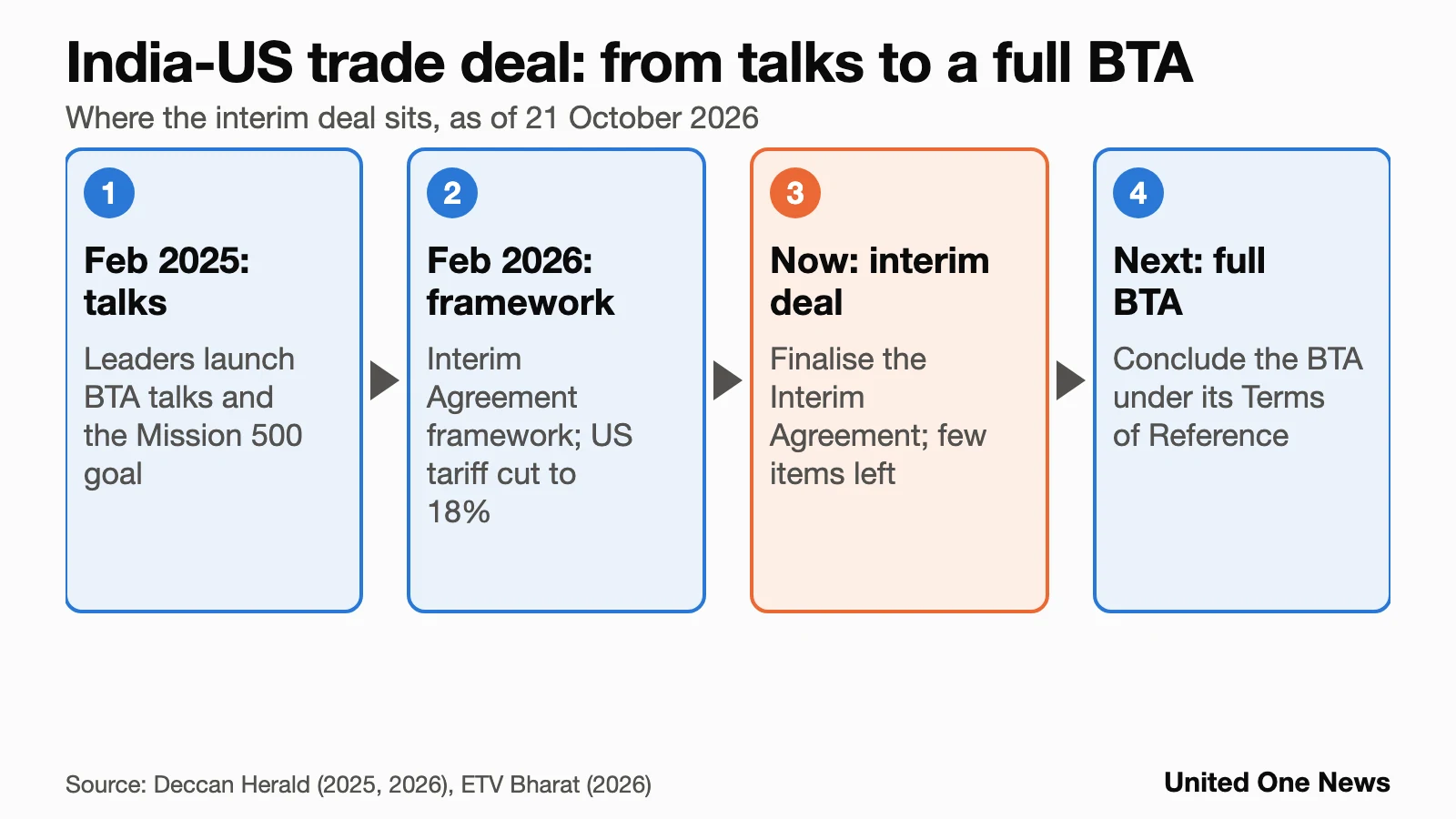
- 13 February 2025: India and the US set "Mission 500", a goal of USD 500 billion in two-way trade by 2030, and aimed to finish the BTA's first tranche "by fall of 2025" (Deccan Herald, 2025).
- August 2025: the US tariff on Indian goods reached 50%: a 25% reciprocal tariff plus a 25% levy linked to India's purchases of Russian oil (ETV Bharat, 2026).
- 7 February 2026: the two sides agreed a framework for an Interim Agreement, cutting the US tariff to 18% (ETV Bharat, 2026).
- 20 February 2026: the US Supreme Court ruled 6-3 that the International Emergency Economic Powers Act (IEEPA) gives no power for these tariffs. A Section 122 tariff of 10-15% applied from 24 February, and an Indian visit was paused (The News Minute, 2026).
- June 2026: negotiators were down to the final 1% of issues, Kuwait Times reported (Kuwait Times, 2026).
- Early October 2026: Commerce Minister Piyush Goyal met US Trade Representative (USTR) Jamieson Greer in Milwaukee and Washington (The Hindu BusinessLine, 2026).
- 20 October 2026: Rubio, in Mumbai, and Trump both said a deal was close (Deccan Herald, 2026; The Hindu BusinessLine, 2026).
- 21 October 2026: AIKS threatened resistance, and Rubio was due at the Jamnagar refinery (The New Indian Express, 2026; Deccan Herald, 2026).
The US ruling came 13 days after the framework was agreed, and Kuwait Times lists the value of the US tariff offer since then as an open issue (Kuwait Times, 2026).
What the law says
In India, signing trade deals is an executive power, and Parliament can pass laws to carry them out. In WTO law, calling a deal an FTA brings a test.
India's Constitution
- Article 73(1)(b): the Union's executive power extends to the rights and authority the Government of India holds under any treaty or agreement (Constitution of India, 2020a).
- Article 253: Parliament may make laws to implement any treaty or agreement (Constitution of India, 2020b).
- Seventh Schedule, Union List: entry 10 (foreign affairs), entry 14 (treaties and agreements) and entry 41 (trade with foreign countries) (Wikipedia, 2026).
GATT Article XXIV (WTO rules)
- Article XXIV:8(b): an FTA removes duties on substantially all the trade between its members.
- Article XXIV:5(c): an interim agreement must include a plan and schedule to complete the FTA within a reasonable length of time, which should be more than 10 years only in exceptional cases (WTO, n.d.).
US law
- IEEPA (1977): requires an "unusual and extraordinary threat"; on 20 February 2026 the Supreme Court held it gives no power for these tariffs.
- Section 122, Trade Act of 1974: allows a tariff of up to 15% for 150 days (The News Minute, 2026).
The 150-day window would have ended around 24 July 2026 unless it was extended. The sources we read do not say what legal basis the US tariff on Indian goods rests on now.
Institutions, committees and judgments
Four offices run the talks, and one US judgment changed them.
- Commerce Ministry: leads for India, under Piyush Goyal (The Hindu BusinessLine, 2026).
- Office of the USTR: leads for the US, under Jamieson Greer.
- Ministry of External Affairs (MEA): under External Affairs Minister S Jaishankar; it said both sides were positive on the BTA (Deccan Herald, 2026).
- US Secretary of State: Marco Rubio, who led the October visit.
- US Supreme Court: its 6-3 ruling of 20 February 2026 on IEEPA tariffs (The News Minute, 2026).
- BTA Terms of Reference: the agreed roadmap the full BTA must follow (ETV Bharat, 2026).
The numbers
Under the framework the US tariff fell by 32 percentage points, and trade is still far from the 2030 goal.
- 18%: the US tariff on Indian goods under the 7 February 2026 framework, down from 50% in August 2025, a cut of 32 percentage points (ETV Bharat, 2026).
- USD 500 billion: what India "intends to purchase" in US energy, aircraft, precious metals, technology and coking coal over five years (ETV Bharat, 2026).
- USD 190.08 billion: two-way trade in 2023, of which USD 123.89 billion was goods and USD 66.19 billion services (Deccan Herald, 2025).
- USD 500 billion by 2030: the Mission 500 goal, about 2.6 times the 2023 level (500 divided by 190.08) (Deccan Herald, 2025).
- More than USD 240 billion: record two-way trade now; US Ambassador Sergio Gor wants it above USD 500 billion "in the next three years", Times Now reported (Times Now, 2026).
- 21%: the rise in Indian goods exports to the US in August 2026, to USD 8.3 billion (Kuwait Times, 2026).
Arguments for and against
Supporters point to momentum and zero-duty gains; farmers and some experts point to farm imports and legal doubt.
For the deal:
- Rubio said on 20 October that only a few items were left (Deccan Herald, 2026).
- Indian goods exports to the US rose 21% in August 2026 (Kuwait Times, 2026).
- The framework promises zero duty on Indian generic drugs, gems and aircraft parts once the Interim Agreement is concluded (ETV Bharat, 2026).
Against, or still open:
- AIKS says subsidised US farm goods threaten Indian farmers. It names soybean, dairy, maize, cotton, nuts and apples, and says Parliament was kept in the dark (The New Indian Express, 2026).
- Trade expert Ajay Srivastava said that after the US court ruling, "the value of the US offer became unclear" (Kuwait Times, 2026).
- Kuwait Times listed three open issues on 18 October: access for farm goods, India's purchases of US energy, and the value of the US tariff offer after the court ruling (Kuwait Times, 2026).
What happens next
No signing date has been announced. Rubio said leaders could sign once the remaining items are settled, and farmers plan a march in Delhi on 23 October (Deccan Herald, 2026; The New Indian Express, 2026).
The joint statement sets the order: finalise the Interim Agreement, then conclude the full BTA in line with the roadmap in its Terms of Reference (ETV Bharat, 2026). Two things are still unknown: the final terms for dairy and soybean, and the legal basis of the US tariff after the Section 122 window.
Questions people are asking
What is an interim trade deal?
An early, partial pact before the full deal. India and the US agreed a framework for one on 7 February 2026, with an 18% US tariff and Indian cuts on industrial and farm goods (ETV Bharat, 2026).
What is the difference between a BTA and an FTA?
A BTA is a two-country deal across many sectors, negotiated in tranches (Deccan Herald, 2025). An FTA must remove duties on substantially all trade between its members under GATT Article XXIV:8(b) (WTO, n.d.).
Is the India-US trade deal signed?
No. On 20 October 2026, Rubio said a small number of items remained (Deccan Herald, 2026).
What is the US tariff on Indian goods now?
The 7 February framework set it at 18% (ETV Bharat, 2026). After the US Supreme Court ruling, a Section 122 tariff of 10-15% applied from 24 February (The News Minute, 2026); the sources we read do not say what applies today.
For students
GS paper: GS Paper II (bilateral agreements, India and its relations with the US) and GS Paper III (Indian economy: external trade and agriculture).
Key terms
- Interim agreement: an early, partial trade deal agreed before the full one.
- Bilateral Trade Agreement (BTA): a two-country deal across many sectors, negotiated in tranches.
- Free trade agreement (FTA): removes duties on substantially all trade between members (GATT Article XXIV).
- Reciprocal tariff: the 25% US tariff placed on Indian goods in August 2025.
- IEEPA: the 1977 US emergency-powers law that the Supreme Court held cannot support these tariffs.
- Section 122: a Trade Act of 1974 power to impose tariffs of up to 15% for 150 days.
- Tariff rate quota: a quota of imports that pays a low duty; offered on Indian auto parts.
- Rules of origin: rules that keep a deal's benefits mainly for goods from the two parties.
Prelims facts
- Mission 500, set on 13 February 2025: USD 500 billion in two-way trade by 2030.
- Interim Agreement framework, 7 February 2026: US tariff on Indian goods 18%, down from 50%.
- Article 73: Union executive power covers treaty rights. Article 253: Parliament may legislate to implement treaties.
- Union List entries 10, 14 and 41: foreign affairs, treaties and agreements, trade with foreign countries.
- GATT Article XXIV covers FTAs and customs unions.
- IEEPA dates from 1977; Section 122 is in the US Trade Act of 1974.
- The US Supreme Court ruled on IEEPA tariffs on 20 February 2026, by 6-3.
Mains practice question (250 words)
The India-US pact under negotiation is an interim agreement on the road to a Bilateral Trade Agreement, not yet a free trade agreement. Distinguish the three, and examine the opportunities and concerns the deal raises for Indian agriculture and exports.
Prelims practice question
With reference to the India-US trade talks, consider the following statements:
- Statement 1: Under the 7 February 2026 framework, the US tariff on Indian goods was set at 18%.
- Statement 2: Mission 500 aims for USD 500 billion in two-way trade by 2030.
- Statement 3: GATT Article XXIV:8(b) requires an FTA to remove duties on all trade without exception.
Which of the statements given above is or are correct? (a) 1 only (b) 1 and 2 only (c) 2 and 3 only (d) 1, 2 and 3
Answer: (b). Statement 3 is wrong: Article XXIV:8(b) says "substantially all" the trade, not all of it.
- Marco Rubio India visit: Rubio says US trade deal is very close
- India-New Zealand FTA: apple duty halved to 25%, capped at 32,500 tonnes
How we did this
We built these notes from primary records and set them against the latest reporting. We read the joint statement on the 7 February 2026 framework as published by ETV Bharat, the WTO's page on GATT Article XXIV, and Articles 73 and 253 of the Constitution of India on Wikisource. For where talks stand, we compared reports from 18 to 21 October 2026 in Deccan Herald, The Hindu BusinessLine, The New Indian Express, Kuwait Times and Times Now, and read the US court ruling as reported by The News Minute. We did not read the BTA Terms of Reference or the US judgment directly. The timeline, the comparison of deal types and the flow chart are our own.
References
- Deccan Herald (2026) 'As close as you can be without having an executed agreement': Marco Rubio on India-US trade deal. Deccan Herald. Available at: Marco Rubio on India-US trade deal (Accessed: 21 October 2026).
- Deccan Herald (2025) India, US aim to double bilateral trade to $500 bn by 2030, begin trade pact talks. Deccan Herald. Available at: India, US aim to double bilateral trade to $500 bn by 2030 (Accessed: 21 October 2026).
- ETV Bharat (2026) India, US reach framework for interim trade agreement; tariffs on New Delhi reduced to 18%. ETV Bharat. Available at: India, US reach framework for interim trade agreement (Accessed: 21 October 2026).
- The Hindu BusinessLine (2026) India, US trade deal to be much different: Trump. The Hindu BusinessLine. Available at: India, US trade deal to be much different: Trump (Accessed: 21 October 2026).
- The New Indian Express (2026) AIKS threatens 'militant resistance' as Rubio pushes to finalise India-US trade deal. The New Indian Express. Available at: AIKS threatens militant resistance (Accessed: 21 October 2026).
- Kuwait Times (2026) What is holding up the US-India trade deal? Kuwait Times. Available at: What is holding up the US-India trade deal (Accessed: 21 October 2026).
- Times Now (2026) US sets $500 billion India trade target in 3 years, then Trump says deal is 'pretty close'. Times Now. Available at: US sets $500 billion India trade target in 3 years (Accessed: 21 October 2026).
- The News Minute (2026) India-US trade deal in limbo after US Supreme Court blocks Trump tariffs. The News Minute. Available at: India-US trade deal in limbo (Accessed: 21 October 2026).
- World Trade Organization (n.d.) Regional trade agreements and GATT Article XXIV. WTO. Available at: Regional trade agreements and GATT Article XXIV (Accessed: 21 October 2026).
- Constitution of India (2020a) Part V, Article 73. Wikisource. Available at: Constitution of India, Part V (Accessed: 21 October 2026).
- Constitution of India (2020b) Part XI, Article 253. Wikisource. Available at: Constitution of India, Part XI (Accessed: 21 October 2026).
- Wikipedia (2026) Seventh Schedule to the Constitution of India. Wikipedia. Available at: Seventh Schedule to the Constitution of India (Accessed: 21 October 2026).
This story was produced, reviewed, edited and verified by the reporter before publication, with AI assistance where required.
Covered by 33 outlets across the spectrum: 21% left, 36% center, 33% right.
Who is covering this story
- Left-leaning (6): Indian Express, The Hindu, The New Indian Express, The Federal, The News Minute, NDTV
- Center (8): Hindustan Times, Mint, Wikipedia, Kuwait Times, Deccan Herald, The Hindu BusinessLine, Free Press Journal, DNA India
- Right-leaning (6): Times Now, India Today, India TV English, Zee News English, ETV Bharat Gujarati, Sunday Guardian
- Not yet rated (2): Wikisource, WTO
Sources
- Trade deal close, says Mark Rubio, asks India to scale up purchase of US tech, energy — Indian Express (left-leaning) ·
- Rubio says India-U.S. trade deal close, urges New Delhi to boost U.S. energy, defence buys — The Hindu (left-leaning) ·
- ‘Very, very close’: Marco Rubio on India-US trade deal after meeting with EAM Jaishankar — Hindustan Times (center) ·
- India-US trade deal ‘much different’: As Marco Rubio meets Jaishankar in Mumbai, here's what Trump said — Mint (center) ·
- 'Pretty Close': Trump Breaks Silence On India-US Trade Deal, Says Pact Will Be 'Much Different' — Times Now (right-leaning) ·
- India-US trade deal pretty close, will be different from previous pacts: Trump — India Today (right-leaning) ·
- US and India 'pretty close' to making trade deal which will be much different than earlier pacts: Trump — India TV English (right-leaning) ·
- Washington-New Delhi ‘pretty close’ to signing a ‘different kind of deal`: Trump on India-US trade agreement — Zee News English (right-leaning) ·
- Trump says US, India 'pretty close' to trade deal, hints it to be 'much different' from previous pacts — The New Indian Express (left-leaning) ·
- Trump says India-US trade deal ‘pretty close’, says it will be ‘much different’ — The Federal (left-leaning) ·
- Seventh Schedule to the Constitution of India - Wikipedia — Wikipedia (center) ·
- Constitution of India (2020)/Part V - Wikisource, the free online library — Wikisource (not yet rated) ·
- Constitution of India (2020)/Part XI - Wikisource, the free online library — Wikisource (not yet rated) ·
- What is holding up the US-India trade deal? - kuwaitTimes — Kuwait Times (center) ·
- India, US aim to double bilateral trade to $500 bn by 2030, begin trade pact talks — Deccan Herald (center) ·
- 'As close as you can be without having an executed agreement': Marco Rubio on India-US trade deal — Deccan Herald (center) ·
- India, US Reach Framework For Interim Trade Agreement; PM Modi Hails It As 'Great News' — ETV Bharat Gujarati (right-leaning) ·
- AIKS threatens 'militant resistance' as Rubio pushes to finalise India-US trade deal — The New Indian Express (left-leaning) ·
- Trump says India, US trade deal to be different from earlier pacts — The Hindu BusinessLine (center) ·
- India-US trade deal in limbo after US Supreme Court blocks Trump tariffs — The News Minute (left-leaning, AI-estimated) ·
- US Sets $500 Billion India Trade Target In 3 Years, Then Trump Says Deal Is 'Pretty Close' — Times Now (right-leaning) ·
- WTO - Regional Trade Agreements — WTO (not yet rated) ·
- India, US Very Close To Trade Deal, Few Issues Left: Marco Rubio — India Today (right-leaning) ·
- 'It's Never Done Till It's Done,' Says EAM S Jaishankar On India-US Trade Deal — Free Press Journal (center) ·
- 'We're Very Close': Marco Rubio on India-US Trade Agreement — India Today (right-leaning) ·
- India-US trade deal in final stages, Jaishankar says 'last mile' poses challenges — DNA India (center) ·
- India-US Trade Deal: Michael Kugelman and Ajay Srivastava on Last-Mile Hitch — India Today (right-leaning) ·
- Rubio optimistic, but India not ready to sign trade deal, yet — Sunday Guardian (right-leaning) ·
- India-EU Trade Deal Set For Year-End Seal, Operational Rollout Slated For Q1 Next Year — NDTV (left-leaning) ·
- India-US trade deal: Most discussions concluded, agreement being fine-tuned — The Hindu BusinessLine (center) ·
- India, US fine-tuning trade deal after concluding most discussions, says minister Piyush Goyal — Mint (center) ·
- India-US Trade Deal Soon? Delhi, Washington Fine-Tuning Agreement; Most Discussions Over, Says Piyush Goyal — Times Now (right-leaning) ·
- India to get comparative advantage in US trade deal: Piyush Goyal — Mint (center) ·