Bihar green hydrogen policy 2026: 10% capital support, capped at ₹1 crore per MW
Published
Approved on 30 September, the policy targets 1,00,000 tonnes a year by 2031 and waives state GST, stamp duty and power charges. The catch, Argus Media notes: Bihar has no advanced hydrogen project yet.
Original report
Figures as reported up to 14 October 2026.
Bihar's Cabinet approved the Bihar green hydrogen policy 2026 on 30 September 2026, UNI and Argus Media reported (UNI, 2026; Argus Media, 2026). It targets 1,00,000 tonnes of renewable hydrogen a year by 2031 and repays electrolysis projects 10% of their capital cost, capped at ₹1 crore per MW, Argus Media reported (Argus Media, 2026).
The policy also waives a list of state duties and charges and promises single-window clearance. Argus Media put the investment estimate at ₹16,000 crore, about $1.66bn (Argus Media, 2026).
Bihar is offering money back and fee waivers to build an industry it does not yet have. Here is what the policy offers, who it is aimed at, and the doubt it carries.
The target: 1,00,000 tonnes a year by 2031
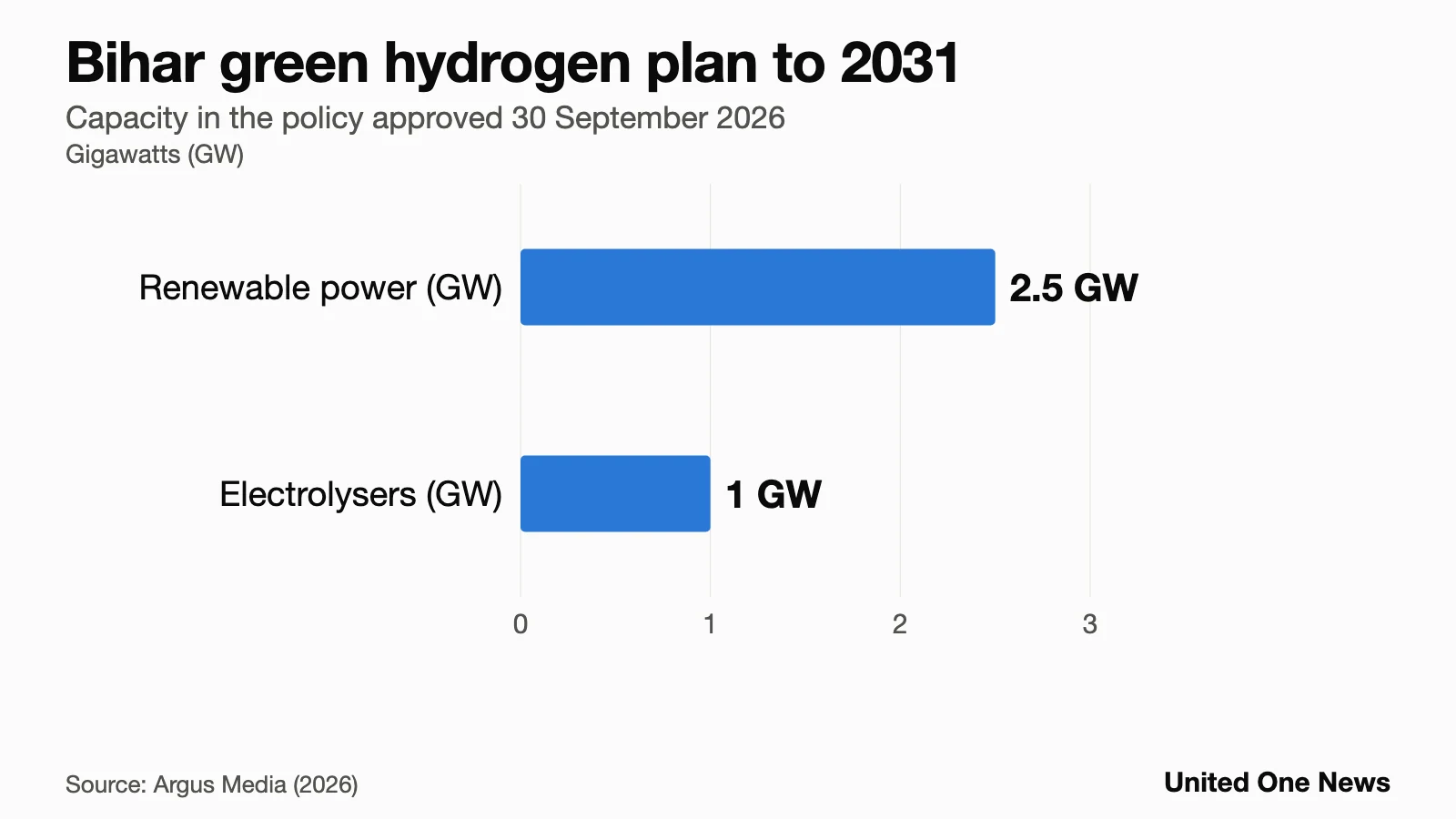
The plan rests on 1 GW of electrolyser capacity backed by 2.5 GW of renewable energy, Argus Media reported (Argus Media, 2026).
That is 2.5 MW of solar or other renewable power for every 1 MW of electrolyser. The working: 2.5 GW divided by 1 GW is 2.5.
Early demand is expected from the fertiliser and refinery sectors, Argus Media said (Argus Media, 2026). Pipelines and industrial clusters are planned, but their timeline is unclear.
The incentive that will matter most to an investor is the capital support.
What projects get: 10% back, and a list of waivers
Electrolysis projects can claim 10% of their capital cost, capped at ₹1 crore per MW, Argus Media reported (Argus Media, 2026).
If every one of the planned 1,000 MW claimed the full cap, the state would repay up to ₹1,000 crore. The working: 1 GW is 1,000 MW, and 1,000 × ₹1 crore is ₹1,000 crore. The actual payout depends on how much capacity is built and its cost.
The policy also exempts projects from these charges, according to Argus Media (Argus Media, 2026):
- electricity duty;
- state GST;
- transmission and wheeling charges;
- stamp duty;
- land conversion fees.
Single-window clearance and fast-track environmental permits are planned (Argus Media, 2026).
The rules on who runs approvals came earlier, in the draft.
Who can apply, and who runs it
The capital support is aimed at electrolysis projects, the plants that split water to make hydrogen (Argus Media, 2026).
In the draft framework, the Bihar Renewable Energy Development Agency (BREDA) was named the nodal agency, Patna Press reported in February 2026 (Patna Press, 2026). The draft also gave green hydrogen units "white category" status, which removes the need for a pollution-control no-objection certificate, and proposed up to 100% reimbursement of state GST.
The final eligibility, land and power-tariff terms were not in the reports we read. Argus Media says the draft policy was released in April 2026 (Argus Media, 2026).
How Bihar compares with other states
Bihar is not first. Maharashtra and Uttar Pradesh already have hydrogen policies, Patna Press reported (Patna Press, 2026).
The reports we read do not give those states' incentive figures, so we cannot set them side by side with Bihar's 10% capital support. We have not filled that gap with estimates.
The risk: no advanced projects yet
Argus Media notes that the plan's feasibility is questioned, because Bihar has no advanced hydrogen projects (Argus Media, 2026).
For readers, that is the counter-view to the incentives: a generous policy only pays out if companies build plants, and none is yet far along in the state.
How the coverage split
UNI reported the policy as one of several Cabinet decisions on 30 September. Argus Media led with the incentives and the feasibility doubt. Patna Press, writing at the draft stage, framed it as Bihar's bid to become a clean energy hub.
Questions people are asking
When was the Bihar green hydrogen policy 2026 approved?
The Bihar Cabinet approved it on 30 September 2026, UNI and Argus Media reported.
What is Bihar's green hydrogen production target?
1,00,000 tonnes of renewable hydrogen a year by 2031, Argus Media reported.
What incentive do electrolysis projects get in Bihar?
A 10% reimbursement of capital cost, capped at ₹1 crore per MW, plus exemptions from state GST, electricity duty, stamp duty and other charges.
Who runs approvals under the Bihar green hydrogen policy?
BREDA was named the nodal agency in the draft framework, Patna Press reported.
What happens next
No dated next step has been announced. Pipelines and industrial clusters are planned, with the timeline unclear, Argus Media reported (Argus Media, 2026).
References
- Argus Media (2026) India's Bihar state approves green hydrogen policy. Argus Media. Available at: India's Bihar state approves green hydrogen policy (Accessed: 14 October 2026).
- Patna Press (2026) Bihar Moves to Frame Green Hydrogen Policy for Clean Energy Hub. Patna Press. Available at: Bihar Moves to Frame Green Hydrogen Policy for Clean Energy Hub (Accessed: 14 October 2026).
- UNI (2026) Bihar Cabinet clears Green Hydrogen Policy 2026. United News of India. Available at: Bihar Cabinet clears Green Hydrogen Policy 2026 (Accessed: 14 October 2026).
How we did this
We compared the draft framework, as Patna Press reported it in February 2026, with the approved policy as reported by Argus Media and UNI after the 30 September 2026 Cabinet meeting, read on 14 October. We set out what changed between draft and approval and did the capacity and incentive-cap arithmetic ourselves. We did not open the official policy document, so final eligibility terms may add detail.
This story was produced, reviewed, edited and verified by the reporter before publication, with AI assistance where required.
Covered by 2 outlets across the spectrum: 0% left, 50% center, 50% right.
Who is covering this story
- Center (1): Patna Press
- Right-leaning (1): Argus Media