UPI charges for shopkeepers delayed till after Diwali: who pays above the Rs 2,000 limit
Published
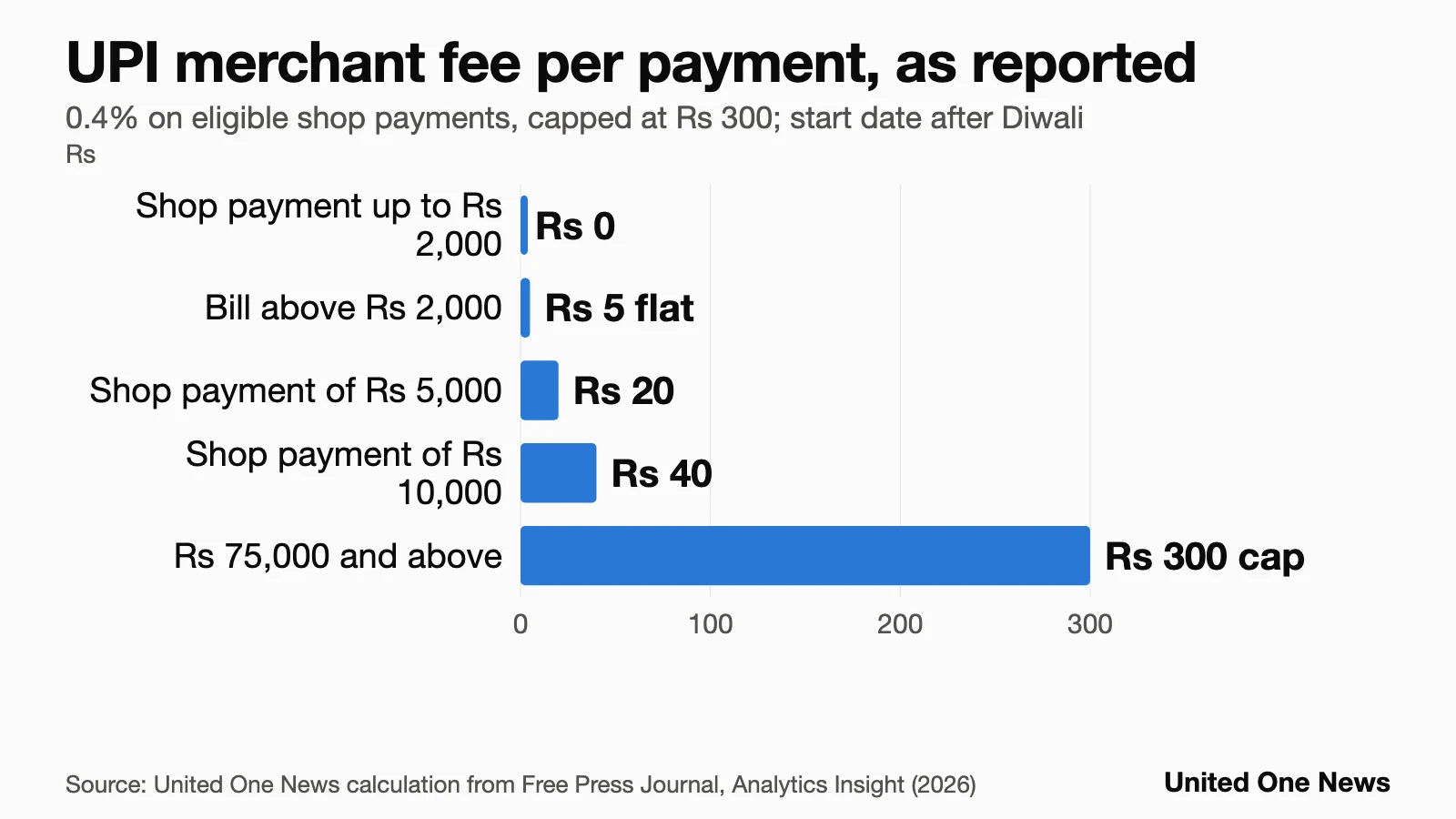
NPCI deferred the 0.4% merchant fee on 13 October 2026; the new date is still to be notified. Payments up to Rs 2,000 stay free, and shops taking up to Rs 1 lakh a month are exempt, as reported.
Original report
Data as of 14 October 2026. This article is for information only and is not investment advice.
UPI charges for small shopkeepers will not start on 15 October: on 13 October 2026, NPCI's UPI and Services Steering Committee deferred the merchant discount rate (MDR) until "immediately post Diwali", on a date to be notified separately, Business Standard and Analytics Insight reported (Business Standard, 2026; Analytics Insight, 2026). When it does start, the fee applies only to select shop payments above the Rs 2,000 limit; payments of Rs 2,000 or less stay free, according to the same reports.
For most small shops the bill may be zero. Merchants receiving up to Rs 1 lakh a month through UPI are exempt, Analytics Insight and Payment Expert reported (Analytics Insight, 2026; Payment Expert, 2026).
Here is who would pay what, from when, and what is still undecided.
The start date moved from 15 October to after Diwali
The MDR was due to begin on 15 October; NPCI's committee deferred it on 13 October 2026, Business Standard reported (Business Standard, 2026). The new date will be notified separately.
The reason given was the festive season. Retailer bodies, fintechs and payment firms had asked for time, Business Standard and Free Press Journal reported (Business Standard, 2026; Free Press Journal, 2026).
The framework itself was announced on 15 September 2026, Payment Expert reported (Payment Expert, 2026). Earlier reports, on 7 and 8 October, said January 2027 had been proposed as the start; the final notice says only "post Diwali", Free Press Journal reported (Free Press Journal, 2026).
So the date is open. The rates, as reported, are not.
The Rs 2,000 limit decides who pays
The MDR applies only to select person-to-merchant (P2M) payments above Rs 2,000, Business Standard and Analytics Insight reported (Business Standard, 2026; Analytics Insight, 2026).
What stays free, according to the same reports:
- All person-to-person (P2P) transfers, such as sending money to a friend.
- Shop payments (P2M) of Rs 2,000 or less.
- Merchants receiving up to Rs 1 lakh a month through UPI, who are exempt (Analytics Insight, 2026; Payment Expert, 2026).
The MDR is charged to the merchant. Whether merchants will pass the fee on to customers is not known.
What the fee would cost, payment by payment
On eligible payments the reported rate is 0.4%, which is Rs 40 on a Rs 10,000 payment, Free Press Journal reported (Free Press Journal, 2026). By the same arithmetic, a Rs 5,000 shop payment would carry Rs 20.
The fee is capped. Payments of Rs 75,000 and above pay at most Rs 300, Analytics Insight and Payment Expert reported (Analytics Insight, 2026; Payment Expert, 2026). The arithmetic matches: 0.4% of Rs 75,000 is Rs 300.
Some payments have their own rates, as reported:
- A flat Rs 5 per transaction for rail, telecom, fuel, insurance and utility payments above Rs 2,000; one outlet also lists education (Analytics Insight, 2026; Payment Expert, 2026).
- 0.02% for capital-market payments (Payment Expert, 2026).
How many payments does that touch? Payment Expert, citing one outlet's data analysis, reported that about 4% of merchant transactions would attract MDR (Payment Expert, 2026). That is a single-source estimate.
What small merchants should know
A shop that takes up to Rs 1 lakh a month through UPI is exempt, as reported. For a larger shop, only P2M payments above Rs 2,000 carry the fee (Analytics Insight, 2026).
Using the reported rate, a shop taking ten Rs 10,000 UPI payments in a day would pay Rs 400 in MDR on those payments, at Rs 40 each.
The risk for merchants is the uncertainty. Free Press Journal reported that an exemption for annual turnover up to Rs 40 lakh had been considered; the final notice does not confirm it (Free Press Journal, 2026). It is also not confirmed whether the Rs 1 lakh a month exemption stays in the final rules.
How the coverage framed it
Business Standard led on the deferral and the date to be notified (Business Standard, 2026). Free Press Journal had earlier led on a proposal to push the start to January 2027 (Free Press Journal, 2026). Analytics Insight led on what merchants should know (Analytics Insight, 2026).
The headlines answer "when not", and most stop there. The merchant arithmetic above is what the shorter wire stories leave out.
What we don't know yet
- The new start date, which NPCI says will be notified after Diwali.
- Whether the Rs 40 lakh turnover exemption was adopted.
- Whether the Rs 1 lakh a month small-merchant exemption stays.
- Whether merchants will pass the fee on to customers.
Questions people are asking
Will small shopkeepers pay UPI charges?
Only on eligible shop payments above Rs 2,000, at a reported 0.4%, and not yet: the start is after Diwali on a date to be notified (Business Standard, 2026; Analytics Insight, 2026). Shops receiving up to Rs 1 lakh a month are exempt, as reported.
Is UPI still free for payments up to Rs 2,000?
Yes. Shop payments up to Rs 2,000 and all person-to-person transfers stay free (Analytics Insight, 2026).
How much is the UPI charge on a Rs 10,000 payment?
Rs 40, at the reported 0.4% rate (Free Press Journal, 2026).
When do UPI merchant charges start after Diwali?
No date has been given. NPCI's committee said on 13 October 2026 that it will be notified separately (Business Standard, 2026).
References
- Analytics Insight (2026) NPCI Defers UPI MDR Charges Until After Diwali: What Merchants Should Know. Analytics Insight. Available at: NPCI Defers UPI MDR Charges Until After Diwali: What Merchants Should Know (Accessed: 14 October 2026).
- Business Standard (2026) UPI MDR deferred until after Diwali, new date to be notified: NPCI. Business Standard. Available at: UPI MDR deferred until after Diwali, new date to be notified (Accessed: 14 October 2026).
- Free Press Journal (2026) NPCI Considering Proposal To Defer Implementation Of UPI MDR Charges To January 2027. Free Press Journal. Available at: NPCI Considering Proposal To Defer Implementation Of UPI MDR Charges To January 2027 (Accessed: 14 October 2026).
- Payment Expert (2026) India UPI MDR merchant fee. Payment Expert, 16 September. Available at: India UPI MDR merchant fee (Accessed: 14 October 2026).
How we did this
We turned the reported rates into a per-payment fee table and checked the arithmetic (0.4% of Rs 5,000, Rs 10,000 and Rs 75,000). Free Press Journal also gave Rs 8 on a Rs 2,000 payment, which conflicts with the reported zero fee up to Rs 2,000, so we left that example out. We compared the deferral notice as reported by Business Standard and Analytics Insight with the earlier proposals reported by Free Press Journal and the September framework reported by Payment Expert. Business Standard and Payment Expert blocked our reader, so their details come from search summaries and are marked as reported. We did not have NPCI's circular itself.
This article is for information only and is not investment advice. Readers should consult a registered adviser before investing.
This story was produced, reviewed, edited and verified by the reporter before publication, with AI assistance where required.
Covered by 26 outlets across the spectrum: 19% left, 54% center, 23% right.
Who is covering this story
- Left-leaning (5): The Hindu, The New Indian Express, The Federal, Scroll.in, Greater Kashmir
- Center (11): Business Today, Inc42, The Hindu BusinessLine, Tribune India, ABP Live English, Mint, Deccan Herald, Hindustan Times, Payment Expert, Free Press Journal, Business Standard
- Right-leaning (6): India TV English, Times of India, Times Now, Deccan Chronicle, Sunday Guardian, @PIB_India
- Not yet rated (1): Analytics Insight
Sources
- UPI MDR on select person-to-merchant transactions to be implemented after Diwali — Business Today (center) ·
- UPI fee on merchant transactions above Rs 2,000 to kick in after Diwali, says government — India TV English (right-leaning) ·
- NPCI Defers UPI MDR Implementation Till Post Diwali — Inc42 (center) ·
- MDR on UPI transactions over Rs 2,000 deferred; to come into effect post Diwali — Times of India (right-leaning) ·
- UPI Merchant Fee On Above Rs 2000 Payments To Be Imposed Post Diwali — Times Now (right-leaning) ·
- UPI payment fee roll-out postponed until after Diwali — The Hindu BusinessLine (center) ·
- UPI fee row: Govt defers 0.4% MDR on select merchant transactions till after Diwali — Tribune India (center) ·
- UPI Merchant Charges Above Rs 2,000 Deferred, New Date After Diwali — Deccan Chronicle (right-leaning) ·
- UPI MDR Deferred: Who Pays, How Much, And What Changes After Diwali — ABP Live English (center) ·
- UPI MDR fee implementation new date: How long do transactions over ₹2,000 remain free? What we know from NPCI statement — Mint (center) ·
- UPI Charges Latest News: Will MDR on Select Merchant Transactions Start After Diwali? Check Expected Date and Key Details — Sunday Guardian (right-leaning) ·
- MDR charges on UPI payments will be implemented post-Diwali, says NPCI — The Hindu (left-leaning) ·
- 📢 UPI MDR on Select Merchant Transactions to be implemented Post-Diwali The #UPI and Services Steering Committee has decided to implement… — @PIB_India (right-leaning) ·
- NPCI defers 0.4% MDR on UPI transactions above Rs 2,000 until after Diwali — The New Indian Express (left-leaning) ·
- MDR on UPI deferred; no new date announced for implementation — The Federal (left-leaning) ·
- Centre postpones rollout of UPI payments fee above Rs 2,000 to after Diwali — Scroll.in (left-leaning) ·
- UPI merchant charge rollout deferred until after Diwali; industry awaits clarity — The Hindu BusinessLine (center) ·
- MDR on UPI deferred until after Diwali: NPCI — Deccan Herald (center) ·
- UPI fee set to raise costs for some merchants as industry awaits rollout — Mint (center) ·
- Festive breather as NPCI defers UPI levy rollout till Diwali — Tribune India (center) ·
- NPCI defers levy of MDR on UPI transactions; no new date announced for implementation — Greater Kashmir (left-leaning, AI-estimated) ·
- National Payments body pushes UPI merchant discount rate implementation till after Diwali — Hindustan Times (center) ·
- India upi mdr merchant fee — Payment Expert (center) ·
- NPCI Considering Proposal To Defer Implementation Of UPI MDR Charges To January 2027 — Free Press Journal (center) ·
- UPI MDR deferred until after Diwali, new date to be notified: NPCI — Business Standard (center) ·
- NPCI Defers UPI MDR Charges Until After Diwali: What Merchants Should Know — Analytics Insight (not yet rated) ·