Jio share listing gain tax: 20% within 12 months, ₹720 a lot at first-day close
Published
Jio Platforms listed 21.36% above its ₹1,119 issue price on 28 October 2026 and closed about 27% up. Our worked examples show the tax per 12-share lot if sold now or after a year, and when anchor lock-ins end.
Original report · Explained
Prices as of the close on 28 October 2026. This article is for information only and is not investment advice. Readers should consult a registered adviser before investing.
Jio share listing gain tax, worked out per lot: a retail allottee who sells a 12-share lot within 12 months pays 20% short-term capital gains tax, which at the 28 October 2026 close of ₹1,419 is ₹720 on a ₹3,600 gain, by our calculation. Jio Platforms listed that day at ₹1,358, 21.36% above the ₹1,119 issue price, and closed about 26.8% above it (HDFC Sky, 2026; Upstox, 2026).
Hold for more than 12 months and the gain becomes long-term, taxed at 12.5% but only on long-term gains above ₹1.25 lakh in a year. For one lot, with no other long-term gains, that means no tax. The listing reports we read covered the price, not the tax.
Jio IPO listing gain: 21% at the open, about 27% at the close
The 27% in some headlines is the closing gain, not the listing gain. Jio listed on the NSE and BSE at ₹1,358 against the ₹1,119 issue price, a 21.36% premium, HDFC Sky reported (HDFC Sky, 2026). The shares closed at ₹1,419 on the NSE, up 4.49% on the day, Upstox reported; that is about 26.8% above the issue price (Upstox, 2026).
Market value at the close was ₹13,05,380.12 crore, according to Upstox. Akash Ambani said the response "surpassed our imagination" (Upstox, 2026).
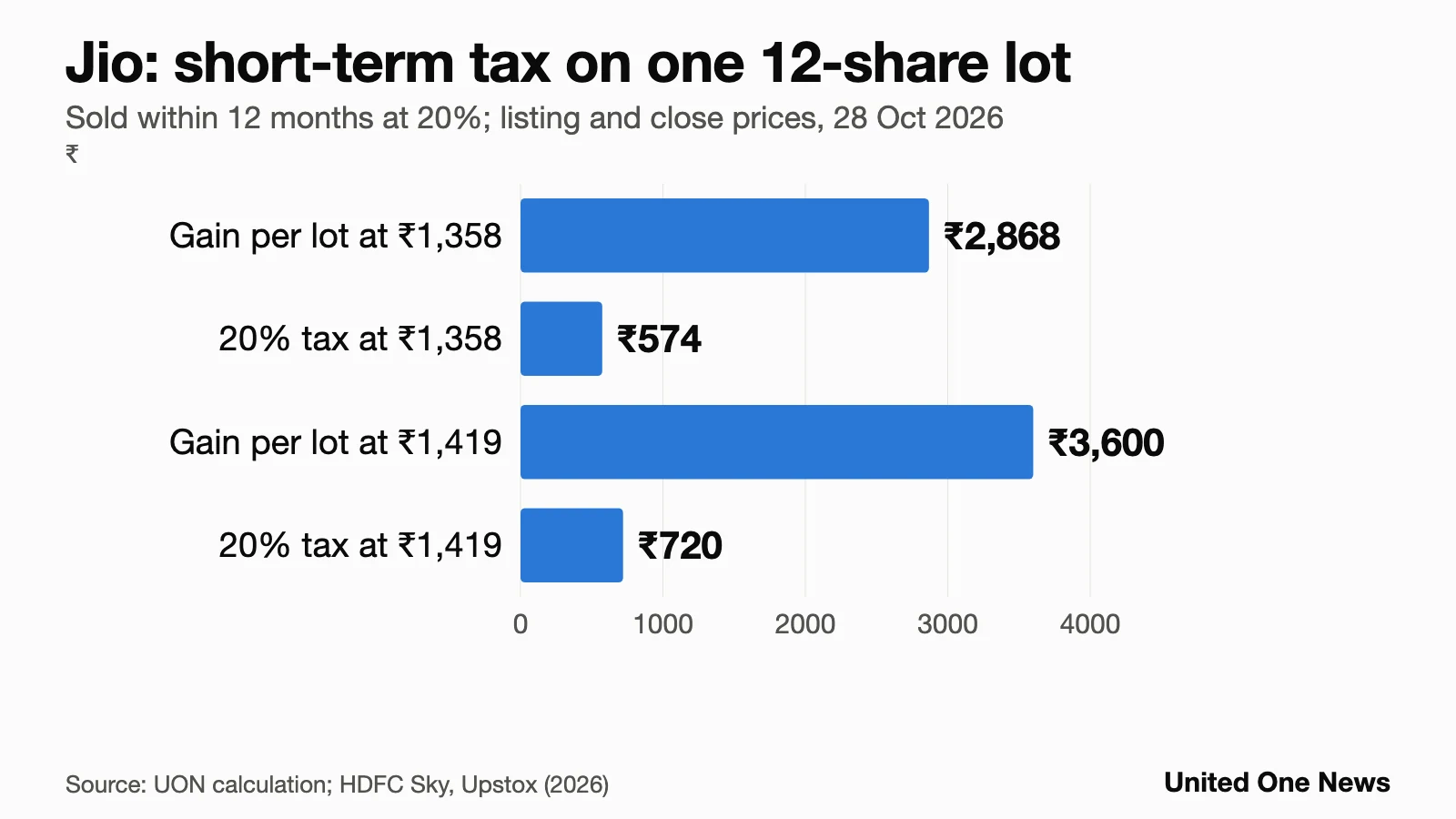
Per 12-share lot, the gain is ₹2,868 at the listing price (12 × ₹239) and ₹3,600 at the close (12 × ₹300). The tax on that gain turns on one date.
Selling within 12 months: 20% short-term tax
Gains on listed shares held for 12 months or less are short-term capital gains, taxed at 20% under Section 111A, the rate set by the Finance (No. 2) Act 2024 from 23 July 2024. Worked examples at the first-day prices:
- One lot sold at ₹1,358: gain ₹2,868, tax about ₹574.
- One lot sold at ₹1,419: gain ₹3,600, tax ₹720.
- The retail maximum of 14 lots (168 shares) sold at ₹1,419: gain ₹50,400, tax ₹10,080.
These figures leave out any surcharge and cess. The real gain is set by the price on the day of sale, not the listing price.
Holding past a year changes both the rate and the allowance.
Holding more than 12 months: 12.5% above ₹1.25 lakh
Long-term gains on listed shares held for more than 12 months are taxed at 12.5% under Section 112A, only on the part above ₹1.25 lakh a year. The Income Tax Department's portal confirms the ₹1,25,000 exemption (Income Tax Department, 2026). Worked examples, assuming the same gains:
- One lot, ₹3,600 gain, no other long-term gains that year: no tax, as it sits within ₹1.25 lakh.
- 14 lots, ₹50,400 gain, no other long-term gains: also within the limit, so no tax.
- The same ₹50,400 on top of ₹1 lakh of other long-term gains: ₹25,400 is above the limit, so tax is ₹3,175.
The ₹1.25 lakh is a yearly allowance across all long-term gains, so a reader's other sales matter. A separate set of dates matters for how many shares can come to market.
Anchor lock-ins end on 24 November and 23 January
Half of the anchor investors' shares can be sold from 24 November 2026 and the rest from 23 January 2027, according to Chittorgarh (Chittorgarh, 2026). Anchors bid on 19 October; our earlier story, Jio IPO anchor investors: ₹8,110 crore from 212 anchors, LIC takes the most, covers who they are.
The lock-in dates come from one source, which did not state the anchors' allotment date. The end of a lock-in allows sales; it does not mean they will happen.
Risks and what could change
- The share price can fall below the listing price, which shrinks the gain or turns it into a loss.
- Other gains and losses in the same year change each person's tax.
- These rates are those set by the Finance (No. 2) Act 2024; a later Finance Act can change them.
Questions people are asking
How much tax do I pay if I sell Jio shares now?
20% of the gain as short-term capital gains. On one 12-share lot sold at the ₹1,419 first-day close, that is ₹720 on a ₹3,600 gain, before any surcharge and cess.
Is the Jio listing gain taxed if I hold for a year?
After more than 12 months it is a long-term gain, taxed at 12.5% only above ₹1.25 lakh a year across all long-term gains (Income Tax Department, 2026).
What was the Jio IPO listing price?
₹1,358 on 28 October 2026, 21.36% above the ₹1,119 issue price (HDFC Sky, 2026).
When does the Jio anchor lock-in end?
For 50% of anchor shares on 24 November 2026 and for the rest on 23 January 2027, according to Chittorgarh.
How many Jio shares could a retail investor apply for?
The minimum was one lot of 12 shares (₹13,428) and the maximum 14 lots, 168 shares (₹1,87,992), at the issue price (Chittorgarh, 2026).
References
- Chittorgarh (2026) Jio Platforms IPO Date, Price, GMP, Review, Details. Chittorgarh. Available at: Jio Platforms IPO Date, Price, GMP, Review, Details (Accessed: 28 October 2026).
- HDFC Sky (2026) Jio Platforms Lists at Rs 1,358, Up 21% Over IPO Price. HDFC Sky. Available at: Jio Platforms Lists at Rs 1,358, Up 21% Over IPO Price (Accessed: 28 October 2026).
- Income Tax Department (2026) Return applicable. Income Tax Department. Available at: Return applicable (Accessed: 28 October 2026).
- Upstox (2026) Jio Platforms IPO Listing, Share Price Highlights. Upstox. Available at: Jio Platforms IPO Listing, Share Price Highlights (Accessed: 28 October 2026).
How we did this
On 28 October 2026 we read the listing reports from HDFC Sky and Upstox and the issue details at Chittorgarh, and checked the ₹1.25 lakh long-term exemption on the Income Tax Department portal. We applied the Finance (No. 2) Act 2024 rates, 20% short-term and 12.5% long-term above ₹1.25 lakh, to the gain per 12-share lot at the listing and closing prices. The hero image is a bar chart we drew from these figures; upload it with the story.
This story was produced, reviewed, edited and verified by the reporter before publication, with AI assistance where required.
Covered by 4 outlets across the spectrum: 0% left, 50% center, 0% right.
Who is covering this story
- Center (2): HDFC Sky, Chittorgarh
- Not yet rated (2): Upstox, Income Tax Department
Sources
- Jio Platforms Lists at ₹1,358, Up 21% Over IPO Price — HDFC Sky (center) ·
- Jio Platforms IPO Listing, Share Price Highlights: Stock settles 4.5% higher after listing at 21% premium — Upstox (not yet rated) ·
- Jio Platforms IPO Date, Price, GMP, Review, Details — Chittorgarh (center) ·
- Salaried Individuals for AY 2026-27 — Income Tax Department (not yet rated) ·