Shamonda virus: France's first human case died; no report found in India
Published · Updated
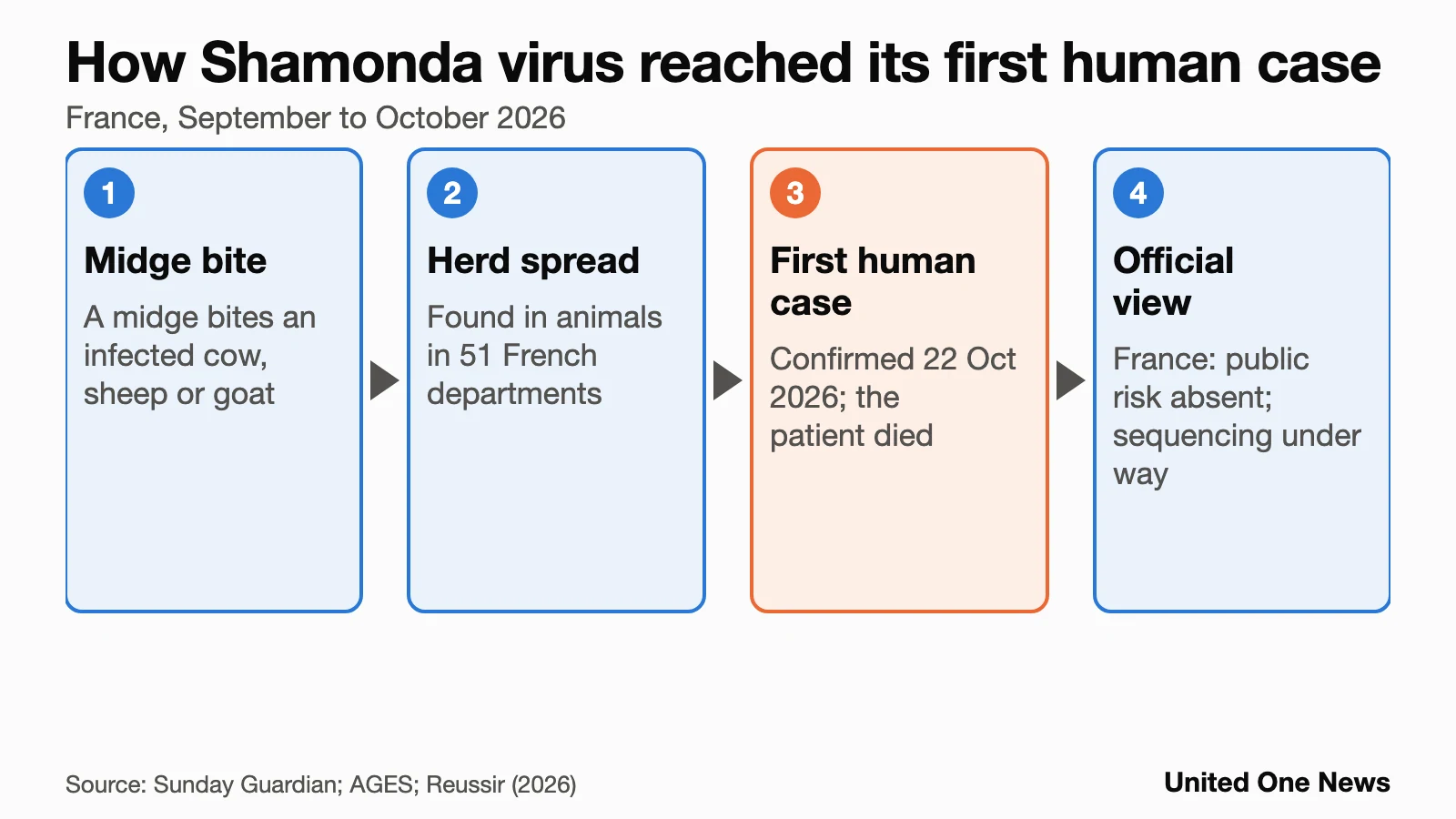
A livestock virus spread by midges has caused its first recorded human case, a patient in France who died. What Shamonda is, what it does to animals, why there is no treatment, and what we found when we checked for it in India.
Original report · Explained
What is Shamonda virus? It is a livestock virus carried by biting midges, and on 22 October 2026 French health authorities confirmed the first recorded human case; the patient died (Sunday Guardian, 2026). A Mid-Day headline said the patient was immunocompromised and that authorities detect no public health risk (Mid-Day, 2026).
Until now Shamonda had been seen only in livestock. France's health ministry said "the general risk to the public is assessed as absent at this stage" (Sunday Guardian, 2026).
For Indian readers the next question is whether it is here. We found no report of Shamonda virus in Indian livestock, and none of the sources we read discusses India. See how every outlet covered it.
Shamonda virus is a midge-borne cousin of Schmallenberg
Shamonda (SHAV) is an orthobunyavirus of the Simbu group, related to Schmallenberg virus, according to Austria's food-safety agency AGES (AGES, 2026). It was first identified in Nigeria in the mid-1960s, with sporadic reports in Africa and Japan since (Sunday Guardian, 2026; British Agriculture Bureau, 2026).
It spreads mainly through the bites of Culicoides midges (Sunday Guardian, 2026). The French patient likely caught it in eastern France, where outbreaks in animals had been recorded.
Europe's animal outbreak is recent, and it moved fast.
The virus reached 51 French departments in about two months
Austria first detected Shamonda in mid-August 2026, and France recorded its first case, in a sheep in Oise, on 22 September (AGES, 2026; Reussir, 2026). By about late October it was present in 51 metropolitan French departments, according to a Reussir summary (Reussir, 2026).
Before this case, French and Austrian authorities said there was no evidence of human infection and that human susceptibility "must be confirmed" (AGES, 2026; British Agriculture Bureau, 2026).
Why farmers have watched it so closely shows in what it does to animals.
Symptoms are known in animals, not yet in people
In cattle, AGES lists fever, diarrhoea and lower milk yield (AGES, 2026). Infection of pregnant animals can cause abortions and birth defects. The window for harm to the unborn animal is days 75 to 175 of pregnancy in cattle and days 30 to 50 in sheep, according to the AGES page updated on 28 September 2026.
Human symptoms were not described in the reports we read. There is no vaccine, and "there is no curative treatment," AGES says; controlling midges is the main measure (AGES, 2026; Sunday Guardian, 2026).
That leaves India's position resting on what has not been found.
Is Shamonda virus in India?
Not known: our searches on 22 October 2026 found no report of it in Indian livestock. Simbu-group viruses such as Akabane are a livestock-surveillance topic, but none of the sources we read covered India (British Agriculture Bureau, 2026).
The only human case so far was in eastern France, and French authorities say the risk to the general public is absent.
How the coverage split
Indian outlets led on different parts of the same facts. NDTV led on the death; The Hindu and Mid-Day on the absence of a public health risk; Mint on how the virus is transmitted and the ECDC's monitoring (NDTV, 2026; The Hindu, 2026; Mid-Day, 2026; Mint, 2026). Sunday Guardian explained the symptoms. None of the headlines we read said whether the virus has been seen in India.
What we don't know yet
- The patient's age and region, and how the infection was confirmed.
- Whether the virus can pass from person to person; no source said.
- Whether the ECDC will raise its risk level.
What happens next
Genomic sequencing of the French strain is under way and surveillance of people continues; no date has been given (Sunday Guardian, 2026).
Questions people are asking
What is Shamonda virus?
An orthobunyavirus of the Simbu group, related to Schmallenberg, first found in Nigeria in the 1960s (AGES, 2026).
How does Shamonda virus spread?
Mainly through the bites of Culicoides midges (Sunday Guardian, 2026).
Is there a vaccine or treatment for Shamonda virus?
No. There is no vaccine and no curative treatment for animals or people (AGES, 2026).
What are the symptoms of Shamonda virus?
In cattle: fever, diarrhoea, lower milk yield, and abortions or birth defects in pregnant animals. Human symptoms are not yet known (AGES, 2026).
Is Shamonda virus in India?
Not known. We found no report of it in Indian livestock.
References
- AGES (2026) Shamonda virus. Austrian Agency for Health and Food Safety. Available at: Shamonda virus (Accessed: 22 October 2026).
- British Agriculture Bureau (2026) Novel Shamonda-like orthobunyavirus in western Europe. British Agriculture Bureau. Available at: Novel Shamonda-like orthobunyavirus in western Europe (Accessed: 22 October 2026).
- Mid-Day (2026) France reports first human case of Shamonda virus, says no public health risk. Mid-Day. Available at: France reports first human case of Shamonda virus (Accessed: 22 October 2026).
- Mint (2026) What is Shamonda virus? How is it transmitted? Mint. Available at: What is Shamonda virus (Accessed: 22 October 2026).
- NDTV (2026) France reports first ever case of human Shamonda virus, 1 dead. NDTV. Available at: France reports first ever case of human Shamonda virus (Accessed: 22 October 2026).
- Reussir (2026) Shamonda Europe: un premier cas detecte dans un elevage ovin en France, dans l'Oise. Reussir. Available at: Shamonda Europe (Accessed: 22 October 2026).
- Sunday Guardian (2026) What Is Shamonda? France Health Authorities Confirm First Ever Human Case of Orthobunyavirus. Sunday Guardian. Available at: What Is Shamonda? (Accessed: 22 October 2026).
- The Hindu (2026) France reports first human Shamonda virus case, says no health risk. The Hindu. Available at: France reports first human Shamonda virus case (Accessed: 22 October 2026).
How we did this
On 22 October 2026 we read the AGES disease page on Shamonda virus and the Sunday Guardian report on the French case, and took the timeline of Europe's animal outbreak from summaries by the British Agriculture Bureau and Reussir. We searched for any report of Shamonda virus in India and found none. We compared the headlines of Mid-Day, The Hindu, Mint and NDTV, whose full articles we could not open. The hero image is a flow chart we drew from these sources; upload it with the story.
This story was produced, reviewed, edited and verified by the reporter before publication, with AI assistance where required.
Covered by 14 outlets across the spectrum: 21% left, 50% center, 14% right.
Who is covering this story
- Left-leaning (3): The Hindu, NDTV, The Federal
- Center (6): The Star (Reuters), Reussir, Mint, Mid-Day, ABP Live English, Down To Earth
- Right-leaning (2): Khaleej Times, Sunday Guardian
- Not yet rated (2): AGES, British Agriculture Bureau
Sources
- France reports first human case of livestock virus Shamonda — The Star (Reuters) (center) ·
- First human case of livestock virus Shamonda unlikely to spread: WHO — Khaleej Times (right-leaning) ·
- Shamonda virus — AGES (not yet rated) ·
- Novel Shamonda-like orthobunyavirus in Ireland — British Agriculture Bureau (not yet rated) ·
- France reports first human shamonda virus case says no health risk — The Hindu (left-leaning) ·
- Shamonda-Europe : un premier cas détecté dans un élevage ovin en France, dans l’Oise — Reussir (center) ·
- What is Shamonda virus? How is it transmitted? ECDC monitoring situation as France reports first, rare human case | Today News — Mint (center) ·
- Article from NDTV — NDTV (left-leaning) ·
- Shamonda virus: France reports first human case after immunocompromised patient dies; authorities detect no public health risk — Mid-Day (center) ·
- What Is Shamonda? France Health Authorities Confirm First Ever Human Case Of Orthobunyavirus Fatal Infection; 1 Dead — Sunday Guardian (right-leaning) ·
- WHO Confirms First Human Case Of Animal-Linked Shamonda Virus In France; Patient Dies — ABP Live English (center) ·
- France reports first human case of livestock virus Shamonda, patient dies — The Federal (left-leaning) ·
- Explained: What is Shamonda virus? WHO says first human case reported in France — risks to humans and animals listed — Mint (center) ·
- First Human Case of Shamonda Virus Reported in France, Patient Dies — Down To Earth (center) ·