Barapullah phase 3: Mayur Vihar to AIIMS timing after a nine-year delay
Published
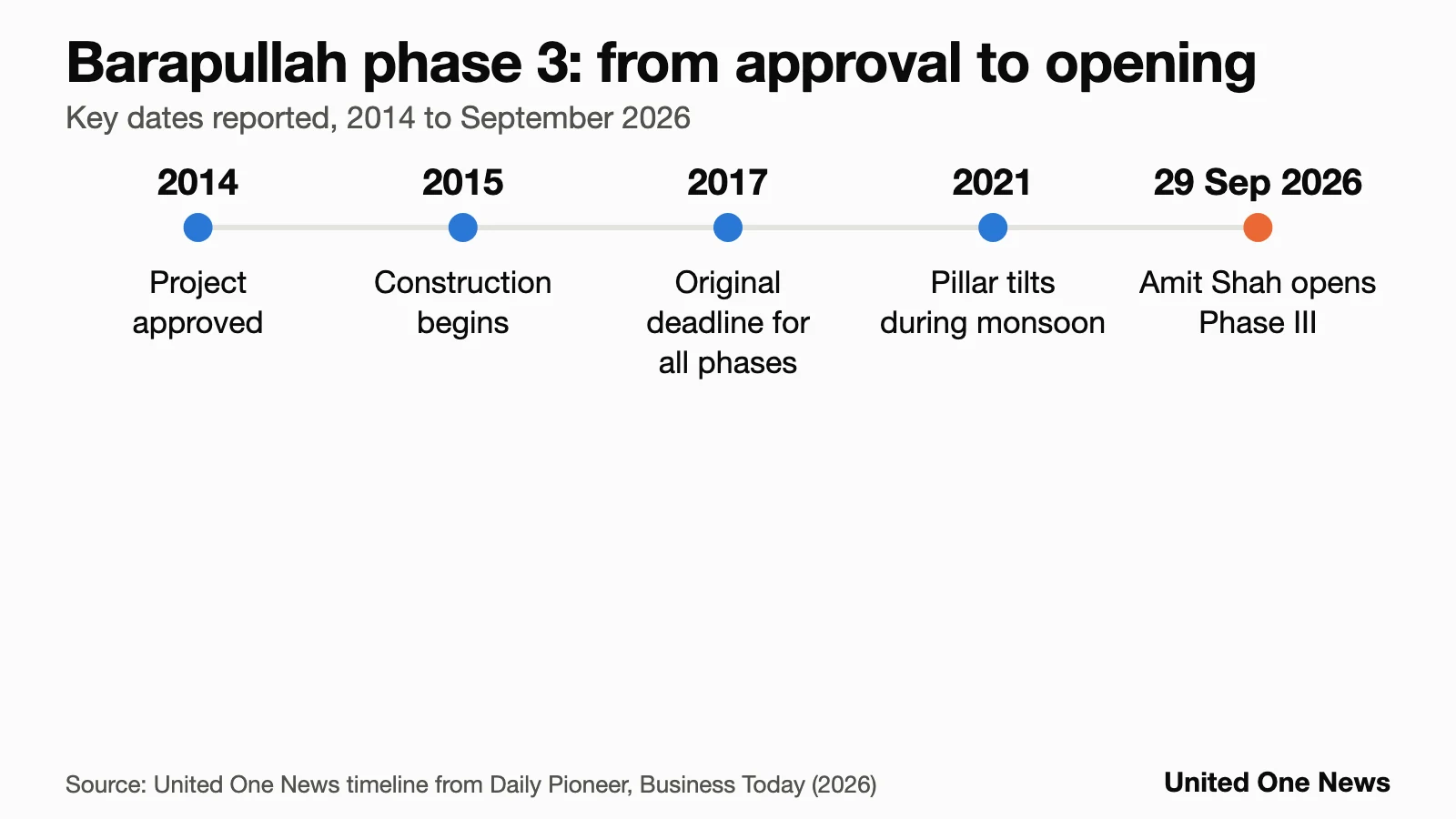
Amit Shah opened the signal-free corridor on 29 September 2026. It was due in 2017 and now costs Rs 1,635 crore. Reports differ on the time it saves and even on its length.
Original report
Barapullah phase 3 is already open: Union Home Minister Amit Shah inaugurated it on Tuesday 29 September 2026, ThePrint and Daily Pioneer reported (ThePrint, 2026; Daily Pioneer, 2026). For the Mayur Vihar to AIIMS timing, reports at the opening put the saving at 15 to 20 minutes, while Business Today's pre-opening report said a 35 to 45 minute trip would fall to about 15 minutes (ThePrint, 2026; Business Today, 2026).
The road arrives about nine years late. It was approved in 2014, work began in 2015, and all phases were due in 2017, Daily Pioneer reported (Daily Pioneer, 2026). Business Today put its revised cost at Rs 1,635 crore (Business Today, 2026).
For east Delhi commuters, the question is no longer when it opens but what it changes. Here is what the record shows.
The new corridor links Mayur Vihar to AIIMS without signals
Phase III is a signal-free elevated corridor from Mayur Vihar Phase I, through Sarai Kale Khan, to south Delhi and the AIIMS area, Daily Pioneer reported (Daily Pioneer, 2026; ThePrint, 2026). It joins the existing Barapullah elevated road at Sarai Kale Khan.
The build includes an extradosed bridge over the Yamuna, nine traffic loops, a footpath and a dedicated cycle track, according to both outlets (Daily Pioneer, 2026; Business Today, 2026).
Before the opening, Deputy Chief Minister Parvesh Verma said "a flyover corridor has been designed with a dedicated cycle track," calling it a first for India, Business Today reported (Business Today, 2026).
The time saving depends on whose figure is used, and the figures do not match.
The time saved differs by report
Two different claims are on record. Business Today's 19 September report said the Mayur Vihar to AIIMS trip of 35 to 45 minutes would be cut to about 15 minutes (Business Today, 2026). Reports at the opening put the saving at 15 to 20 minutes (ThePrint, 2026).
Those are different measures: one is a total trip time, the other a saving. Neither is a measured post-opening travel time, and we found none in the sources we read.
Amit Shah said the corridor would give signal-free connectivity between east and south Delhi and ease traffic congestion, as paraphrased by Daily Pioneer (Daily Pioneer, 2026).
The length is not settled either.
Outlets give different lengths
Business Today described the road as about 9 km before it opened (Business Today, 2026). Daily Pioneer put it at about 10 to 10.9 km after the opening (Daily Pioneer, 2026).
We could not find an official length in the sources we read, so we report both figures with their outlets. The difference matters less to commuters than the route, which all reports agree on.
What took nine extra years is the longer story.
A 2017 deadline, a 2026 opening
The project was approved in 2014, work began in 2015, and all phases were due in 2017, Daily Pioneer reported; delays raised the cost (Daily Pioneer, 2026).
Daily Pioneer also reported that a pillar tilted during the monsoon in 2021 (Daily Pioneer, 2026).
The opening date itself moved. Earlier reports had said August; on 19 September the opening was announced for 29 September, Business Today reported (Business Today, 2026).
The arithmetic of the delay: from the 2017 due date to the 29 September 2026 opening is about nine years.
The opening came with a wider road package
Amit Shah inaugurated four to five Delhi road projects worth Rs 1,941 crore at the same event, Daily Pioneer reported (Daily Pioneer, 2026). Delhi Chief Minister Rekha Gupta and Minister of State for Road Transport Harsh Malhotra were present.
The package included foundation stones for the Modi Mill-Savitri Cinema flyover and the Loni underpass, according to the same report (Daily Pioneer, 2026). No dated completion target for those projects appears in the sources we read.
What we don't know yet
- The exact length of the corridor (9, 10 or 10.9 km, depending on the outlet).
- Measured travel times since the opening, and where jams form.
- Whether the road is open 24 hours for all vehicle types.
Questions people are asking
When did Barapullah phase 3 open?
On 29 September 2026, inaugurated by Union Home Minister Amit Shah (ThePrint, 2026; Daily Pioneer, 2026).
What is the Barapullah phase 3 timing from Mayur Vihar to AIIMS?
Business Today said before the opening that a 35 to 45 minute trip would fall to about 15 minutes; reports at the opening put the saving at 15 to 20 minutes (Business Today, 2026; ThePrint, 2026).
Does Barapullah phase 3 connect Mayur Vihar to AIIMS?
Yes, via Sarai Kale Khan, as a signal-free elevated corridor (Daily Pioneer, 2026).
How much did Barapullah phase 3 cost?
Rs 1,635 crore, the revised cost reported by Business Today (Business Today, 2026).
Why was Barapullah phase 3 so late?
It was approved in 2014 and due in 2017; delays raised the cost, and a pillar tilted during the 2021 monsoon, Daily Pioneer reported (Daily Pioneer, 2026).
References
- Business Today (2026) Big relief for Delhi commuters: Barapullah Phase 3 to open Sept 29. Business Today. Available at: Big relief for Delhi commuters: Barapullah Phase 3 to open Sept 29 (Accessed: 14 October 2026).
- Daily Pioneer (2026) Amit Shah opens Barapullah phase III, promises smoother east-south link. Daily Pioneer. Available at: Amit Shah opens Barapullah phase III, promises smoother east-south link (Accessed: 14 October 2026).
- ThePrint (2026) Amit Shah inaugurates Barapullah flyover, 3 other road projects in Delhi. ThePrint. Available at: Amit Shah inaugurates Barapullah flyover, 3 other road projects in Delhi (Accessed: 14 October 2026).
How we did this
We built the project timeline (approval, start, deadline, pillar tilt, opening) and compared the commute, length and cost figures across three reports: Business Today's pre-opening report, Daily Pioneer's opening report and ThePrint's opening report. Where outlets disagree, we give each figure with its outlet rather than pick one. ThePrint was read from its search summary only, so we use it for the date and the reported saving, and rely on the other two for detail. A report of a traffic jam after the opening could not be traced to an opened source and is left out.
This story was produced, reviewed, edited and verified by the reporter before publication, with AI assistance where required.
Covered by 3 outlets across the spectrum: 33% left, 67% center, 0% right.
Who is covering this story
- Left-leaning (1): Daily Pioneer
- Center (2): Business Today, ThePrint