Unbiased news channel in India: what 2026 Reuters trust data shows, and a better test
Published
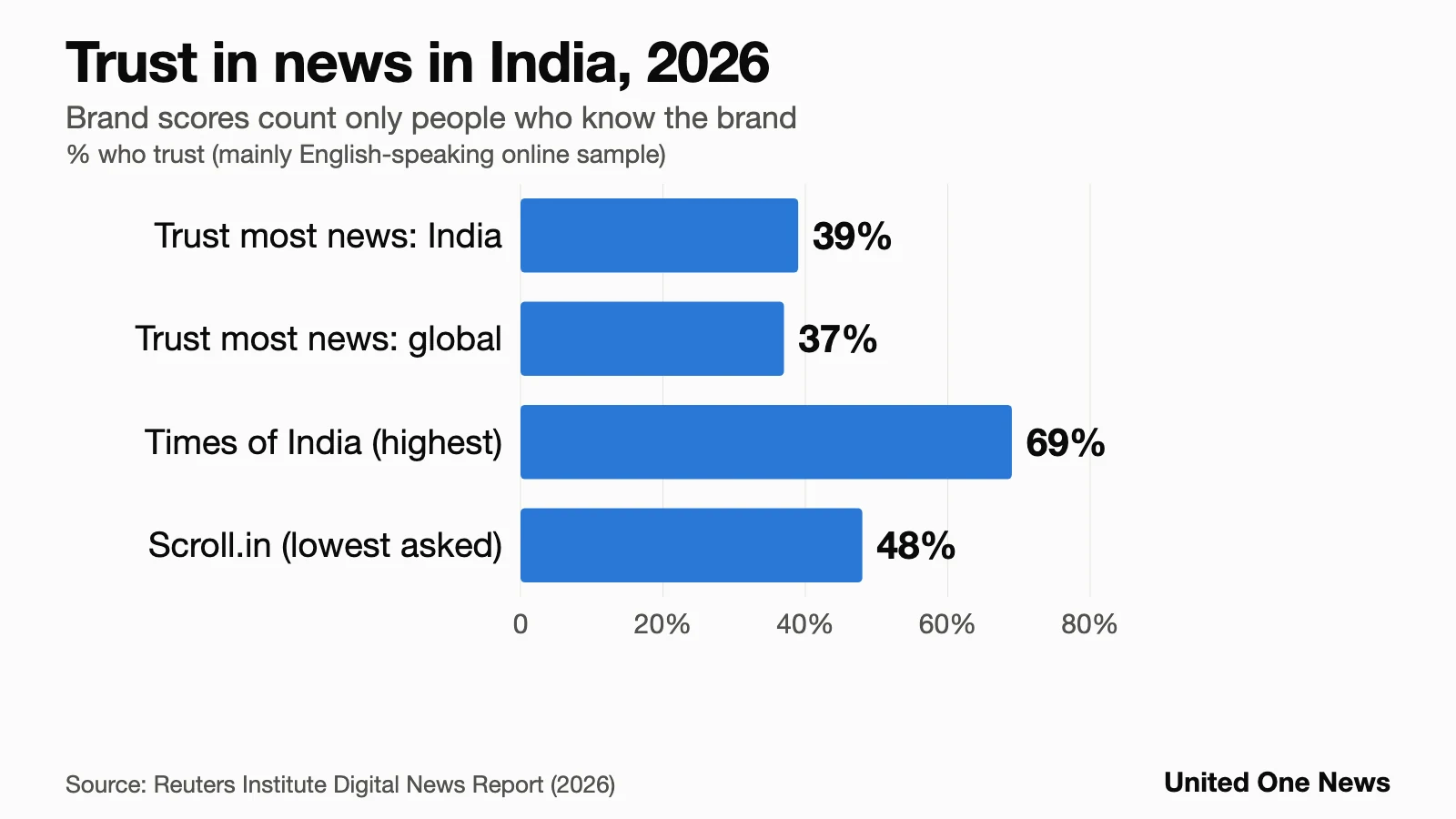
The Reuters Institute's 2026 survey found 39% of Indian respondents trust most news, and brand trust ranged from 48% to 69%. It names no single most trusted outlet. Four checks work better than hunting for a neutral channel.
Original report · Analysis
Data from the Reuters Institute Digital News Report 2026, published 16 June 2026; checked 15 October 2026.
Is there any unbiased news channel in India? No survey can certify one, and the most detailed public data available in October 2026 does not crown a winner. The Reuters Institute's Digital News Report 2026, published on 16 June 2026, found that 39% of Indian respondents trust most news most of the time, down 4 points on the previous year (Reuters Institute, 2026).
That figure is close to the global average of 37%, and it places India 18th of 48 markets (Krishnan, 2026). What the data does show is that trust is spread across many brands, which is why the better question is not "who is unbiased?" but "whose work can be checked?"
What the Reuters Institute measured in India
The India figures come from an online YouGov survey of 2,044 people, run from mid-January to the end of February 2026 (Reuters Institute, 2026). The Institute says the sample is mainly English-speaking online news users, younger than the country as a whole, and not nationally representative. It adds that the poll will under-represent TV and print.
So treat every number below as the view of India's connected, English-reading audience, not of all 1.46 billion people.
No single "most trusted news channel in India" in the data
The survey asked people to rate 15 brands from 0 to 10, counting 6 to 10 as trust. Among people who had heard of each brand, trust ranged from 69% for The Times of India to 48% for Scroll.in (Reuters Institute, 2026).
The other scores were:
- Hindustan Times 67%
- All India Radio and The Economic Times 65% each
- BBC News and The Indian Express 64% each
- DD India and The Hindu 63% each
- NDTV and "other regional or local newspaper" 62% each
- CNN-News18 and India Today TV 61% each
- Republic TV 57%
- The Wire 51%
The Institute warns against reading this as a league table. It says gaps of about 2 points or less cannot show that one brand is more trusted than another, and that only the listed brands were asked, so the table "should not be treated as a list of the most or least trusted brands" (Reuters Institute, 2026). Its own summary is that trust in legacy print publishers and public broadcasters "remains high" (Krishnan, 2026).
So the search for one "most trusted news source in India" has no answer in this data, and the Institute says so itself.
Why "unbiased" is the wrong test
Every newsroom decides which stories to cover, which words to use and whom to quote. Those choices make total neutrality impossible to prove, for any outlet, including this one. Ownership adds another layer: Reporters Without Borders, which ranked India 157th of 180 countries in its 2026 index, says Indian media ownership has become "heavily concentrated in the hands of a few conglomerates" (RSF, 2026).
A more useful test is whether an outlet shows its work, so readers can judge it.
Four things to look for instead
These signals can be checked on any outlet's website in a few minutes:
- Named sourcing. Good reports say who said what, and link or name the document behind a number.
- Visible corrections. Look for a published corrections policy and notes on stories that were changed.
- News kept apart from opinion. Reporting, analysis and debate should be labelled, so a column is not mistaken for a news report.
- Ownership disclosure. Check who owns the outlet; the Media Ownership Monitor India maps owners across TV, print, radio and online (Global Media Registry and Data Leads, n.d.).
An outlet that does all four can still get things wrong. The difference is that readers can see how, and hold it to account.
Most of this audience meets news on platforms
The same survey found 58% of Indian respondents used YouTube for news each week, 56% WhatsApp and 45% Instagram, against 44% who used TV (Reuters Institute, 2026). On those platforms, outlets, independent journalists and creators sit side by side in one feed.
That makes the four checks more important, not less. A YouTube channel or a forwarded clip can be tested the same way: who is the source, where is the document, has it been corrected, and who is behind it.
Comparing coverage as a habit
One practical way to apply these checks is to read the same story in several outlets and note what each includes or leaves out. United One News, which publishes this article, is one tool for that: it groups Indian outlets' coverage of each story and shows how outlets labelled left, centre and right covered it. Most of those outlet labels are still automated estimates, as its methodology page explains (United One News, 2026).
Questions people are asking
Is there any unbiased news channel in India?
No study certifies any Indian channel as unbiased. The Reuters Institute's 2026 survey measured trust, not bias, and found trust in its listed brands ranging from 48% to 69%.
What is the most trusted news source in India?
The Digital News Report 2026 does not name one. It asked about 15 brands only, and says small gaps between them cannot show that one is more trusted than another.
Which is the most trusted news channel in India?
Among channels in the 2026 survey, All India Radio scored 65%, DD India 63%, NDTV 62%, CNN-News18 and India Today TV 61% and Republic TV 57%. These come from a mainly English-speaking online sample, not the whole country.
What is the most trusted news app in India?
The Reuters Institute's survey asks about news brands, not about apps, so it gives no trust ranking for news apps. The same four checks (sourcing, corrections, opinion labels, ownership) work for any app.
References
- Reuters Institute for the Study of Journalism (2026) Digital News Report 2026. Oxford: Reuters Institute. Available at: Digital News Report 2026 (Accessed: 15 October 2026).
- Krishnan, A. (2026) India, in Digital News Report 2026. Reuters Institute for the Study of Journalism. Available at: India: Digital News Report 2026 (Accessed: 15 October 2026).
- Reporters Without Borders (2026) India. RSF. Available at: India: RSF (Accessed: 15 October 2026).
- Global Media Registry and Data Leads (n.d.) Media Ownership Monitor India. Available at: Media Ownership Monitor India (Accessed: 15 October 2026).
- United One News (2026) How we rate Indian news outlets. United One News. Available at: How we rate Indian news outlets (Accessed: 15 October 2026).
How we did this
We read the Reuters Institute's India page and the full Digital News Report 2026, and took every trust and platform figure from the India data page (page 145 of the report), including its sampling note. We read Reporters Without Borders' India page for the press freedom rank and its comment on ownership. We did not commission our own survey.
United One News compares news coverage for a living, so it has an interest in this question. We have mentioned our own product once, near the end, and we do not describe it as unbiased.
This story was produced, reviewed, edited and verified by the reporter before publication, with AI assistance where required.
Covered by 3 outlets across the spectrum: 0% left, 100% center, 0% right.
Who is covering this story
Sources
- Digital news report — Reuters Institute for the Study of Journalism (center, AI-estimated) ·
- Article from Reuters Institute for the Study of Journalism — Reuters Institute for the Study of Journalism (center, AI-estimated) ·
- Article from Reporters Without Borders — Reporters Without Borders (center, AI-estimated) ·