Kolkata pandal stampede: what the NDMA crowd guide asks, step by step
Published
India's 2014 crowd guide asks for a written plan, police and fire approvals and ample, unobstructed exits. Chorbagan had one way in and one way out. We set each step against what police, organisers and the state have said, and against three editorials.
Original report · Explained
What do India's crowd-management rules ask of a Durga Puja pandal? The National Disaster Management Authority's 2014 guide, Managing Crowd at Events and Venues of Mass Gathering, asks organisers to write a crowd plan, get police, fire, public works and electricity approvals, and keep ample entrances and exits unobstructed (NDMA, 2014). On the evening of 17 October 2026, the Chorbagan Sarbojanin pandal in Kolkata's Girish Park had one entry and one exit onto narrow lanes when a crush killed 19 people and injured 25, Dainik Jagran and Outlook India reported (Dainik Jagran, 2026; Outlook India, 2026).
We read the 95-page guide and set its steps against what police, organisers and the state have said since. Three editorials, in The Hindu, Hindustan Times and Deccan Herald, call the failures foreseeable; the guide shows which steps they mean. For the arrests and the inquiry, see our live report, Kolkata pandal stampede: High Court rules out sitting judge to head probe.
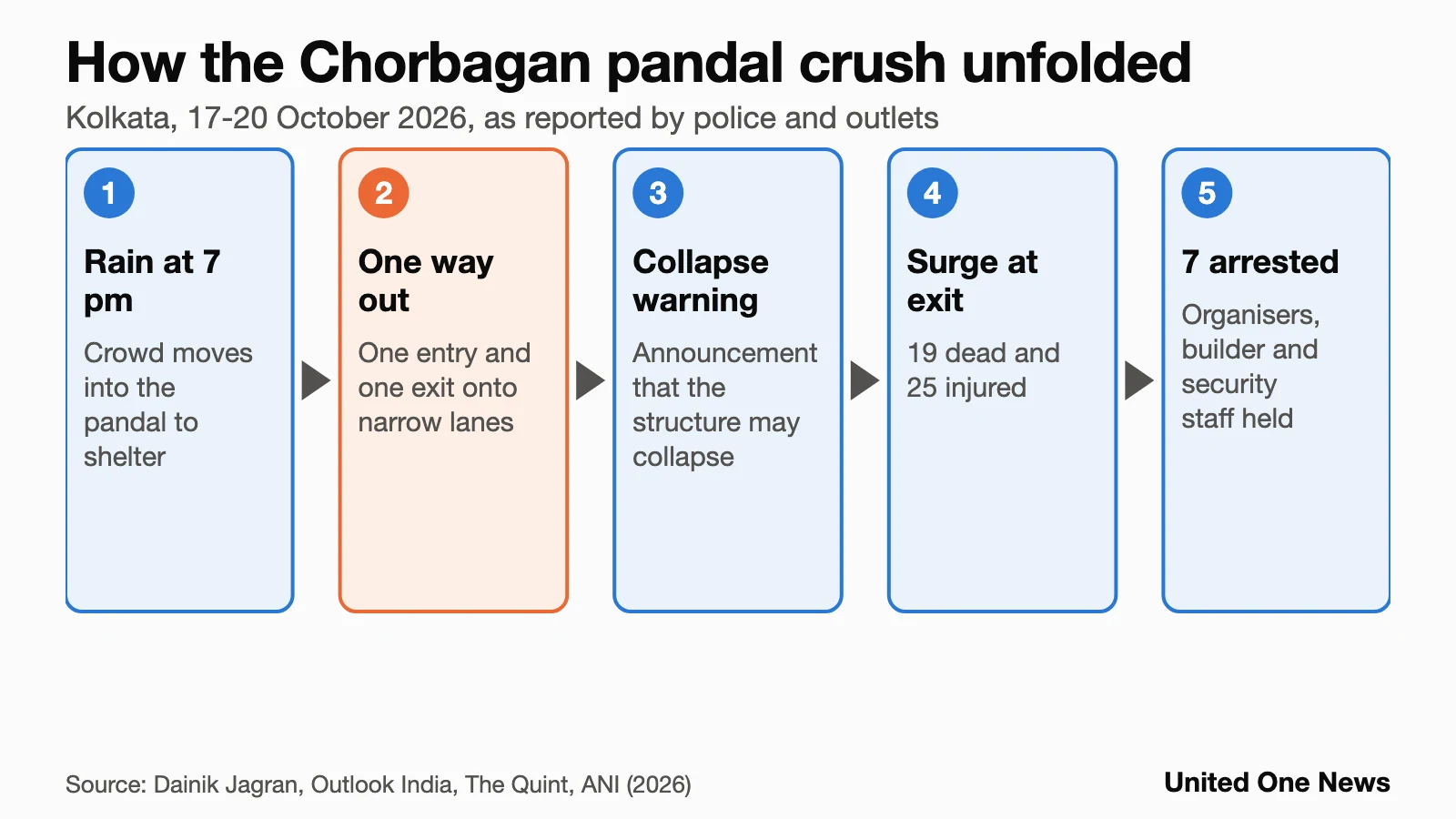
The night, in five steps
Every step below is what police, the Chief Minister or a named outlet has reported; none has been tested in court.
- Rain: from about 7 pm, rain drove people into the pandal, Dainik Jagran reported. Entry was meant to be capped in batches.
- One way out: the pandal had one entry and one exit, both onto narrow lanes (Dainik Jagran, 2026).
- A warning: Chief Minister Suvendu Adhikari said an announcement that the structure might collapse added to the panic (Outlook India, 2026).
- The surge: the crowd surged at the exit gate, The Quint reported, and 19 people died (The Quint, 2026).
- The case: police registered a case at Girish Park under BNS sections 105, 110 and 3(5) and arrested seven people, including the puja secretary, vice-president, the bamboo-structure builder and crowd and private-security staff, ANI reported (Asianet Newsable, 2026). Their lawyers say they were visitors who helped with the rescue.
The guide was written for exactly this sequence.
The guide's first rule is ample, unobstructed exits
NDMA's guide splits crowd control into three jobs: control the inflow, regulate the crowd at the venue, and control the outflow (section 3.2.4). Section 3.2.4.5 asks for "ample entrances and exits (including administrative/ emergency route)" that "remain unobstructed".
It also explains why crowds turn dangerous. Section 3.2.3 says crowd force builds from three things: information (false or real), space and time. On our reading, all three were present at Chorbagan: a collapse warning, a single exit onto narrow lanes, and rain that pushed people in at once.
The guide also says who should have seen that coming.
The guide puts the plan on organisers and the checks on police
Under Appendix 3.1, organisers write the crowd plan and get approvals from police, fire, public works and electricity departments; police regulate the crowd and traffic; the district disaster management authority makes sure plans are approved (NDMA, 2014).
What has been said so far points to gaps on both sides:
- A police source told The Quint "everything was handled verbally", with no clear plan (The Quint, 2026).
- The Chief Minister said police helped rush victims to hospital, but only temporary home guards were posted, in The Hindu's reading of his remarks (The Hindu, 2026).
- Kolkata Police Commissioner Ajay Nand had told every police station on 5 September to "prevent overcrowding at Puja pandals", UNI reported (UNI, 2026).
- Trinamool Congress leader Kalyan Banerjee says no police officer was present, Asianet Newsable reported. That is a claim, not a finding.
We have not seen the pandal's permission file, so we cannot say which approvals it held.
Announcements, VIP gates, stalls and the structure
Section 3.5.1 asks for a public-address system to give the crowd clear messages, CCTV by sector, emergency exits that are never barricaded, and refusing VIP entry where it adds risk. It says stalls should sit on one side only, with gaps of 3-4 metres.
At Chorbagan, the one announcement on record is the collapse warning. Deccan Herald says a VIP gate may have cut the space, and asks why shops stood in a narrow lane (Deccan Herald, 2026).
Section 3.5.2 asks for a structure's load capacity to be set with a factor of safety and certified by qualified people. The bamboo-structure builder is among those arrested; who, if anyone, certified the pandal has not been reported.
What it means for pandal-goers and organisers
The scale is large: the Chief Minister put this year's pandals at more than 57,000 statewide, up 25% on 2025, The Hindu reported, and Outlook India counts about 3,500 in Kolkata. NCRB data cited by Deccan Herald records 3,935 stampede incidents from 1996 to 2022.
Since the crush, Kolkata Police have issued an 11-point crowd directive, nine IPS officers were recalled to Kolkata Police until 20 October, and the state set up a high-level pandal-safety committee, Asianet Newsable and The Quint reported.
For visitors, the guide's checklist is a practical test of a crowded venue: more than one way out, exits kept clear, and announcements that guide rather than alarm. For exam aspirants, its information-space-time model is the core idea.
What the editorials argue
All three papers agree on narrow exits, the rain and thin policing. They differ on why.
- The Hindu says better regulation could have avoided it, the panic came from the announcement, and the crowd should have been let out in a regulated way. It asks whether the state's push for grand pujas sidelined safe practice: "Both the police and the puja organisers failed to anticipate the sudden surge of the crowd at the venue."
- Hindustan Times argues every cause was foreseeable: "None of these factors are unforeseeable or can't be hedged against." It points to Hathras in 2024, where 121 died, and asks why prevention was slower than the arrests.
- Deccan Herald calls the response a familiar script of compensation, arrests and an SIT, and says the tragedy was "foretold but ignored". It blames rivalry between organisers and asks why guidelines were not followed.
None of the three reads the NDMA guide clause by clause, or says that it gives the plan to organisers and the checks to police and the district authority.
The other side
The seven arrested are accused, not convicted; their lawyers say they were visitors who helped rescue people. The Chief Minister has said police helped get victims to hospital. Whether the NDMA guide binds West Bengal's pujas is not settled in anything we have read: it is guidance, and the state's own permission conditions were not in the documents we could open.
What happens next
Police custody of the seven ends on 28 October, Asianet Newsable reported. On 20 October the Calcutta High Court said a sitting judge cannot head the inquiry, and the state is to appoint a commission led by a retired judge, National Herald reported (National Herald, 2026). No date has been set.
Questions people are asking
What do NDMA crowd rules ask of puja organisers?
A written crowd plan, approvals from police, fire, public works and electricity departments, ample unobstructed exits and a certified structure load check (NDMA, 2014).
Who is responsible for the Kolkata pandal stampede?
That is not decided. Seven people are arrested and in custody to 28 October; their lawyers dispute their roles.
Were crowd-management rules broken at Chorbagan?
Police say this "will be checked", The Quint reported. The pandal had one entry and one exit, while the NDMA guide asks for ample, unobstructed exits.
Is the NDMA crowd guide binding on pujas?
Not settled in what we read. It is a national guide; the state's puja permission conditions were not public in the documents we found.
- Kolkata pandal stampede: High Court rules out sitting judge to head probe
- Today's editorials, 19 October 2026: Kolkata stampede and voter rolls
References
- Dainik Jagran (2026) Kolkata Pandal Stampede: 19 Dead, Seven Arrested, SIT Probe. Dainik Jagran English. Available at: Kolkata Pandal Stampede: 19 Dead, Seven Arrested, SIT Probe (Accessed: 20 October 2026).
- Outlook India (2026) Kolkata Durga Puja Pandal Stampede: SIT To Be Headed By Sitting Calcutta HC Judge, Announces Suvendu Adhikari. Outlook India. Available at: Kolkata Durga Puja Pandal Stampede: SIT To Be Headed By Sitting Calcutta HC Judge, Announces Suvendu Adhikari (Accessed: 20 October 2026).
- The Quint (2026) Kolkata Durga Puja Stampede: At Least 13 Women, 1 Child Among 19 Killed. The Quint. Available at: Kolkata Durga Puja Stampede: At Least 13 Women, 1 Child Among 19 Killed (Accessed: 20 October 2026).
- ANI (2026) Kolkata stampede: 7 accused, including puja panel members, in custody. Asianet Newsable. Available at: Kolkata stampede: 7 accused, including puja panel members, in custody (Accessed: 20 October 2026).
- The Hindu (2026) Beyond religiosity: on the Kolkata pandal tragedy. The Hindu. Available at: Beyond religiosity: on the Kolkata pandal tragedy (Accessed: 20 October 2026).
- Hindustan Times (2026) A crowd management disaster, yet again. Hindustan Times. Available at: A crowd management disaster, yet again (Accessed: 20 October 2026).
- Deccan Herald (2026) A familiar script after a tragedy. Deccan Herald. Available at: A familiar script after a tragedy (Accessed: 20 October 2026).
- National Disaster Management Authority (2014) Managing Crowd at Events and Venues of Mass Gathering. NDMA (copy on Goa SDMA site). Available at: Managing Crowd at Events and Venues of Mass Gathering (Accessed: 20 October 2026).
- UNI (2026) Kolkata top cop directs all police stations to strategise Durga puja crowd control. UNI. Available at: Kolkata top cop directs all police stations to strategise Durga puja crowd control (Accessed: 20 October 2026).
- ETV Bharat (2026) Kolkata Police Hands Chorbagan Stampede Case To Detective Department, 7 Arrested. ETV Bharat. Available at: Kolkata Police Hands Chorbagan Stampede Case To Detective Department, 7 Arrested (Accessed: 20 October 2026).
- National Herald (2026) Chorbagan stampede: HC directs probe panel to be headed by retired judge. National Herald. Available at: Chorbagan stampede: HC directs probe panel to be headed by retired judge (Accessed: 20 October 2026).
How we did this
We read the full 95-page NDMA guide on managing crowds (2014), using the copy hosted by Goa's disaster management authority, and matched its sections to the sequence reported by Dainik Jagran, Outlook India, The Quint and ANI between 17 and 20 October 2026. We opened the three editorials published on 19 and 20 October in full, summarised them in our own words, and quoted at most once from each. The link between the guide's information-space-time model and the night's events is our reading. We did not find West Bengal's puja permission conditions or the pandal's file. The suggested hero is ETV Bharat's photo of the pandal interior, credited to the outlet, with our flow chart of the night as the fallback.
This story was produced, reviewed, edited and verified by the reporter before publication, with AI assistance where required.
Covered by 10 outlets across the spectrum: 30% left, 20% center, 30% right.
Who is covering this story
- Left-leaning (3): Outlook India, The Hindu, The Quint
- Center (2): Deccan Herald, Hindustan Times
- Right-leaning (3): Dainik Jagran English, Asianet Newsable, ETV Bharat Gujarati
- Not yet rated (2): NDMA, National Herald
Sources
- Kolkata Pandal Stampede: 19 Dead, Seven Arrested, SIT Probe — Dainik Jagran English (right-leaning) ·
- Kolkata stampede: 7 accused, including puja panel members, in custody — Asianet Newsable (right-leaning) ·
- Article from NDMA — NDMA (not yet rated) ·
- A familiar script after a tragedy — Deccan Herald (center) ·
- Kolkata Police Hands Chorbagan Stampede Case To Detective Department, 7 Arrested — ETV Bharat Gujarati (right-leaning) ·
- A crowd management disaster, yet again — Hindustan Times (center) ·
- Chorbagan stampede: HC directs probe panel to be headed by retired judge — National Herald (not yet rated) ·
- Kolkata Durga Puja Pandal Stampede: SIT To Be Headed By Sitting Calcutta HC Judge, Announces Suvendu Adhikari | Outlook India — Outlook India (left-leaning) ·
- Beyond religiosity: on the Kolkata pandal tragedy — The Hindu (left-leaning) ·
- Kolkata Durga Puja Stampede: At Least 13 Women, 1 Child Among 19 Killed — The Quint (left-leaning) ·