UK tax rises and the £35bn gap: what the IFS figure measures before the 28 October Budget
Published
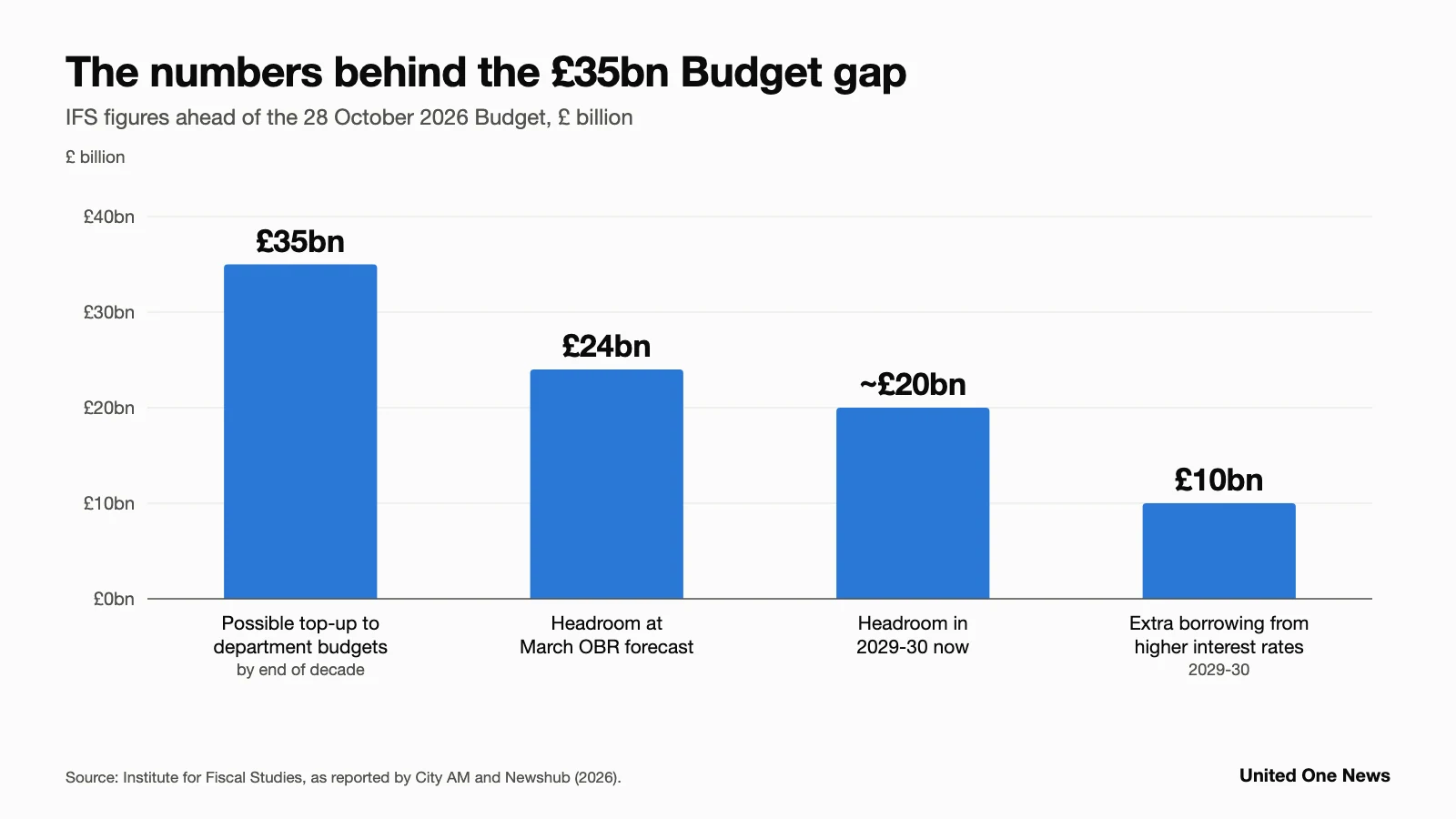
The £35bn is not a hole in the public finances. It is what topping up department budgets for inflation could cost by the end of the decade, against forecast headroom of about £20bn.
Original report
The £35bn behind this week's UK tax-rise headlines is not a hole the Institute for Fiscal Studies (IFS) found in the public finances. It is the IFS's estimate, reported on 12 October 2026, of the tax rises or benefit cuts Chancellor John Healey may need by the end of the decade if he tops up departmental budgets so inflation does not erode their real value (City AM, 2026; Newshub, 2026).
That matters because the Budget on 28 October, Healey's first as Chancellor, will be judged against it (Brit Brief, 2026). If he does not top up budgets, the IFS warns, staying with inherited plans would mean "chunky cuts" to public services (Brit Brief, 2026; Newshub, 2026).
The £35bn is a spending choice, not a shortfall
City AM reported the IFS as saying inflation is a bigger Budget challenge than shrinking headroom, and that the £35bn is the cost of a spending top-up driven by inflation (City AM, 2026). In other words, the figure appears only if the Chancellor decides to protect departments' real-terms budgets.
IFS director Helen Miller put the choice bluntly: "Simply pencilling in implicit cuts he has no intention of delivering would make the Budget fiction," City AM reported (City AM, 2026).
Inflation is the driver. The BDO inflation index reached 103.65 in September 2026, its highest since June 2023, City AM reported (City AM, 2026).
The headroom figures show why the choice is tight.
Headroom is shrinking at the same time
- Fiscal headroom is forecast to fall to about £20bn in 2029-30, from £24bn at the March forecast by the Office for Budget Responsibility (OBR), according to the IFS as reported by City AM (City AM, 2026).
- Higher interest rates add about £10bn to borrowing in 2029-30, the IFS said (City AM, 2026; Newshub, 2026).
- Defence spending at 3% of GDP costs about £11bn by the end of the decade-31, Brit Brief reported (Brit Brief, 2026).
- Health needs about £25bn more in 2030-31 to grow by 2.7% a year (Brit Brief, 2026; Newshub, 2026).
Set side by side, the £35bn top-up is larger than the whole £20bn of forecast headroom. That is why tax options are being floated.
Which taxes are being discussed
Only one report we read names specific taxes. A Pressbee rewrite of an inews report lists bank levies, capital gains tax and a possible windfall tax on oil and gas, and mentions a mansion tax threshold of £1.5m (Pressbee, 2026). No other outlet we read confirms these options, and the Treasury has not said which taxes it favours.
We looked for what each option would cost a typical household in pounds. No source we could open gives a per-household figure, so we have not estimated one.
How each side framed it
- The Treasury: no Treasury spokesperson was quoted in any report we read.
- The opposition: Shadow Chancellor Griffith said "Labour raised taxes £66 billion already; families cannot afford more", Brit Brief reported (Brit Brief, 2026). That figure is his claim, carried by one outlet.
- City AM led on inflation landing Healey with a £35bn bill; Brit Brief on a choice between tax rises and benefit cuts; Newshub on a Budget showdown.
Questions people are asking
Where does the £35bn figure come from?
The IFS, which says it is the possible cost by the end of the decade of topping up departmental budgets to offset inflation (City AM, 2026).
When is the UK Budget?
On 28 October 2026, with a new OBR forecast (Brit Brief, 2026; Newshub, 2026).
How much fiscal headroom does the UK have?
About £20bn in 2029-30, down from £24bn at the March forecast, according to the IFS (City AM, 2026).
Will income tax go up?
Not known yet. No source we could open reports Healey's plans for income tax.
What happens next
Healey attends IMF meetings in Bangkok in October before presenting the Budget and the OBR forecast on 28 October 2026 (City AM, 2026; Brit Brief, 2026).
References
- Brit Brief (2026) IFS warns Healey faces £35bn tax or benefit cuts dilemma. Brit Brief. Available at: IFS warns Healey faces £35bn tax or benefit cuts dilemma (Accessed: 12 October 2026).
- City AM (2026) Rampant inflation could land Healey with £35bn bill. City AM. Available at: Rampant inflation could land Healey with £35bn bill (Accessed: 12 October 2026).
- Newshub (2026) Healey budget: £35bn tax rise or benefit cuts looming. Newshub. Available at: Healey budget: £35bn tax rise or benefit cuts looming (Accessed: 12 October 2026).
- Pressbee (2026) Tax rises needed to plug £35bn hole in Budget, UK economists warn Healey. Pressbee. Available at: Tax rises needed to plug £35bn hole in Budget (Accessed: 12 October 2026).
How we did this
On 12 October we read the IFS findings as reported by City AM, Brit Brief and Newshub, and a Pressbee rewrite of an inews report, and separated what the £35bn measures from how headlines described it. The IFS's own pages returned an error when we tried to open them, and we could not open OBR, Resolution Foundation or Treasury documents, so every IFS figure here is as reported by those outlets. Claims found in one source only are marked as such.
This story was produced, reviewed, edited and verified by the reporter before publication, with AI assistance where required.
Covered by 4 outlets across the spectrum: 0% left, 25% center, 50% right.
Who is covering this story
- Center (1): Newshub
- Right-leaning (2): Brit Brief, City A.M. | The City's Business Website
- Not yet rated (1): Pressbee (inews rewrite)
Sources
- IFS warns Healey faces £35bn tax or benefit cuts dilemma — Brit Brief (right-leaning) ·
- Tax rises needed to plug £35bn hole in Budget, UK economists warn Healey ...Middle East — Pressbee (inews rewrite) (not yet rated) ·
- Rampant inflation could land Healey with £35bn bill — City A.M. | The City's Business Website (right-leaning) ·
- Healey budget: £35bn tax rise or benefit cuts looming | NewsHub.co.uk — Newshub (center) ·