Sugar ethanol diversion barred for 2026-27: why C-heavy molasses still flows
Published
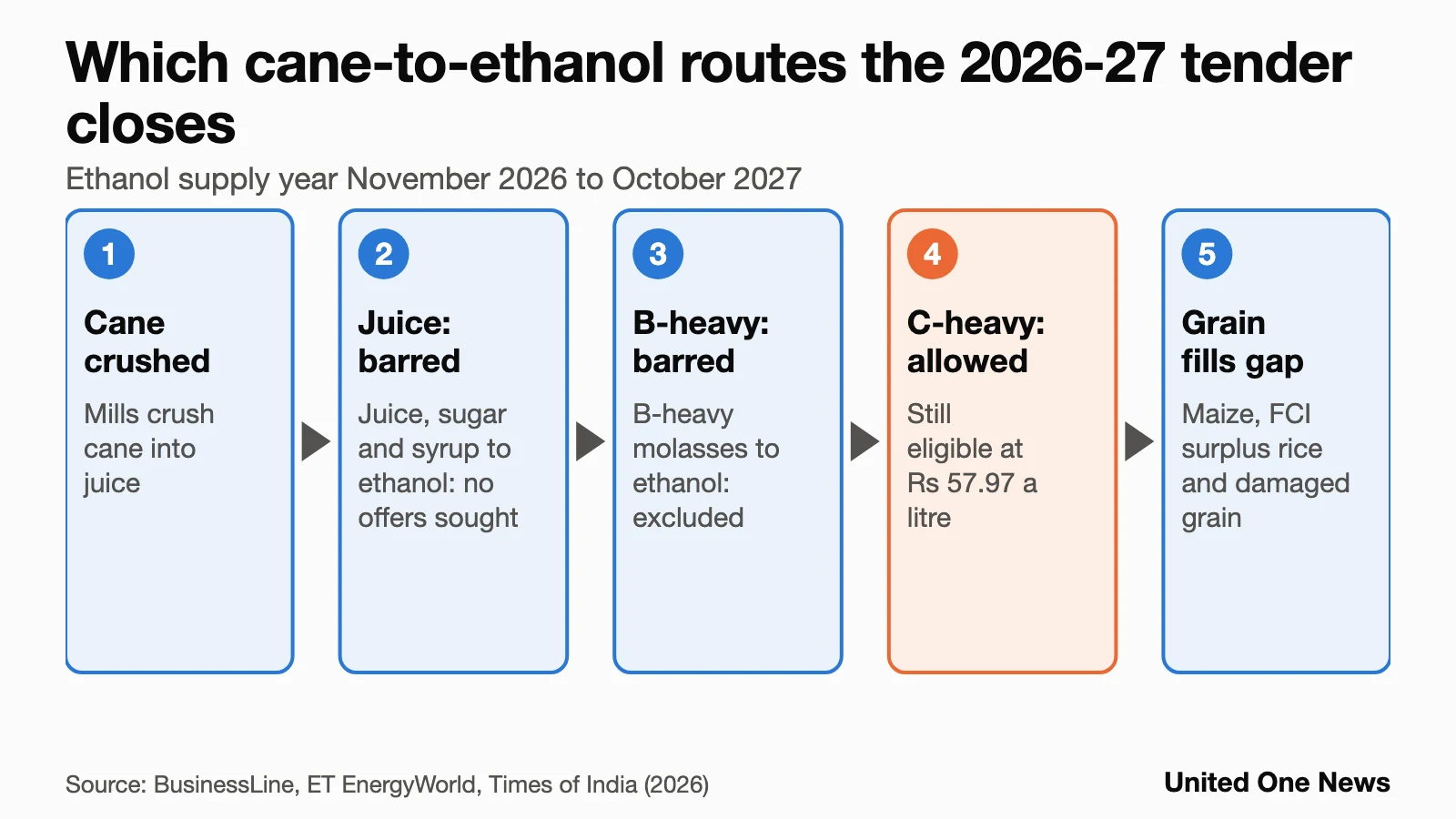
The 16 October ethanol tender shuts out cane juice and B-heavy molasses to save about 3 million tonnes of sugar. C-heavy molasses and grain stay open. We trace each route and what it means for mills, cane farmers and E20.
Original report · Explained
Data as of 20 October 2026. This article is for information only and is not investment advice.
About 3 million tonnes of sugar went into ethanol in 2025-26; for 2026-27 the government wants that to be zero. The tender BPCL issued on 16 October 2026 for the oil marketing companies seeks about 1,100 crore litres of ethanol and says the government directed that "sugar diversion for ethanol be reduced to zero", BusinessLine and ChiniMandi reported (BusinessLine, 2026; ChiniMandi, 2026).
It is a bar, not a cap, but not on every cane route. We read the tender's terms as reported and traced each path from cane to fuel: which ones close, which stay open, and what that does to the sugar balance, mills and cane farmers.
Which cane routes the tender closes
No offers were sought for ethanol made from cane juice, sugar, sugar syrup or B-heavy molasses (BusinessLine, 2026; ChiniMandi, 2026). Still open, as separate categories:
- C-heavy molasses, at ₹57.97 a litre.
- Damaged food grains, at ₹64.
- Food Corporation of India (FCI) surplus rice, at ₹60.32.
- Maize, at ₹66.07 plus a ₹2.79 incentive, ₹68.86 in all, as The New Indian Express reports.
That corrects a point in The Tribune's editorial, which says only corn and rice can be blended: C-heavy molasses is still eligible, per the tender and the Indian Sugar & Bio-Energy Manufacturers Association (ISMA) (ET EnergyWorld, 2026). ISMA says C-heavy ethanol uses no "recoverable sugar". No source we read explains the B-heavy and C-heavy steps in detail.
How much sugar the bar protects
ISMA's Deepak Ballani put 2025-26 gross output at 31 million tonnes (MT), with about 3 MT diverted to ethanol (Financial Express, 2026). For 2026-27, ISMA says gross will equal net, with consumption at 28.5-29 MT and opening mill stock at 3.5-3.6 MT, the lowest in over a decade.
Crisil's figures, reported by Oneindia, show diversion rising from 0.8 MT in 2019-20 to over 3 MT, with a 2025-26 closing stock of 3.9 MT, 40% below the five-year average of 6.5 MT. The stock figures differ by source.
Prices explain the urgency. Retail sugar averaged ₹57.82 a kg on 16 October, up 24% on a year, Financial Express reported.
The shortfall by state
BusinessLine's own estimate, not ISMA's, puts 2026-27 gross output at about 270 lakh tonnes, with a deficit of 15-25 lakh tonnes (BusinessLine, 2026):
- Maharashtra: 88 lakh tonnes, down 22%.
- Uttar Pradesh: 96 lakh tonnes, stable.
- Karnataka: 46 lakh tonnes, down 26%.
Without imports, it sees closing stock in September 2027 at 5-15 lakh tonnes. Mill-level effects in UP and Maharashtra have not been reported.
What it means for E20, mills and farmers
E20 likely slips to about 18-19% in 2026-27, by BusinessLine's arithmetic: a full 20% blend needs 1,150-1,210 crore litres, against a tender of about 1,100. Grain already supplied 624 crore litres, about 70%, in 2025-26, according to the grain distillers' body AIDA (New Indian Express, 2026).
For mills, ISMA welcomed the bar but objects to preference for dedicated ethanol plants with long-term offtake deals. Sugar shares fell on 19 October: Shree Renuka by 6% and Bajaj Hindusthan by up to 8%, Trade Brains reported, with Balrampur Chini, EID Parry, Triveni and Dhampur also lower.
For farmers, the cane price (FRP) is ₹365 a quintal for 2026-27, up 3% (Financial Express, 2026). Karnataka growers want ₹4,500-5,500 a tonne against ₹3,650 now; a panel under Ramesh Chand is examining their case (BusinessLine, 2026). Of ₹1.12 lakh crore payable for 2025-26, 88.6% was paid by 20 April 2026, and Maharashtra's arrears were ₹4,898 crore on 28 February.
What the editorial argues
The Tribune (20 October) calls the move pragmatic, given record retail prices and weak rain in Maharashtra and Karnataka. It says mills diverted about 10% of output to ethanol this year, and warns: "A fuel blending programme dependent entirely on food crops will remain vulnerable to the shifting demand-supply dynamics." It wants crop-residue ethanol pushed.
The industry case is narrower. ISMA backs the bar ("Domestic sugar consumption must remain the foremost priority") but objects to the allocation rules, and mill shares fell. The Tribune does not do the litre arithmetic or note that C-heavy molasses stays open.
Risks and what could change
- Allocations are subject to Writ Petition 109133 of 2025 on the allocation method (ChiniMandi, 2026).
- Output estimates vary by source, and depend on rain and crushing.
- Officials expect retail sugar near ₹52 a kg as crushing starts, Financial Express reported; that is a forecast.
What happens next
Crushing may start on 22-23 October if on schedule, BusinessLine reported. The ethanol supply year starts on 1 November, with the government's sugar output estimate due in November (BusinessLine, 2026).
Questions people are asking
Is sugar-based ethanol banned in 2026-27?
Ethanol from cane juice, sugar, syrup and B-heavy molasses is excluded from the tender; C-heavy molasses is allowed (ET EnergyWorld, 2026).
Is it a cap on ethanol diversion?
No. The tender says sugar diversion should be "reduced to zero", a bar on the sugar-rich routes rather than a percentage cap.
Will E20 survive?
BusinessLine's estimate implies about an 18-19% blend in 2026-27.
Will sugar get cheaper?
Retail was ₹57.82 a kg on 16 October; officials see ₹52 as crushing starts (Financial Express, 2026).
This article is for information only and is not investment advice. Readers should consult a registered adviser before investing.
References
- The Tribune (2026) Ethanol curbs : Prioritising sugar supply is a pragmatic step. The Tribune. Available at: Ethanol curbs : Prioritising sugar supply is a pragmatic step (Accessed: 20 October 2026).
- Economic Times (2026) ISMA hails govt ethanol supply policy for 2026-27 to ensure domestic sugar supply. ET EnergyWorld. Available at: ISMA hails govt ethanol supply policy for 2026-27 (Accessed: 20 October 2026).
- BusinessLine (2026) No sugar diversion for ethanol production: Govt to OMCs. The Hindu BusinessLine. Available at: No sugar diversion for ethanol production (Accessed: 20 October 2026).
- ChiniMandi (2026) ESY 2026-27: OMCs invite bids for around 1100 crore litres of ethanol. ChiniMandi. Available at: ESY 2026-27: OMCs invite bids (Accessed: 20 October 2026).
- New Indian Express (2026) Govt: No diversion of sugar for ethanol fuel blending. The New Indian Express. Available at: Govt: No diversion of sugar for ethanol fuel blending (Accessed: 20 October 2026).
- Financial Express (2026) Sugar output may fall in 2026-27, no ethanol diversion: Industry. Financial Express. Available at: Sugar output may fall in 2026-27 (Accessed: 20 October 2026).
- BusinessLine (2026) A comfortable Diwali, an uncomfortable 2027: India's sugar balance sheet is running thin. The Hindu BusinessLine. Available at: India's sugar balance sheet is running thin (Accessed: 20 October 2026).
- Oneindia (2026) Sugar Prices Surge, Stocks Fall: Why India Is Shifting Its Ethanol Policy. Oneindia. Available at: Sugar Prices Surge, Stocks Fall (Accessed: 20 October 2026).
- Trade Brains (2026) Sugar Stocks Plunge Nearly 8%. Trade Brains. Available at: Sugar Stocks Plunge Nearly 8% (Accessed: 20 October 2026).
- BusinessLine (2026) Maharashtra, Karnataka farmers stage protests seeking revision of cane FRP, sugar MSP. The Hindu BusinessLine. Available at: Farmers stage protests seeking revision of cane FRP (Accessed: 20 October 2026).
- Financial Express (2026) CCEA approves 3% rise in cane fair price for 2026-27 season. Financial Express. Available at: CCEA approves 3% rise in cane fair price (Accessed: 20 October 2026).
- BusinessLine (2026) As sugar mills are yet to clear Rs 5,000 cr cane dues to farmers, ISMA seeks revision in minimum selling price. The Hindu BusinessLine. Available at: Sugar mills yet to clear cane dues (Accessed: 20 October 2026).
How we did this
We read the terms of BPCL's 16 October tender as reported by BusinessLine and ChiniMandi, and set them against ISMA's sugar balance in Financial Express, Crisil's figures and BusinessLine's state estimates, all published between February and October 2026. We did not see the government's direction itself. We opened The Tribune's editorial in full, summarised it in our own words and quoted it once. The hero is our flow chart of the cane-to-ethanol routes; the first step is our plain-language framing.
This story was produced, reviewed, edited and verified by the reporter before publication, with AI assistance where required.
Covered by 12 outlets across the spectrum: 8% left, 75% center, 17% right.
Who is covering this story
- Left-leaning (1): The New Indian Express
- Center (5): ET EnergyWorld, Trade Brains, Financial Express, The Hindu BusinessLine, Tribune India
- Right-leaning (2): ChiniMandi, OneIndia
Sources
- ISMA hails govt ethanol supply policy for 2026-27 to ensure domestic sugar supply — ET EnergyWorld (center) ·
- Sugar Stocks Plunge Nearly 8%: What Does the Govt’s Ethanol Supply Decision Mean for Sugar Mills? — Trade Brains (center) ·
- ESY 2026-27: OMCs invite bids for around 1100 crore litres of ethanol; Sugarcane Juice and B-Heavy Molasses excluded - ChiniMandi — ChiniMandi (right-leaning) ·
- CCEA approves 3% rise in cane fair price for 2026-27 season — Financial Express (center) ·
- Sugar output may fall in 2026-27, no ethanol diversion: Industry — Financial Express (center) ·
- Govt: No diversion of sugar for ethanol fuel blending — The New Indian Express (left-leaning) ·
- Sugar Prices Surge, Stocks Fall: Why India Is Shifting Its Ethanol Policy — OneIndia (right-leaning) ·
- No sugar diversion for ethanol production: Govt to OMCs — The Hindu BusinessLine (center) ·
- A comfortable Diwali, an uncomfortable 2027: India’s sugar balance sheet is running thin — The Hindu BusinessLine (center) ·
- As sugar mills are yet to clear ₹5,000 cr cane dues to farmers, ISMA seeks revision in minimum selling price — The Hindu BusinessLine (center) ·
- Maharashtra, Karnataka farmers protest for higher cane FRP, sugar MSP — The Hindu BusinessLine (center) ·
- Ethanol curbs : Prioritising sugar supply is a pragmatic step - The Tribune — Tribune India (center) ·