FSSAI infant formula rules: what the IMS Act 1992 bans, from ads to free samples
Published · Updated
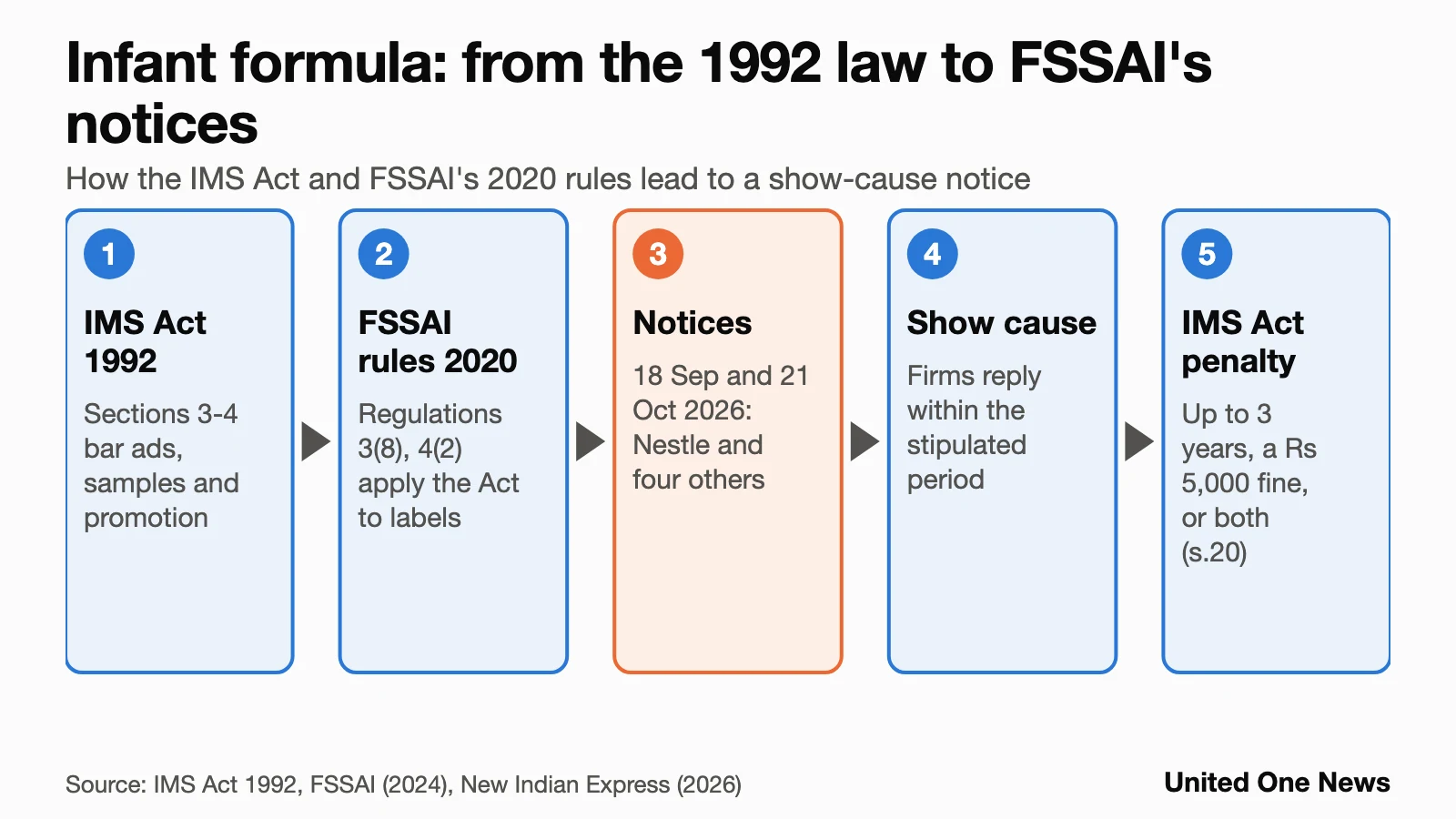
FSSAI served show-cause notices on Nestle India and four other companies on 21 October 2026 over formula claims and an Instagram reel. India's 1992 law bans advertising and promoting infant milk substitutes. What it forbids, the penalties, and study notes.
Original report · Explained
What do FSSAI's infant formula rules ban? The Infant Milk Substitutes Act 1992 (IMS Act) bars any advertisement or promotion of infant milk substitutes, feeding bottles and infant foods, as well as free samples, gifts to mothers and gifts or funding for health workers; FSSAI's 2020 infant nutrition regulations require every infant food to comply with it (Government of India, 1992; FSSAI, 2024). On 21 October 2026, the Food Safety and Standards Authority of India (FSSAI) served show-cause notices on Nestle India, Abbott Healthcare, Nutricia International, Mead Johnson Nutrition (India) and Zydus Wellness over product claims and promotion, The New Indian Express reported (The New Indian Express, 2026).
For Nestle, FSSAI sought proof for a Lactogen Pro 1 claim that its whey is "easy to digest", and questioned a Nan Excella Pro Stage 1 claim that "5 HMOs helps support the normal immune system", which it read as linking the product to a physiological condition (The New Indian Express, 2026). It also flagged an Instagram "Top 5" reel that recommended five infant formulas as an alleged breach of the IMS Act and the infant nutrition regulations. Zydus Wellness faces questions over "2X faster growth" claims for a growth drink under the 2018 advertising and claims rules.
These are allegations: each company has been asked to show why action should not be taken under the Food Safety and Standards (FSS) Act 2006, and no reply has been made public. See how every outlet covered the infant formula notices.
The law exists to protect breastfeeding. In the National Family Health Survey's fifth round (NFHS-5), 63.7% of children under 6 months were exclusively breastfed, up from 54.9% in NFHS-4 (International Breastfeeding Journal, 2023). That still leaves about one in three infants under 6 months who are not (100 minus 63.7 is 36.3%).
What it is
The IMS Act regulates the production, supply and distribution of baby milk products, with the stated aim of protecting breastfeeding.
- What it covers: infant milk substitutes, feeding bottles and infant foods. "Infant foods" were added by an amendment in 2003 (Government of India, 1992).
- Its aim: the Act's stated purpose is the "protection and promotion of breastfeeding" (BPNI, n.d.).
- What "promotion" means: section 2 defines it as using any method, directly or indirectly, to encourage any person to buy or use these products (BPNI, n.d.). FSSAI's notice over an Instagram reel will test how far this definition reaches.
- FSSAI's role: its Foods for Infant Nutrition Regulations 2020 set product and label rules and tie them back to the IMS Act (FSSAI, 2024).
Background and timeline
The law has been in force for 33 years, and FSSAI has acted under it twice in five weeks.
- 31 July 1993: the IMS Act's commencement is notified (G.S.R. 527(E)); it comes into force on 1 August 1993 (Government of India, 1992).
- 1 November 2003: the amendment, Act 38 of 2003, brings infant foods within the Act (Government of India, 1992).
- 2006: the FSS Act, under which FSSAI works within the Union Health Ministry (Vajiram & Ravi, n.d.).
- 2018: FSSAI's Advertising and Claims Regulations (The New Indian Express, 2026).
- 1 July 2021: food businesses must comply with the FSS (Foods for Infant Nutrition) Regulations 2020 (FSSAI, 2024).
- 18 September 2026: FSSAI finds that Nan Excella Pro Stage 1 and Lactogen Pro 1 breached Regulation 4(2) and section 3 of the IMS Act; a follow-up formula sample had sub-standard biotin, Business Today reported (Business Today, 2026).
- 21 October 2026: five companies are served notices (The New Indian Express, 2026).
What the law says
The Act reaches the advert, the free sample, the clinic and the label.
IMS Act 1992, as amended in 2003
- Section 3: no advertising or promotion, and no claim that a product is "equivalent to, or better than, mother's milk" (Government of India, 1992).
- Section 4: no samples, gifts, contact with pregnant women or mothers, or other inducements to promote use.
- Section 6: every container and label must carry an important notice that mother's milk is best for the baby.
- Section 8: no promotion within the health care system.
- Section 9: no gifts or funding for health workers.
- Sections 12 and 13: food inspectors have powers of entry, search and seizure.
- Section 20(1): breaking sections 3, 4, 5, 7, 8, 9 or 10 is punishable with up to 3 years in prison, a fine of up to Rs 5,000, or both.
- Section 20(2): breaking the labelling rule (section 6) or the standards rule (section 11(1)) carries 6 months to 3 years plus a fine of at least Rs 2,000.
- Section 23: offences are cognizable and bailable.
FSS (Foods for Infant Nutrition) Regulations 2020
- Regulation 3(8): infant food must comply with the IMS Act, including sections 3, 4, 5, 7, 8, 9 and 10 (FSSAI, 2024).
- Regulation 3(13): adverts and claims must follow the 2018 Advertising and Claims Regulations.
- Regulation 4(2): labels may not carry pictures of babies or women, or words such as "Humanised".
- The label notice: "IMPORTANT NOTICE" and "MOTHER'S MILK IS BEST FOR YOUR BABY", in capitals at least 5 mm high, on the front of the pack.
The Constitution
- Article 47 (Directive Principles): the State is to raise the level of nutrition and improve public health (Wikipedia, 2026).
Institutions and enforcement
Two laws, one regulator: the notices come under the FSS Act, and the conduct rules come from the IMS Act.
- FSSAI: the regulator under the FSS Act 2006, within the Union Health Ministry; it issued the 21 October notices (The New Indian Express, 2026; Vajiram & Ravi, n.d.).
- Food inspectors: the IMS Act gives them powers of entry, search and seizure under sections 12 and 13 (Government of India, 1992).
- The notice route: each company must show cause why action should not be initiated under the FSS Act, within a period the reports do not state (The New Indian Express, 2026).
The numbers
Five companies, five named formulas in one reel, and more than 150 food makers noticed in recent months.
- 5: companies served notices on 21 October 2026 (The New Indian Express, 2026).
- 5: formulas the Instagram reel recommended: Nan-Pro 1, Aptamil Premium 1, Similac Advance 1, Enfamil A+ Stage 1 and Dexolac 1.
- More than 150: food and beverage makers FSSAI has issued notices to "in recent times", The New Indian Express reported.
- 63.7%: children under 6 months exclusively breastfed in NFHS-5, up from 54.9% in NFHS-4 (International Breastfeeding Journal, 2023).
- 3 years or Rs 5,000: the maximum prison term and fine under section 20(1) of the IMS Act (Government of India, 1992).
- 5 mm: the minimum height of the "MOTHER'S MILK IS BEST FOR YOUR BABY" notice on the front of the pack (FSSAI, 2024).
Arguments for and against
FSSAI says formula claims need a legal basis; the companies have not yet answered in public.
- The case for strict rules: the Act's stated aim is to protect and promote breastfeeding (BPNI, n.d.).
- FSSAI's position: the Nan Excella Pro claim was "considered non-compliant" with rules that bar disease or physiological-condition claims (The New Indian Express, 2026).
- The companies' side: their replies are not public, and none is quoted in the reports we read.
- The open legal question: whether a creator's reel is "promotion" turns on section 2's definition, which covers encouraging a purchase "directly or indirectly" (BPNI, n.d.). FSSAI's notice treats the reel as an alleged breach (The New Indian Express, 2026).
What happens next
The companies must now answer. Each has to submit documents and evidence within the stipulated period, which the reports do not state, and FSSAI will then decide on action under the FSS Act (The New Indian Express, 2026).
Still unknown: the companies' replies, the deadline and any penalty. FSSAI named none in the 21 October reports.
Questions people are asking
Is advertising infant formula legal in India?
No. Section 3 of the IMS Act bars any advertisement or promotion of infant milk substitutes, feeding bottles and infant foods (Government of India, 1992).
Can formula companies give gifts to doctors or fund seminars?
No. Section 9 bars gifts or funding for health workers, and section 8 bars promotion in the health care system (Government of India, 1992).
What must an infant formula label say?
"IMPORTANT NOTICE" and "MOTHER'S MILK IS BEST FOR YOUR BABY", in capitals at least 5 mm high, on the front of the pack (FSSAI, 2024).
Which companies got FSSAI notices on 21 October 2026?
Nestle India, Abbott Healthcare, Nutricia International, Mead Johnson Nutrition (India) and Zydus Wellness (The New Indian Express, 2026).
For students
GS paper: GS Paper II (health; government policies and interventions).
Key terms
- Infant milk substitute: the formula products the IMS Act regulates, alongside feeding bottles and infant foods.
- Infant food: a category brought within the IMS Act by the 2003 amendment.
- Health worker: a term the IMS Act uses; formula makers may not give health workers gifts or funding (section 9).
- Promotion: any direct or indirect method of encouraging someone to buy or use these products (section 2).
- Show-cause notice: a notice asking a company to explain why action should not be taken.
- Food business operator (FBO): a business bound by FSSAI's regulations, including the 2020 infant nutrition rules.
- Article 47: the Directive Principle on raising nutrition and improving public health.
Prelims facts
- The IMS Act 1992 came into force on 1 August 1993 and was amended in 2003 (Act 38 of 2003).
- Section 20(1): up to 3 years in prison, a fine of up to Rs 5,000, or both.
- Section 23: offences are cognizable and bailable.
- Regulation 3(8) of the 2020 regulations cites IMS Act sections 3, 4, 5, 7, 8, 9 and 10.
- Label: "MOTHER'S MILK IS BEST FOR YOUR BABY", in capitals at least 5 mm high.
- FSSAI works under the FSS Act 2006, within the Union Health Ministry.
- Exclusive breastfeeding under 6 months: 63.7% in NFHS-5, 54.9% in NFHS-4.
Mains practice question (250 words)
India's IMS Act 1992 bans the promotion of infant milk substitutes to protect breastfeeding. In the light of FSSAI's October 2026 notices, including one over a social media reel, examine whether the law is equipped for digital marketing, and suggest changes.
Prelims practice question
Under India's rules on infant milk substitutes, which of the following must appear on the label? (a) "Clinically proven" (b) "Mother's milk is best for your baby" (c) "Humanised milk" (d) "Equivalent to mother's milk"
Answer: (b). "Humanised" is barred by Regulation 4(2), and a claim of equivalence to mother's milk is barred by section 3 of the IMS Act.
How we did this
We read the IMS Act as published by B&B Associates and in BPNI's copy of the amended Act, and FSSAI's Foods for Infant Nutrition Regulations, and listed what they ban against the allegations in the 21 October 2026 report by The New Indian Express and the September action reported by Business Today. The breastfeeding figures come from a study in the International Breastfeeding Journal. We did not see the notices themselves. A Mid-Day headline also names Hindustan Unilever; the New Indian Express list does not, and we could not confirm a notice to it. We have not named the Instagram creator.
References
- The New Indian Express (2026) FSSAI serves notices on Nestle India, others for misleading claims and promotion of infant milk substitutes. The New Indian Express. Available at: FSSAI serves notices on Nestle India, others (Accessed: 21 October 2026).
- Mid-Day (2026) FSSAI issues notices to Nestle India, Hindustan Unilever for misleading claims. Mid-Day. Available at: FSSAI issues notices to Nestle India, Hindustan Unilever (Accessed: 21 October 2026).
- Business Today (2026) Nestle faces FSSAI crackdown over baby food formula claims, shares take a hit. Business Today. Available at: Nestle faces FSSAI crackdown over baby food formula claims (Accessed: 21 October 2026).
- Government of India (1992) The Infant Milk Substitutes, Feeding Bottles and Infant Foods (Regulation of Production, Supply and Distribution) Act, 1992, as amended. B&B Associates LLP. Available at: The IMS Act, 1992 (Accessed: 21 October 2026).
- BPNI (n.d.) The IMS Act 1992 as amended in 2003. Breastfeeding Promotion Network of India. Available at: The IMS Act 1992 as amended in 2003 (Accessed: 21 October 2026).
- FSSAI (2024) Food Safety and Standards (Foods for Infant Nutrition) Regulations, 2020, Version II. FSSAI. Available at: Foods for Infant Nutrition Regulations, 2020 (Accessed: 21 October 2026).
- International Breastfeeding Journal (2023) Exclusive breastfeeding practices and its determinants in Indian infants: findings from NFHS-4 and 5. International Breastfeeding Journal. Available at: Exclusive breastfeeding practices in Indian infants (Accessed: 21 October 2026).
- Vajiram & Ravi (n.d.) Consider the following statements (FSS Act 2006). Vajiram & Ravi. Available at: Consider the following statements (Accessed: 21 October 2026).
- Wikipedia (2026) Directive Principles of State Policy. Wikipedia. Available at: Directive Principles of State Policy (Accessed: 21 October 2026).
This story was produced, reviewed, edited and verified by the reporter before publication, with AI assistance where required.
Covered by 11 outlets across the spectrum: 9% left, 36% center, 9% right.
Who is covering this story
- Left-leaning (1): The New Indian Express
- Center (4): Wikipedia, Business Today, Mid-Day, The Hindu BusinessLine
- Right-leaning (1): Deccan Chronicle
- Not yet rated (5): Vajiram and Ravi, BPNI, FSSAI, International Breastfeeding Journal, B&B Associates
Sources
- FSSAI Notices Nestlé, Abbott, Others, Ira Johnson Over Illegal Instagram Ads — Deccan Chronicle (right-leaning) ·
- Directive Principles in India - Wikipedia — Wikipedia (center) ·
- Consider the following statements — Vajiram and Ravi (not yet rated) ·
- Article from BPNI — BPNI (not yet rated) ·
- Nestle faces FSSAI crackdown over over baby food formula claims, shares take a hit - BusinessToday — Business Today (center) ·
- Article from FSSAI — FSSAI (not yet rated) ·
- FSSAI notice to Nestle: FSSAI issues notices to Nestle India, Hindustan Unilever for misleading claims — Mid-Day (center) ·
- Exclusive breastfeeding practices and its determinants in Indian infants: findings from the National Family Health Surveys-4 and 5 — International Breastfeeding Journal (not yet rated) ·
- FSSAI serves notices on Nestle India, others for misleading claims and promotion of infant milk substitutes — The New Indian Express (left-leaning) ·
- The Infant Milk Substitutes, Feeding Bottles and Infant Foods (Regulation of Production, Supply and Distribution) Act 1992 - B&B Associates LLP — B&B Associates (not yet rated) ·
- Nestle India responds to FSSAI notice over Lactogen Pro 1 labelling claim — The Hindu BusinessLine (center) ·