I&B ministry TV advisory: Cable TV Act, Programme Code Rule 6 and Article 19(2)
Published
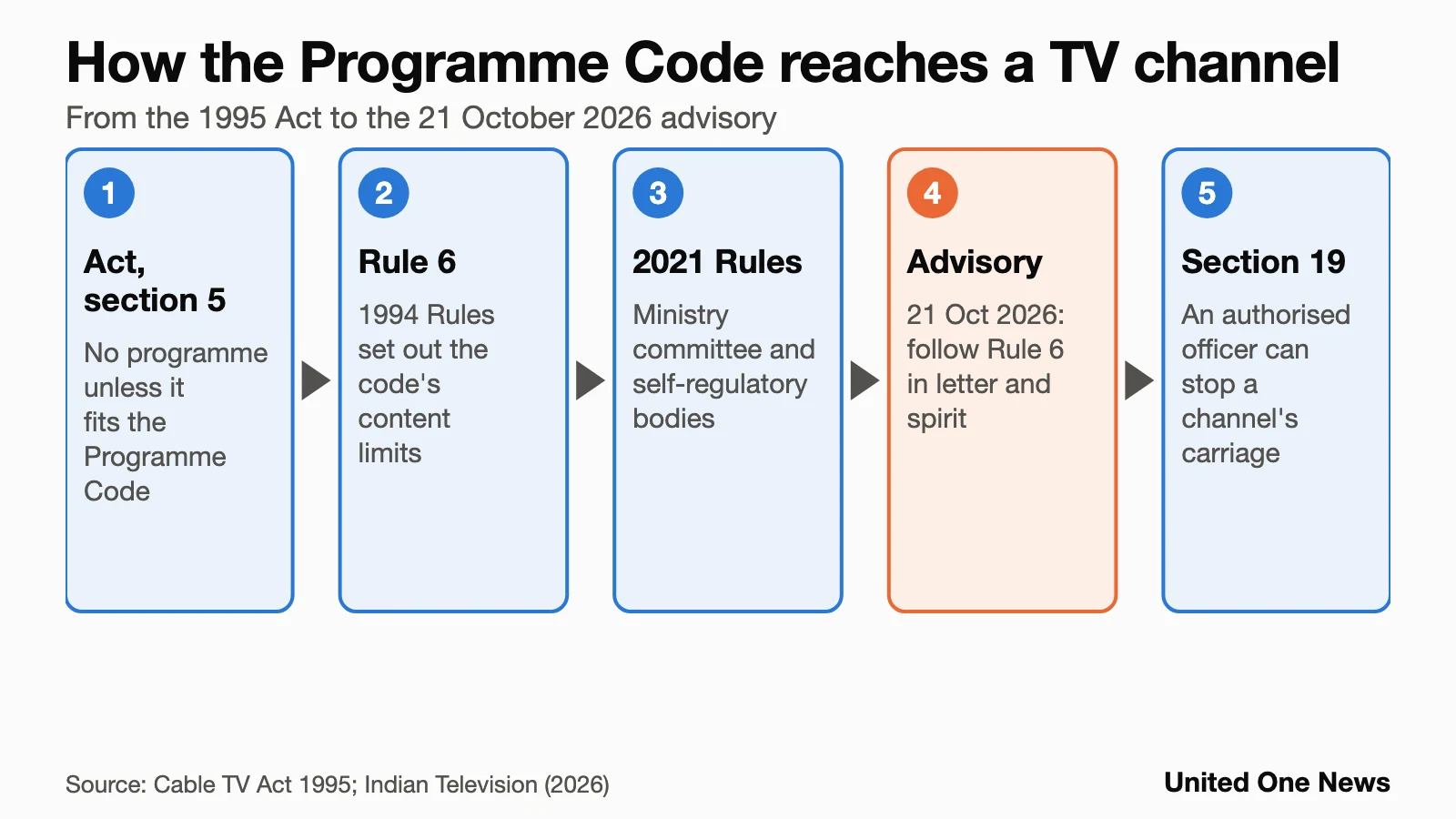
The 21 October advisory tells channels not to promote communal or anti-national attitudes and adds no new penalty. What sections 5, 19 and 20 of the 1995 Act allow, the 144 actions taken in 2021-25, and what Article 19(2) and the courts say.
Original report · Explained
Private satellite TV channels were told on 21 October 2026 that their live debates must not promote communal or anti-national attitudes, and that muting speakers, adding disclaimers or cutting the feed are the remedies, in an advisory from the Ministry of Information and Broadcasting (MIB) reported by Indian Television (Indian Television, 2026). The rules it invokes are the Programme Code: Rule 6 of the Cable Television Networks Rules, 1994, which section 5 of the Cable Television Networks (Regulation) Act, 1995 makes binding by barring any programme that does not conform to it (Indian Television, 2026; Government of India, 1995).
The advisory adds no new penalty and no blanket ban on artificial intelligence (AI), Indian Television reported. It sits on top of real powers, though. Section 19 of the Act lets an authorised officer order a cable operator not to carry a programme or channel that breaks the codes, and the Ministry took 144 actions against TV channels between 2021 and 2025, according to a Rajya Sabha reply reported by Storyboard18 (Government of India, 1995; Storyboard18, 2026).
The constitutional limit is Article 19(2), which allows reasonable restrictions on free speech only on the grounds it lists; "anti-national" is not one of the words it uses (Ministry of Law and Justice, 2024). This study note sets out the Act, the Code, the Article and the judgments, with each side's position attributed.
What it is
The Programme Code is the list of content limits every programme on cable TV must meet. It is Rule 6 of the Cable Television Networks Rules, 1994 (Indian Television, 2026). Section 5 of the 1995 Act says no programme may be transmitted unless it conforms to the prescribed Programme Code; section 6 does the same for an Advertisement Code (Government of India, 1995).
The advisory lists seven areas. The clauses it names, as Indian Television reported them (Indian Television, 2026):
- Rule 6(1)(c): telecasts must not promote communal attitudes.
- Rule 6(1)(e): telecasts must not promote anti-national attitudes.
- Rule 6(1)(h): channels must use only authentic Survey of India maps.
- Rule 6(1)(p): no live coverage of security operations.
- AI may be used only as an assistive tool.
- Victims' identities must be protected.
The advisory was signed by Deputy Secretary Arpitha S. and sent to the self-regulatory bodies set up under the 2021 Rules (Indian Television, 2026).
It is not the first reminder of its kind.
Background and timeline
In the records we read, the 21 October advisory is at least the seventh such reminder to channels since 2019.
- 1994: the Cable Television Networks Rules, with the Programme Code in Rule 6 (Indian Television, 2026).
- 1995: the Cable Television Networks (Regulation) Act (Government of India, 1995).
- 12 December 2019: an advisory against "anti-national attitudes", issued on a day of protests against the Citizenship Bill, according to headlines from that day (Google News listing, 2026).
- 17 June 2021: the Cable Television Networks (Amendment) Rules are notified, under which the Inter-Departmental Committee and the self-regulatory bodies work (Storyboard18, 2026; Indian Television, 2026).
- 9 January 2023 and 8 June 2023: earlier advisories (Indian Television, 2026).
- 5 April 2023: the Supreme Court lifts the telecast ban on MediaOne (Newslaundry, 2023).
- 9 August 2024 and 13 September 2024: further advisories (Indian Television, 2026).
- 18 November 2025: an advisory after coverage of the Red Fort blast (Storyboard18, 2025).
- 21 October 2026: the latest advisory (Indian Television, 2026).
Each of these reminders rests on the same few sections of law.
What the law says
Three sections of the Act give the government its powers, and one Article of the Constitution limits them.
- Section 5: no programme may be transmitted unless it conforms to the prescribed Programme Code (Government of India, 1995).
- Section 6: the same rule for the Advertisement Code (Government of India, 1995).
- Section 19: an authorised officer, if it is necessary in the public interest, may order a cable operator not to carry a programme or channel that does not conform to the codes, or that is likely to promote disharmony or enmity between groups on grounds of religion, race, language, caste or community, or to disturb public tranquillity (Government of India, 1995).
- Section 20: the Central Government may prohibit the operation of a cable network in areas it notifies, in the public interest (Government of India, 1995).
- Article 19(1)(a): the right to freedom of speech and expression (Ministry of Law and Justice, 2024).
- Article 19(2): the State may impose reasonable restrictions on that right only in the interests of the sovereignty and integrity of India, the security of the State, friendly relations with foreign States, public order, decency or morality, or in relation to contempt of court, defamation or incitement to an offence (Ministry of Law and Justice, 2024).
Our reading of the two texts: Rule 6(1)(e), as the advisory cites it, uses the phrase "anti-national"; Article 19(2) lists eight grounds and does not use that phrase. The reports we read do not say whether any court has ruled on Rule 6(1)(e) itself.
Institutions, committees and judgments
A Ministry committee watches compliance; the Supreme Court has set out the limits on state action against a channel.
- Inter-Departmental Committee (IDC): the Ministry committee under the 2021 Amendment Rules. Indian Television reported that it found telecasts were not always in the spirit of Rule 6 (Indian Television, 2026).
- Self-regulatory bodies: the industry bodies under the 2021 Rules, to which the advisory was sent (Indian Television, 2026).
- Authorised officer: the official who can issue a section 19 order (Government of India, 1995).
- MediaOne (5 April 2023): the Supreme Court lifted the telecast ban on the channel. It held that national security cannot be claimed out of thin air, and that relying on sealed covers left the rights at stake hollow, on paper only (Newslaundry, 2023).
How often the Ministry has acted is on the record.
The numbers
The Ministry took 144 actions against TV channels between 2021 and 2025, according to a Rajya Sabha reply of February 2026 reported by Storyboard18 (Storyboard18, 2026).
- By year: 43 in 2021, 52 in 2022, 37 in 2023, 4 in 2024 and 8 in 2025.
- By type: 35 advisories, 50 warnings, 54 orders to run apology scrolls, 3 off-air orders and 1 cancelled permission.
Two things stand out in our arithmetic. Actions fell from 52 in 2022 to 4 in 2024, a drop of more than 90%. And the types, as reported, add up to 143, one fewer than the total of 144. Apology-scroll orders were the most common single action.
Those figures are what each side can point to.
Arguments for and against
The government's case rests on the rules; the case for restraint rests on Article 19 and the courts. Each position is attributed. No broadcaster's or self-regulatory body's response to this advisory was in the reports we read.
The government's position:
- The Ministry says the rules bind channels in letter and spirit, and that its Inter-Departmental Committee found telecasts that fell short of Rule 6 (Indian Television, 2026).
- It asks for safeguards rather than new penalties: muting, disclaimers or cutting the feed in live debates, and AI only as an assistive tool (Indian Television, 2026).
- It asks channels to strengthen editorial review and train staff (Indian Television, 2026).
The limits set by the Constitution and the courts:
- Article 19(2) permits restrictions only on its listed grounds, and "anti-national" is not among the words it uses (Ministry of Law and Justice, 2024).
- In the MediaOne case, the Supreme Court said: "Critical views of the media cannot be termed anti-establishment." (Newslaundry, 2023)
- The same judgment said national security claims need a basis and criticised reliance on sealed covers (Newslaundry, 2023).
What happens next
No date is set. The advisory says violations may draw action under the Act, and the reports we read name no channel (Indian Television, 2026).
- Any action would come through the Act and the Ministry's existing tools: a section 19 order by an authorised officer, or the advisories, warnings, apology-scroll orders and off-air orders it used in 2021-25 (Government of India, 1995; Storyboard18, 2026).
- Not yet known: whether any channel is named, or whether any action follows.
Questions people are asking
What is the Programme Code under the Cable TV Act?
The content limits in Rule 6 of the Cable Television Networks Rules, 1994. Section 5 of the 1995 Act bars any programme that does not conform to them (Indian Television, 2026; Government of India, 1995).
What does Article 19(2) allow?
Reasonable restrictions on free speech only on eight listed grounds, from the sovereignty and integrity of India to incitement to an offence (Ministry of Law and Justice, 2024).
Is anti-national a ground under Article 19(2)?
The word is not in the Article's text. Its grounds include the sovereignty and integrity of India and the security of the State (Ministry of Law and Justice, 2024).
Can the government take a TV channel off air?
The Ministry issued 3 off-air orders in 2021-25, Storyboard18 reported, and section 19 lets an authorised officer order a cable operator not to carry a channel that breaks the codes (Storyboard18, 2026; Government of India, 1995).
What did the I&B ministry TV advisory of 21 October 2026 say?
That channels must not promote communal or anti-national attitudes, must not air live coverage of security operations, must use authentic Survey of India maps, and must use AI only as an assistive tool (Indian Television, 2026).
For students
Syllabus link
GS Paper II: Polity, fundamental rights and the regulation of media.
Key terms
- Programme Code: the content limits in Rule 6 of the Cable Television Networks Rules, 1994.
- Advertisement Code: the parallel code for advertisements, under section 6 of the Act.
- Authorised officer: the official who can issue a section 19 order.
- Inter-Departmental Committee (IDC): the Ministry committee under the 2021 Amendment Rules.
- Apology scroll: an on-air apology the Ministry orders a channel to run.
- Reasonable restriction: a limit on a fundamental right that must fit the grounds in Article 19(2).
- Self-regulatory body: an industry body under the 2021 Rules that receives the Ministry's advisories.
Prelims facts
- The Cable Television Networks (Regulation) Act dates from 1995.
- Section 5 requires programmes to follow the Programme Code; section 6 the Advertisement Code.
- Section 19 lets an authorised officer stop a programme or channel; section 20 lets the Centre prohibit a cable network in notified areas.
- The Programme Code is Rule 6 of the 1994 Rules.
- Article 19(2) lists eight grounds for reasonable restrictions on speech.
- The Amendment Rules under which the IDC works were notified on 17 June 2021.
(Government of India, 1995; Indian Television, 2026; Ministry of Law and Justice, 2024; Storyboard18, 2026)
Mains practice question (250 words)
The Ministry of Information and Broadcasting's advisory of 21 October 2026 asks TV channels not to promote anti-national attitudes under the Programme Code. Examine how far such content rules can be reconciled with Article 19(1)(a) and the grounds of restriction in Article 19(2), with reference to judicial pronouncements.
Prelims practice question
Which of the following is NOT a ground for reasonable restriction listed in Article 19(2) of the Constitution? (a) Friendly relations with foreign States (b) Public order (c) Anti-national attitudes (d) Incitement to an offence. Answer: (c).
How we did this
On 21 October 2026 we read the text of the Cable Television Networks (Regulation) Act, 1995 on WIPO Lex and Article 19 of the Constitution of India, and set the advisory's clauses, as Indian Television reported them, against both. We took the 2021-25 action figures from Storyboard18 and checked that they add up: the yearly figures do, while the types come to 143. We counted the advisories since 2019 from Indian Television, Storyboard18's 2025 report and a Google News listing, and took the MediaOne judgment from Newslaundry.
Headlines framed the advisory differently: The Hindu led on its warning against anti-national attitudes, the Times of India on communal rhetoric, violent visuals and AI, and Indian Television on Programme Code violations. We did not read the full texts of The Hindu's or the Times of India's reports. We found no previous-year UPSC question we could verify, so none is listed. The hero image is a flow chart we drew from the Act and the advisory; upload it with the story.
References
- Fazal, I. (2026) MIB issued 144 notices, warnings and off air orders to TV channels in five years. Storyboard18. Available at: MIB issued 144 notices, warnings and off air orders (Accessed: 21 October 2026).
- Google News (2026) Headlines of The Hindu, Times of India and Scroll.in, 21 October 2026 and 12 December 2019. Google News. Available at: Google News listing (Accessed: 21 October 2026).
- Government of India (1995) The Cable Television Networks (Regulation) Act, 1995. WIPO Lex. Available at: The Cable Television Networks (Regulation) Act, 1995 (Accessed: 21 October 2026).
- Indian Television (2026) MIB warns TV channels against Programme Code violations in fresh advisory. Indian Television Dot Com. Available at: MIB warns TV channels against Programme Code violations (Accessed: 21 October 2026).
- Ministry of Law and Justice (2024) The Constitution of India (as on 1 May 2024). Government of India. Available at: The Constitution of India (Accessed: 21 October 2026).
- Newslaundry (2023) Critical views cannot be termed anti-establishment: Supreme Court lifts telecast ban on MediaOne. Newslaundry. Available at: Supreme Court lifts telecast ban on MediaOne (Accessed: 21 October 2026).
- Storyboard18 (2025) I&B Ministry warns TV channels against airing content that could incite violence, compromise National Security. Storyboard18. Available at: I&B Ministry warns TV channels (Accessed: 21 October 2026).
This story was produced, reviewed, edited and verified by the reporter before publication, with AI assistance where required.
Covered by 10 outlets across the spectrum: 20% left, 30% center, 40% right.
Who is covering this story
- Left-leaning (2): The Hindu, Newslaundry
- Center (3): Odisha News, Odisha Breaking News, Odisha Latest N, Tribune India, Google News IPL
- Right-leaning (3): Storyboard18, Legislative Department, Government of India, Indian Television Dot Com
- Not yet rated (1): WIPO Lex
Sources
- I&B Ministry advisory warns TV channels against promoting ‘anti-national’ attitudes — The Hindu (left-leaning) ·
- Govt Warns TV Channels Over Programme Code Violations, Urges Caution In AI Use — Odisha News, Odisha Breaking News, Odisha Latest N (center, AI-estimated) ·
- Avoid communal, anti-national content, govt tells TV channels — Tribune India (center) ·
- ‘Critical views cannot be termed anti-establishment’: Supreme Court lifts telecast ban on MediaOne — Newslaundry (left-leaning) ·
- I&B Ministry warns TV channels against airing content that could incite violence, compromise National Security — Storyboard18 (right-leaning) ·
- Breaking: MIB issued 144 notices, warnings and off air orders to TV channels in five years — Storyboard18 (right-leaning) ·
- Article from Legislative Department — Legislative Department, Government of India (right-leaning) ·
- Article from WIPO Lex — WIPO Lex (not yet rated) ·
- MIB warns TV channels against Programme Code violations in fresh advisory — Indian Television Dot Com (right-leaning) ·
- Article from Google News listing — Google News IPL (center, AI-estimated) ·