One Nation One Election bill: Article 82A lets ECI seek a later Assembly poll
Published
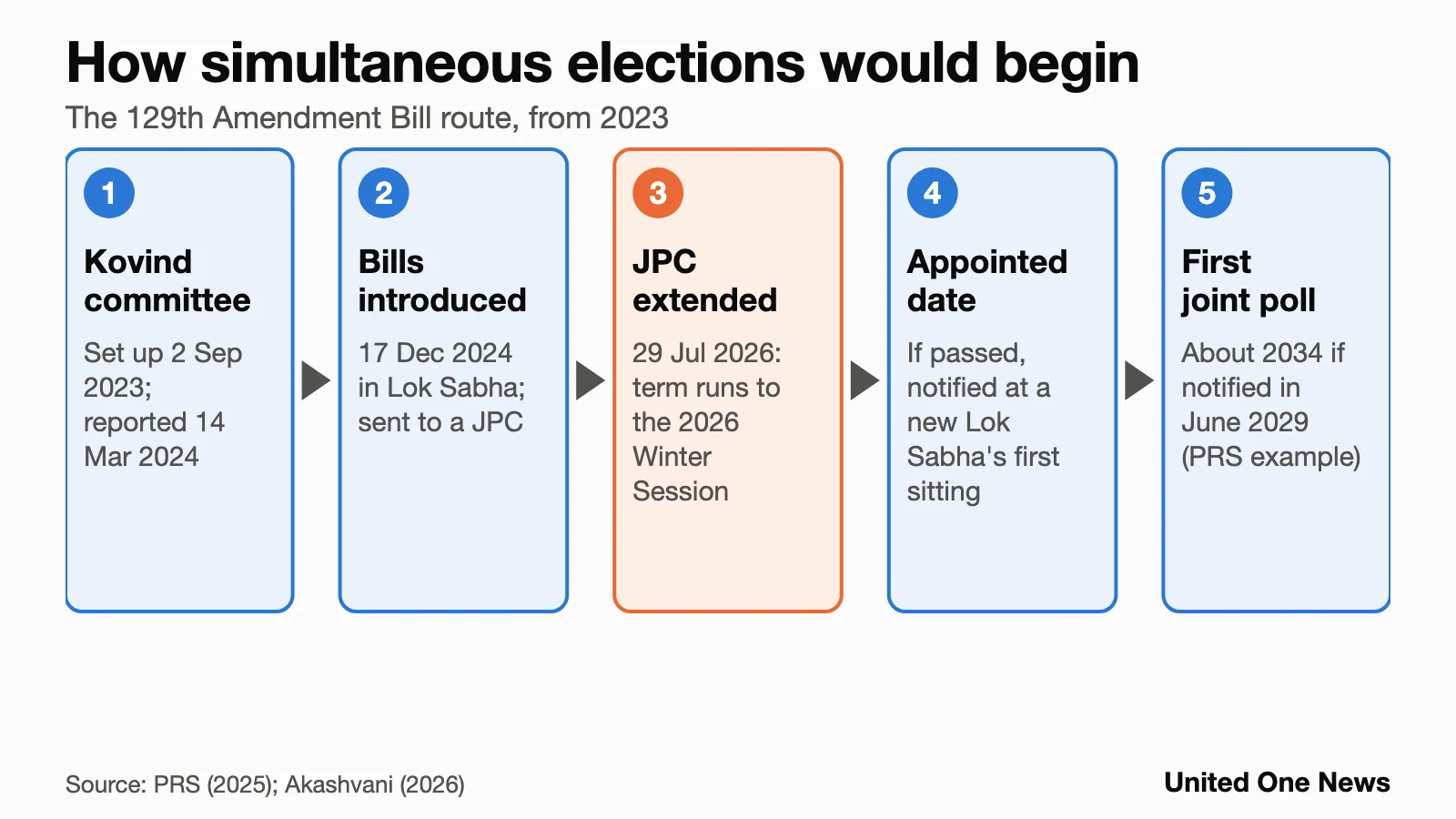
The committee examining the Bills now has until the 2026 Winter Session to report. What the 129th Amendment Bill changes, the powers it gives the Election Commission, why the first joint poll could be about 2034, and the arguments on both sides.
Original report · Explained
The Joint Parliamentary Committee (JPC) examining the One Nation One Election Bills now has until the first day of the last week of the 2026 Winter Session to report, after the Lok Sabha extended its term on 29 July 2026, All India Radio reported (Akashvani News, 2026). The powers at stake are in the main Bill, introduced on 17 December 2024: a new Article 82A under which the Election Commission of India (ECI) "shall conduct" simultaneous elections to the Lok Sabha and the state Assemblies, and may recommend to the President that a state's Assembly poll be held later (Ministry of Law and Justice, 2024).
The committee's latest attempt to consult the judiciary did not go ahead. On 1 October 2026 the Supreme Court said there would be no meeting with the JPC, after Kapil Sibal said the panel had planned to meet the Chief Justice of India and judges on 6 October. Sibal called the plan unprecedented: "This is a joke on the Constitution." (Bar and Bench, 2026) JPC chairman P.P. Chaudhary said the meeting was cancelled over members' schedules (The Leaflet, 2026).
This study note sets out what the Bills would change, how simultaneous polls would start, the committees behind the idea, and the arguments on both sides, each attributed.
What it is
Simultaneous elections means electing the Lok Sabha and all the state Assemblies together (Ministry of Law and Justice, 2024). Two Bills would bring it about. Both were introduced in the Lok Sabha on 17 December 2024 and sent to a JPC chaired by P.P. Chaudhary (PRS Legislative Research, 2025; The Leaflet, 2026):
- The Constitution (129th Amendment) Bill, 2024, Bill No. 275 of 2024, for the Lok Sabha and the state Assemblies.
- The Union Territories Laws (Amendment) Bill, 2024, for the Union Territories that have Assemblies.
In one line, the ECI's new powers would be to run the joint polls and to recommend a later date for a state that cannot vote with the rest (Ministry of Law and Justice, 2024).
India has held joint polls before.
Background and timeline
India's first four general elections were held together with Assembly polls, and the cycle broke in the late 1960s.
- 1951-52, 1957, 1962 and 1967: Lok Sabha and Assembly elections are held together (Ministry of Law and Justice, 2024).
- 1968-69: early dissolutions break the cycle; in 1970 the Lok Sabha is dissolved early (PRS Legislative Research, 2025).
- Earlier reviews: the Law Commission's 170th report and a parliamentary Standing Committee's 79th report back the idea (Ministry of Law and Justice, 2024).
- 2 September 2023: the High-Level Committee chaired by Ram Nath Kovind is set up (Ministry of Law and Justice, 2024).
- 14 March 2024: the committee reports to the President (Ministry of Law and Justice, 2024).
- 17 December 2024: the two Bills are introduced and sent to the JPC (PRS Legislative Research, 2025).
- 11 December 2025: the Lok Sabha extends the JPC's term to the last week of the 2026 Budget session (The Tribune, 2025).
- 29 July 2026: the Lok Sabha extends it again, to the first day of the last week of the 2026 Winter Session (Akashvani News, 2026).
- 1 October 2026: the Supreme Court says there will be no meeting with the JPC (Bar and Bench, 2026).
- 19 October 2026: the JPC holds a hearing in Goa, according to a headline (Google News listing, 2026).
The Bill's text explains why the start date matters so much.
What the law says
The 129th Amendment Bill adds one Article and amends three others (Ministry of Law and Justice, 2024).
- New Article 82A: the President notifies an appointed date. Assemblies elected after that date end with the Lok Sabha's full term. The ECI "shall conduct" simultaneous general elections. If the ECI thinks an Assembly poll cannot be held together with the rest, it may recommend a later date to the President; the deferred Assembly's term still ends with the Lok Sabha's.
- Articles 83 and 172: new clauses define the full term (five years from the first sitting) and the unexpired term. A House elected mid-term after an early dissolution serves only the remainder.
- Article 327: adds the words "conduct of simultaneous elections".
- The Union Territories Laws (Amendment) Bill covers the Union Territory Assemblies and has no deferral clause (PRS Legislative Research, 2025).
The appointed date is the trigger. If the Bills pass, the President would notify it on the date of the first sitting of the Lok Sabha after a general election. In PRS Legislative Research's example, a notification in June 2029 would put the first joint poll at about 2034 (PRS Legislative Research, 2025).
Institutions and committees
Two committees shape the Bills: the Kovind panel that proposed the scheme and the JPC now examining it.
- High-Level Committee, chaired by Ram Nath Kovind (set up 2 September 2023, reported 14 March 2024): recommended Lok Sabha and Assembly elections together, with local body polls within 100 days; an amendment to Article 325 for a single electoral roll; and a new Article 324A for local bodies (PRS Legislative Research, 2025; Drishti IAS, 2024).
- Joint Parliamentary Committee: 39 members, chaired by P.P. Chaudhary (The Leaflet, 2026).
- Law Commission (170th report) and a parliamentary Standing Committee (79th report): earlier backers of the idea (Ministry of Law and Justice, 2024).
- Supreme Court: said on 1 October 2026 that there would be no meeting with the JPC. The Leaflet reported that the visit was cancelled after concerns over a breach of the separation of powers, and that the court's secretary general warned the amendments could face judicial review (Bar and Bench, 2026; The Leaflet, 2026).
The cost argument for the Bills rests on figures from these earlier reviews.
The numbers
The government's own cost estimate in the debate is more than a decade old.
- About ₹4,500 crore: government spending on Lok Sabha and Assembly polls, an ECI estimate cited by a Standing Committee in 2015 (PRS Legislative Research, 2025).
- 0.25% of the 2015-16 Union budget and 0.03% of GDP: the same sum as a share (PRS Legislative Research, 2025).
- ₹2,378 crore: what seven national parties reported spending in the 2019 Lok Sabha polls (PRS Legislative Research, 2025).
- 39: members of the JPC (The Leaflet, 2026).
- 4: general elections held together with Assembly polls, from 1951-52 to 1967 (Ministry of Law and Justice, 2024).
- 100 days: the gap the Kovind committee proposed between the main polls and local body elections (PRS Legislative Research, 2025).
- About 2034: the first joint poll in PRS's example, if the appointed date is notified in June 2029 (PRS Legislative Research, 2025).
How those numbers weigh against the Bill's risks is where the two sides part.
Arguments for and against
Supporters point to cost and the pause in government work during polls; critics point to short terms and an open-ended power to defer. Each argument is attributed.
For:
- The Bill's statement of objects says elections are costly and long, and that the Model Code of Conduct (MCC) halts development work (Ministry of Law and Justice, 2024).
- Three former Chief Justices of India support simultaneous polls, PTI reported, while flagging issues in the Bill (The Tribune, 2025).
- Former Chief Justice D.Y. Chandrachud said the Bill does not breach the basic structure of the Constitution (The Tribune, 2025).
Against:
- PRS Legislative Research notes that an Assembly could get a very short term (PRS Legislative Research, 2025).
- PRS says the threshold for deferring a state's poll is lower than under Article 356, has no time limit, and could leave a state without an Assembly (PRS Legislative Research, 2025).
- Chandrachud said the ECI's powers under the Bill lack guidelines (The Tribune, 2025).
What happens next
The JPC's report is due by the first day of the last week of the 2026 Winter Session, unless the Lok Sabha extends its term again (Akashvani News, 2026).
- The Winter Session dates, and whether the report will be tabled, are not yet known.
- Timing: Manish Tewari said on 26 August 2026 that the Bill talks of 2034, not 2029, and a former election commissioner said on 20 October that 2029 is possible "if states agree", according to headlines (Google News listing, 2026).
- Ways forward suggested by former Chief Justices: Justice Lalit proposed rolling the scheme out in stages, and Chandrachud said the Constitution should define when the ECI may defer a poll (The Tribune, 2025).
Questions people are asking
What powers does the simultaneous elections bill give the ECI?
Under the new Article 82A, the ECI would conduct simultaneous elections and could recommend to the President a later date for a state's Assembly poll (Ministry of Law and Justice, 2024).
When could simultaneous elections begin?
In PRS Legislative Research's example, about 2034, if the appointed date is notified in June 2029 (PRS Legislative Research, 2025).
What is the appointed date in the One Nation One Election bill?
The date the President notifies to start the scheme, on the first sitting of the Lok Sabha after a general election (Ministry of Law and Justice, 2024; PRS Legislative Research, 2025).
Who chairs the JPC on One Nation One Election?
P.P. Chaudhary. The committee has 39 members (The Leaflet, 2026).
When is the JPC report due?
By the first day of the last week of the 2026 Winter Session, after the Lok Sabha extended its term on 29 July 2026 (Akashvani News, 2026).
For students
Syllabus link
GS Paper II: Polity, elections and constitutional amendments.
Key terms
- Simultaneous elections: electing the Lok Sabha and all state Assemblies together.
- Appointed date: the date the President notifies to start the scheme.
- Full term: five years from the date of a House's first sitting.
- Unexpired term: the remainder of a full term, served by a House elected after an early dissolution.
- Article 82A: the new Article that sets out simultaneous elections and the ECI's power to recommend a deferral.
- Joint Parliamentary Committee (JPC): a committee with members from both Houses of Parliament.
- Model Code of Conduct (MCC): the code that applies during polls, which the Bill says halts development work.
Prelims facts
- The Constitution (129th Amendment) Bill, 2024 is Bill No. 275 of 2024.
- It was introduced in the Lok Sabha on 17 December 2024.
- It inserts a new Article 82A and amends Articles 83, 172 and 327.
- The Kovind High-Level Committee was set up on 2 September 2023 and reported on 14 March 2024.
- The JPC is chaired by P.P. Chaudhary and has 39 members.
- Lok Sabha and Assembly polls were held together in 1951-52, 1957, 1962 and 1967.
(Ministry of Law and Justice, 2024; PRS Legislative Research, 2025; The Leaflet, 2026)
Mains practice question (250 words)
The Constitution (129th Amendment) Bill, 2024 would let the Election Commission recommend deferring a state's Assembly election, with no time limit. Critically examine the Bill's scheme for simultaneous elections in the light of federalism and the Election Commission's powers.
Prelims practice question
Consider the following statements about the Constitution (129th Amendment) Bill, 2024: (1) It inserts a new Article 82A. (2) It was introduced in the Rajya Sabha on 17 December 2024. (3) The High-Level Committee whose report preceded it was chaired by Ram Nath Kovind. Which of the statements given above are correct? (a) 1 and 2 only (b) 1 and 3 only (c) 2 and 3 only (d) 1, 2 and 3. Answer: (b). The Bill was introduced in the Lok Sabha.
How we did this
On 21 October 2026 we read the text of the 129th Amendment Bill_Bill,_2024.pdf) and PRS Legislative Research's analysis, and built the route from the Kovind committee to a first joint poll from their dates. We traced the JPC's record through All India Radio and The Tribune, the planned meeting with judges through Bar and Bench and The Leaflet, the former Chief Justices' views through The Tribune, and the Kovind committee's recommendations through Drishti IAS. The Goa hearing and the remarks on 2029 and 2034 come from headlines in a Google News listing; we did not read those reports in full.
Bar and Bench led on the Supreme Court's refusal of the meeting; The Leaflet led on the separation-of-powers concern. We found no previous-year UPSC question we could verify, so none is listed. The hero image is a flow chart we drew from the Bill and PRS dates; upload it with the story.
References
- Akashvani News (2026) Lok Sabha extends tenure of JPC on One Nation, One Election. All India Radio. Available at: Lok Sabha extends tenure of JPC on One Nation, One Election (Accessed: 21 October 2026).
- Drishti IAS (2024) High-Level Committee Report on Simultaneous Elections. Drishti IAS. Available at: High-Level Committee Report on Simultaneous Elections (Accessed: 21 October 2026).
- Google News (2026) Headlines of Prudent Media Goa, Bhaskar English and ANI, 2026. Google News. Available at: Google News listing (Accessed: 21 October 2026).
- Ministry of Law and Justice (2024) The Constitution (129th Amendment) Bill, 2024, Bill No. 275 of 2024. Lok Sabha. Available at: The Constitution (129th Amendment) Bill, 2024_Bill,_2024.pdf) (Accessed: 21 October 2026).
- PRS Legislative Research (2025) The Constitution (129th Amendment) Bill, 2024. PRS Legislative Research. Available at: The Constitution (129th Amendment) Bill, 2024 (Accessed: 21 October 2026).
- PTI (2025) Lok Sabha extends tenure of committee examining One Nation, One Election Bills. The Tribune. Available at: Lok Sabha extends tenure of committee (Accessed: 21 October 2026).
- PTI (2025) 3 ex-CJIs support simultaneous polls, but flag issues in Bill. The Tribune. Available at: 3 ex-CJIs support simultaneous polls (Accessed: 21 October 2026).
- Roy, D. (2026) One Nation, One Election: Supreme Court says no parliamentary panel meeting with CJI, judges. Bar and Bench. Available at: Supreme Court says no parliamentary panel meeting (Accessed: 21 October 2026).
- The Leaflet (2026) JPC on One Nation, One Election Cancels SC visit Following Concerns Over Breach of Separation of Powers. The Leaflet. Available at: JPC on One Nation, One Election Cancels SC visit (Accessed: 21 October 2026).
This story was produced, reviewed, edited and verified by the reporter before publication, with AI assistance where required.
Covered by 9 outlets across the spectrum: 11% left, 78% center, 11% right.
Who is covering this story
- Left-leaning (1): The Leaflet
- Center (5): Google News IPL, PRS Legislative Research, Bar & Bench, Drishti IAS, Tribune India
- Right-leaning (1): All India Radio / newsonair
Sources
- Article from Google News listing — Google News IPL (center, AI-estimated) ·
- Lok Sabha extends tenure of JPC on One Nation, One Election — All India Radio / newsonair (right-leaning, AI-estimated) ·
- The Constitution (129th Amendment) Bill, 2024 [Simultaneous Elections/One Nation One Election] — PRS Legislative Research (center) ·
- Constitution (One Hundred and Twenty Ninth Amendment) Bill, 2024.pdf — PRS Legislative Research (center) ·
- JPC on 'One Nation, One Election' Cancels SC visit Following Concerns Over Breach of Separation of Powers — The Leaflet (left-leaning) ·
- One Nation, One Election: Supreme Court says no parliamentary panel meeting with CJI, judges — Bar & Bench (center) ·
- High level committee report on simultaneous elections — Drishti IAS (center, AI-estimated) ·
- 3 ex-CJIs support simultaneous polls, but flag issues in Bill - The Tribune — Tribune India (center) ·
- Lok Sabha extends tenure of committee examining One Nation, One Election Bills - The Tribune — Tribune India (center) ·