Ladakh statehood and Sixth Schedule: the 371-K offer vs the Article 244(2) route
Published
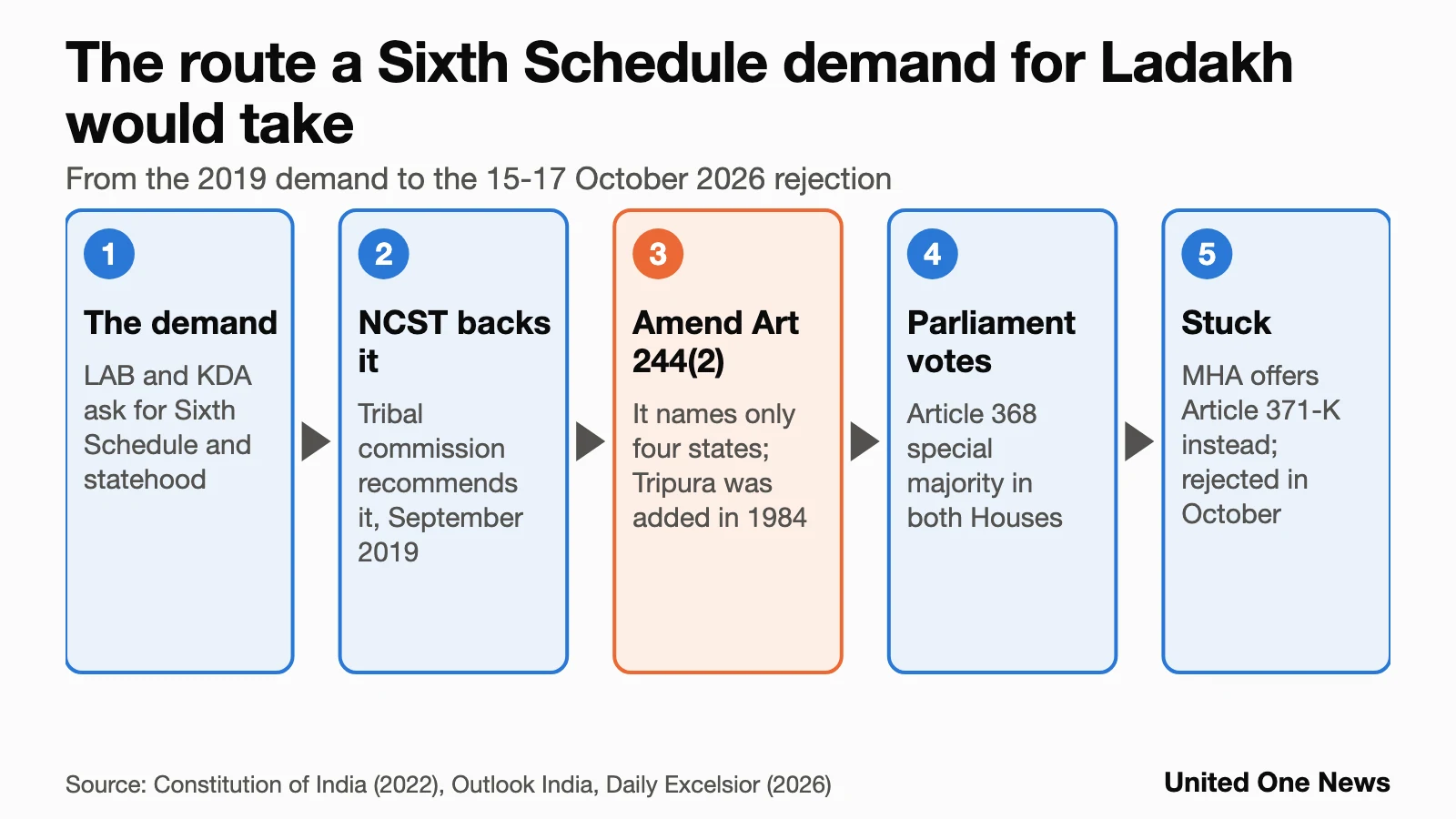
The Home Ministry's 15 October draft offers Ladakh an elected body under a new Article 371-K, not the Sixth Schedule. We read the Constitution: what a Sixth Schedule council could do, and why Parliament would need a special majority to grant it.
Original report · Explained
Ladakh's leaders want Sixth Schedule powers over land and custom; the Centre is offering Article 371-K instead. On 15 October 2026 the Home Ministry (MHA) handed Ladakh's two leading bodies, the Leh Apex Body (LAB) and the Kargil Democratic Alliance (KDA), a 32-page draft in Leh that rules out statehood and offers a "sui generis" elected body under a new Article 371-K, Daily Excelsior reported (Daily Excelsior, 2026). LAB and KDA rejected it in about two hours (Indian Opinion, 2026).
The Sixth Schedule, the protection Ladakh has asked for since 2019, does not appear in the offer as Outlook described it. We read the Constitution to answer what the press coverage and two editorials leave out: what the Schedule would give Leh and Kargil, and what Parliament would have to change to extend it.
What the Centre put on the table on 15 October
The draft offers a directly elected UT-level body, a new Article 371-K, and then a regulation under Article 240, not statehood or a legislature, Daily Excelsior reported (Daily Excelsior, 2026). It refuses the name "Government of Ladakh" and adds a Chief Executive Secretary.
- Chief Secretary Ashish Kundra said the route is "a constitutional amendment and a subsequent regulation under Article 240".
- He said the draft was not final: "It was a draft proposal and they could have given suggestions."
- LAB's Chering Dorjay Lakruk says the ministry backtracked on a 22 May in-principle deal over the Chief Secretary's confidential reports.
That leaves the demand the offer skips.
What a Sixth Schedule council could do
A Sixth Schedule district council can make laws on land, forests, village life and custom, but needs the Governor's assent, under the Constitution's text (Government of India, 2022). Its main features:
- Up to 30 members, of whom up to 4 may be nominated.
- Lawmaking on land, forests other than reserved forests, canals, village administration, inheritance, marriage and divorce, and social customs.
- Every such law needs the Governor's assent.
Compare that with what Leh and Kargil have now. Their hill councils were recast by an October 2026 regulation as district-level panchayats under the J&K Panchayati Raj Act 1989, with 7 to 24 elected seats, up to 4 nominated, and a five-year term, Daily Excelsior reported. Separately, local reservation in government jobs for Scheduled Tribes has risen from 10% in 2019 to 84%, Kundra said; Wikipedia puts it at 85% (Wikipedia, 2026).
The practical difference is lawmaking over land and custom. That is the "say over land, resources and culture" the Deccan Chronicle editorial describes (Deccan Chronicle, 2026).
Why Parliament cannot simply add Ladakh
Article 244(2) applies the Sixth Schedule only to tribal areas "in the States of Assam, Meghalaya, Tripura and Mizoram" (Government of India, 2022). Paragraph 20 lists areas in those four states only. Tripura was added by the 49th Amendment in 1984, which rewrote Article 244(2) itself.
Paragraph 21 lets Parliament amend the Schedule by ordinary law. Our reading, not any source's: because Ladakh is a Union Territory, not a state, Article 244(2) would itself need an Article 368 amendment. That means a majority of each House's total membership and two-thirds of members present and voting. Article 244 is not among the provisions that also need ratification by state legislatures.
The Tripura precedent shows it can be done, but only with that two-House majority.
How the talks reached this point
The dispute is seven years old. Our timeline, built from Wikipedia unless marked (Wikipedia, 2026):
- September 2019: the National Commission for Scheduled Tribes recommends the Sixth Schedule, Outlook reports (single source).
- 31 October 2019: Ladakh becomes a UT without a legislature.
- January 2023: the MHA's high-powered committee on Ladakh is set up.
- 24 September 2025: violence in Leh; 4 people die (Greater Kashmir, 2026).
- 26 September 2025: Sonam Wangchuk is detained under the National Security Act; he is freed on 14 March 2026.
- 22 May and 9 September 2026: talks; Article 371-K is floated in September (Outlook India, 2026).
- 15 October 2026: the 32-page draft is given in Leh and rejected.
What the editorials argue
Both papers want a settlement; they put the burden on opposite sides.
- Deccan Chronicle (19 October) argues that refusing statehood or a legislature means Ladakh leaves the usual constitutional road, and that a model imposed without local acceptance deepens alienation. It asks both sides for statesmanship: "A peaceful, empowered and confident Ladakh is not merely a regional aspiration; it is a national necessity."
- Greater Kashmir (20 October, Arun Joshi) argues the Centre will not give Ladakh what it has not given Jammu and Kashmir since 2019. It cites Kargil, Galwan and China's stance, and says Ladakh's leaders never specified the powers they want: "Strategic solidarity must be unconditional."
Neither says what Sixth Schedule status would actually change, or that extending it needs a constitutional amendment.
The two sides
The Centre's position, through Kundra, is that the draft was open to suggestions and that a constitutional amendment plus an Article 240 regulation is the route. LAB and KDA say a body without legislative powers is not what they asked for, and that the ministry went back on the May understanding. The National Commission for Scheduled Tribes backed the Sixth Schedule in 2019, by Outlook's account.
What happens next
LAB said on 18 October it would reply in writing; another report says 22 October (Daily Excelsior, 2026). Kundra said the sides would meet again in 10 to 15 days, or in the "coming months" (Indian Opinion, 2026). No date is fixed.
Questions people are asking
What would Sixth Schedule status change for Ladakh?
Councils could make laws on land, forests, inheritance and custom, subject to the Governor's assent (Government of India, 2022).
Can Parliament add Ladakh to the Sixth Schedule by simple majority?
Not on our reading. Article 244(2) names four states, so a UT would need a constitutional amendment with special majorities.
Is statehood on offer for Ladakh?
No. The 15 October draft rules it out and offers a "sui generis" body under Article 371-K (Daily Excelsior, 2026).
What is Article 371-K?
A proposed new article giving Ladakh a directly elected UT-level body, followed by a regulation under Article 240 (Outlook India, 2026).
References
- Deccan Chronicle (2026) DC Edit | Bridge Ladakh's Trust Deficit. Deccan Chronicle. Available at: DC Edit | Bridge Ladakh's Trust Deficit (Accessed: 20 October 2026).
- Joshi, A. (2026) Ladakh and Delhi Should Forge Strategic Solidarity. Greater Kashmir. Available at: Ladakh and Delhi Should Forge Strategic Solidarity (Accessed: 20 October 2026).
- Pargal, S. (2026) MHA rejects terminology Govt of Ladakh; CES, not CS to be under UT-level body head. Daily Excelsior. Available at: MHA rejects terminology Govt of Ladakh (Accessed: 20 October 2026).
- Deccan Chronicle (2026) No State Tag for Ladakh, Says Centre. Deccan Chronicle. Available at: No State Tag for Ladakh, Says Centre (Accessed: 20 October 2026).
- Indian Opinion (2026) Ladakh bodies reject MHA draft, chief secretary says 'unfortunate'. Indian Opinion. Available at: Ladakh bodies reject MHA draft (Accessed: 20 October 2026).
- Outlook India (2026) What Is Article 371(K), And How Could It Change Ladakh's Governance? Outlook India. Available at: What Is Article 371(K) (Accessed: 20 October 2026).
- Wikipedia (2026) Ladakh protests. Wikimedia Foundation. Available at: Ladakh protests (Accessed: 20 October 2026).
- Government of India (2022) The Constitution of India [as on May 2022]. Legislative Department. Available at: The Constitution of India (Accessed: 20 October 2026).
How we did this
We read Article 244, Article 368 and paragraphs 1 to 21 of the Sixth Schedule in the Legislative Department's Constitution of India (May 2022 edition), and set them against the 15 October draft as reported by Daily Excelsior, Indian Opinion and Outlook India between 16 and 20 October 2026. We could not read the draft itself. We opened both editorials in full, summarised them in our own words and quoted once from each. The view that Article 244(2) needs an Article 368 amendment is our reading of the text, not a court's. The timeline is ours, built mainly from Wikipedia. The hero is a flow chart of the route a Sixth Schedule demand would take.
This story was produced, reviewed, edited and verified by the reporter before publication, with AI assistance where required.
Covered by 8 outlets across the spectrum: 38% left, 25% center, 38% right.
Who is covering this story
- Left-leaning (3): Indian Opinion, Greater Kashmir, Outlook India
- Center (2): Wikipedia, Daily Excelsior
- Right-leaning (2): Legislative Department, Government of India, Deccan Chronicle
Sources
- Article from Legislative Department, Government of India — Legislative Department, Government of India (right-leaning) ·
- Ladakh protests - Wikipedia — Wikipedia (center) ·
- Ladakh bodies reject MHA draft, chief secretary says ‘unfortunate’ — Indian Opinion (left-leaning) ·
- MHA rejects terminology Govt of Ladakh; CES, not CS to be under UT-level body head - Daily Excelsior — Daily Excelsior (center) ·
- No State Tag for Ladakh, Says Centre — Deccan Chronicle (right-leaning) ·
- DC Edit |Bridge Ladakh’s Trust Deficit — Deccan Chronicle (right-leaning) ·
- Ladakh and Delhi Should Forge Strategic Solidarity — Greater Kashmir (left-leaning, AI-estimated) ·
- What Is Article 371(K), And How Could It Change Ladakh’s Governance? | Outlook India — Outlook India (left-leaning) ·