Uniform Civil Code in Assam: assent on 29 September, Scheduled Tribes exempt
Published
Assam became the third state with its own code, after Uttarakhand and Gujarat, and Maharashtra is now drafting one. What Article 44 says, how the three codes differ on residence, live-ins and penalties, and the arguments on both sides.
Original report · Explained
Maharashtra is asking citizens about marriage, live-in relationships and halala as it prepares a Uniform Civil Code (UCC), according to an Indian Express headline of 18 October 2026 (Google News listing, 2026). In Assam, the code is already law: its UCC Act received the President's assent on 29 September 2026, after the Assembly passed the Bill in May, making Assam the third state with such a code after Uttarakhand and Gujarat (The Federal, 2026; Drishti IAS, 2026).
Assam's code bans polygamy and bigamy, gives men and women equal shares when a person dies without a will, exempts Scheduled Tribes, and repeals the Assam Compulsory Registration of Muslim Marriages and Divorces Act, 2024, Drishti IAS reported, citing The Hindu (Drishti IAS, 2026).
The short answer for students: Article 44 of the Constitution asks the State to "endeavour to secure" a uniform civil code for citizens, but as a Directive Principle it cannot be enforced in court (Ministry of Law and Justice, 2024; Drishti IAS, 2026). Three states have now passed their own codes, and they differ from each other in important ways (The Federal, 2026).
What it is
A uniform civil code is one set of civil rules, on matters such as marriage and inheritance, for all citizens, in place of personal laws that vary by religion (Drishti IAS, 2026).
- Article 44 sits in Part IV of the Constitution, the Directive Principles of State Policy (Ministry of Law and Justice, 2024).
- Goa has the only long-standing state civil code, the Goa Civil Code (Drishti IAS, 2026).
- Uttarakhand's code has operated since 27 January 2025 and was amended in 2026 (The Federal, 2026).
- Gujarat's UCC Act received presidential assent on 17 September 2026, and Assam's on 29 September 2026; both were reported publicly on 2-3 October (The Federal, 2026; Google News listing, 2026).
The idea is as old as the Constitution, but the state codes are new.
Background and timeline
For four decades the debate ran through the Supreme Court; since 2025 it has moved to state legislatures.
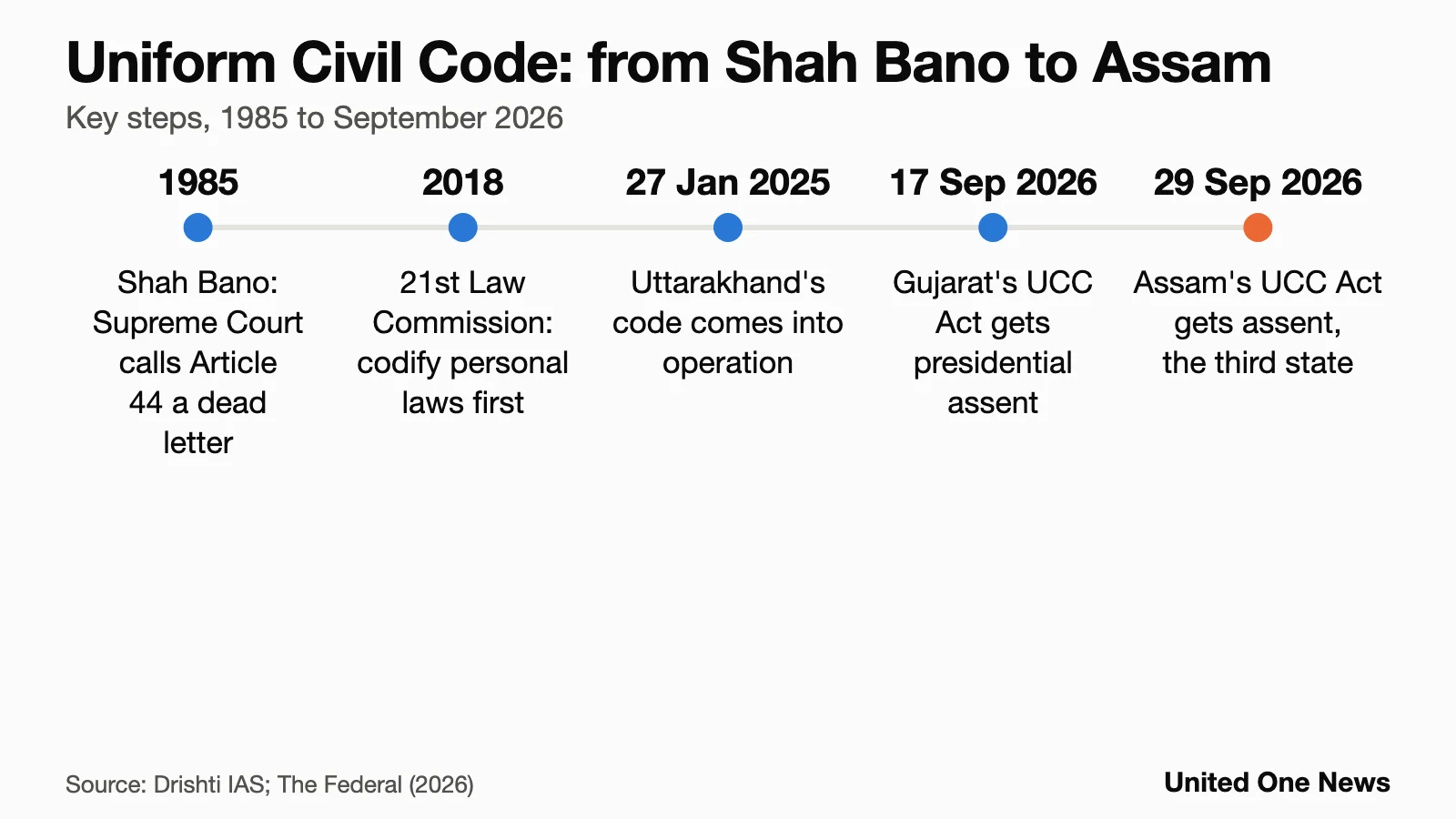
- 1985: in Shah Bano, the Supreme Court says "Article 44 has remained a dead letter" (Drishti IAS, 2026).
- 1995, 2003 and 2017: the court returns to the subject in Sarla Mudgal, John Vallamattom and Shayara Bano (Drishti IAS, 2026).
- 2017: the Puttaswamy judgment recognises privacy as part of Article 21 (Drishti IAS, 2026).
- 2018: the 21st Law Commission advises codifying existing personal laws first (Drishti IAS, 2026).
- 2019: the Supreme Court holds up Goa's civil code as a model (Drishti IAS, 2026).
- 27 January 2025: Uttarakhand's code comes into operation (The Federal, 2026).
- May 2026: Assam's Assembly passes its UCC Bill (Drishti IAS, 2026).
- July 2026: Maharashtra forms a seven-member panel under Justice Ranjana Desai to draft a code (Scroll, 2026).
- 11 July and 21 July 2026: headlines report a high-level committee in West Bengal and a Madhya Pradesh cabinet nod to a Bill (Google News listing, 2026).
- 17 September and 29 September 2026: Gujarat's and Assam's Acts receive assent (The Federal, 2026).
- 26 September 2026: a headline reports that a UCC is unlikely in Uttar Pradesh before its polls (Google News listing, 2026).
- 18 October 2026: Maharashtra asks citizens for their views, an Indian Express headline reports (Google News listing, 2026).
What each state has written into law is set out below.
What the law says
Article 44 sets the goal; other parts of the Constitution set the limits, and the three state codes differ on the details.
The Constitution (Ministry of Law and Justice, 2024; Drishti IAS, 2026):
- Article 44 (Part IV): the State shall endeavour to secure a uniform civil code for citizens throughout India; as a Directive Principle, it is not enforceable in court.
- Articles 25 to 28: the freedom of religion.
- Article 21: the right to privacy, as read in Puttaswamy (2017).
- The Sixth Schedule and Articles 371A and 371G: protect tribal customs.
The state codes, compared (The Federal, 2026, unless stated):
- Residence test: 1 year in Uttarakhand and Assam; 10 continuous years in Gujarat.
- Who is exempt: Uttarakhand and Gujarat exempt Scheduled Tribes and groups protected under Part XXI of the Constitution; Assam exempts Scheduled Tribes.
- Marriage registration: within 60 days in Gujarat; in Assam, 60 days for a marriage in the state and 90 days for one outside it.
- Live-in relationships: Uttarakhand and Gujarat require statements, even from non-residents, which are forwarded to the police.
- Penalties: Uttarakhand's 2026 amendment allows up to 7 years for coerced consent to a live-in relationship; Gujarat's maximum is 5 years.
- Marriage age in Uttarakhand: 21 for men and 18 for women, under Section 4 of its Bill (IAS Gyan, n.d.).
- Assam's code also bans polygamy and bigamy, sets equal inheritance without a will, and repeals the 2024 Muslim marriage registration Act (Drishti IAS, 2026).
Institutions, committees and judgments
The Supreme Court framed the debate; the Law Commission and state panels have shaped what came next.
- Supreme Court: Shah Bano (1985), Sarla Mudgal (1995), John Vallamattom (2003) and Shayara Bano (2017) are the judgments Drishti IAS lists on the code; in 2019 the court praised Goa's code (Drishti IAS, 2026).
- Puttaswamy (2017): privacy under Article 21, which critics cite on live-in registration (Drishti IAS, 2026).
- 21st Law Commission (2018): codify existing personal laws first, and encourage reform from within communities (Drishti IAS, 2026).
- State drafting panels: Justice Ranjana Prakash Desai headed Uttarakhand's and Gujarat's panels, and now chairs Maharashtra's seven-member panel (Scroll, 2026).
The numbers
The figures show how far apart the three codes are.
- 3: states with their own UCC laws, Uttarakhand, Gujarat and Assam (The Federal, 2026; Drishti IAS, 2026).
- 1 year vs 10 years: the residence test in Uttarakhand and Assam against Gujarat (The Federal, 2026).
- 60 or 90 days: the deadline to register a marriage in Assam, depending on where it took place; Gujarat's is 60 days (The Federal, 2026).
- 7 years vs 5 years: the top penalties in Uttarakhand (for coerced live-in consent) and Gujarat (The Federal, 2026).
- 21 and 18: Uttarakhand's marriage ages for men and women (IAS Gyan, n.d.).
- 12 days: the gap between Gujarat's assent on 17 September and Assam's on 29 September 2026, by our count (The Federal, 2026).
- 7 members and 6 months: Maharashtra's drafting panel and its deadline (Scroll, 2026).
Those differences sit at the centre of the arguments on both sides.
Arguments for and against
Supporters cite equality and protection; critics cite religious freedom, privacy and tribal autonomy. The points below are as summarised by Drishti IAS, citing The Hindu, unless another source is named.
For:
- Gender justice: equal rules for men and women, such as Assam's equal inheritance and its ban on polygamy (Drishti IAS, 2026).
- One law for all citizens, instead of rights that vary by faith (Drishti IAS, 2026).
- Protection for partners in live-in relationships (Drishti IAS, 2026).
Against:
- Religious freedom under Article 25 (Drishti IAS, 2026).
- Privacy, in the registration of live-in relationships (Drishti IAS, 2026).
- Tribal autonomy (Drishti IAS, 2026). All three state codes exempt Scheduled Tribes (The Federal, 2026).
- Acceptance among communities (Drishti IAS, 2026).
- The state codes are not uniform with each other, as The Federal's comparison shows on residence, exemptions and penalties (The Federal, 2026).
The 21st Law Commission's middle path was to codify personal laws first and let reform come from within communities (Drishti IAS, 2026).
What happens next
Maharashtra is the next state on the record, with a draft due around January 2027 (Scroll, 2026).
- Maharashtra: its panel has six months from July 2026 to report, and a Bill is planned for the winter session (Scroll, 2026).
- West Bengal and Madhya Pradesh: headlines report a committee and a cabinet nod, but their drafts are not public (Google News listing, 2026).
- Uttar Pradesh: a headline reports a code is unlikely before its polls (Google News listing, 2026).
- Not yet known: whether Parliament will legislate a national code.
Questions people are asking
Which states have a Uniform Civil Code?
Uttarakhand, Gujarat and Assam have passed UCC laws; Goa has its long-standing civil code (The Federal, 2026; Drishti IAS, 2026).
When did Assam's Uniform Civil Code get assent?
On 29 September 2026, 12 days after Gujarat's on 17 September (The Federal, 2026).
Does the Assam UCC apply to Scheduled Tribes?
No. Assam's code exempts Scheduled Tribes (Drishti IAS, 2026).
Is a Uniform Civil Code mandatory under Article 44?
No. Article 44 is a Directive Principle, which guides the State but cannot be enforced in court (Drishti IAS, 2026).
How does Assam's UCC differ from Uttarakhand's?
Both use a 1-year residence test and exempt Scheduled Tribes; Uttarakhand also exempts groups protected under Part XXI, The Federal reported. Assam's code also repeals its 2024 Muslim marriage registration Act (The Federal, 2026; Drishti IAS, 2026).
For students
Syllabus link
GS Paper II: Polity, Directive Principles, personal laws and governance.
Key terms
- Directive Principle: a guide to the State in Part IV of the Constitution, not enforceable in court.
- Personal laws: religion-based rules on marriage and inheritance.
- Goa Civil Code: the only long-standing state civil code.
- Part XXI: the part of the Constitution that protects the customary rights of some areas and groups.
- Differentiated citizenship: rights that vary by a citizen's faith.
- Intestate inheritance: how property passes when a person dies without a will.
- Residence test: the period of residence the state codes use, from 1 year to 10 years.
Prelims facts
- Article 44 is in Part IV, the Directive Principles.
- Goa is the only state with a long-standing civil code.
- Uttarakhand was the first state to bring a UCC into operation, on 27 January 2025.
- Gujarat is the second state and Assam the third.
- Assam's code exempts Scheduled Tribes and repeals the Assam Compulsory Registration of Muslim Marriages and Divorces Act, 2024.
- In Shah Bano (1985), the Supreme Court called Article 44 a dead letter.
(Ministry of Law and Justice, 2024; Drishti IAS, 2026; The Federal, 2026)
Previous-year questions
- Prelims 2012: a question on which provisions of the Constitution reflect Gandhian principles listed the uniform civil code among its options; Drishti IAS gives the answer as (b) 2 and 3 only (Drishti IAS, 2026).
- Mains 2015: "Discuss the possible factors that inhibit India from enacting for its citizen a uniform civil code" (Drishti IAS, 2026).
Mains practice question (250 words)
Uttarakhand, Gujarat and Assam now have their own uniform civil codes, which differ on residence, exemptions and live-in rules. Examine whether state-level codes advance the goal of Article 44, with reference to the concerns of religious freedom, privacy and tribal autonomy.
Prelims practice question
Consider the following statements: (1) Article 44 is one of the Directive Principles of State Policy. (2) Assam's Uniform Civil Code exempts Scheduled Tribes. (3) Gujarat's Uniform Civil Code uses a one-year residence test. Which of the statements given above are correct? (a) 1 only (b) 1 and 2 only (c) 2 and 3 only (d) 1, 2 and 3. Answer: (b). Gujarat's test is 10 continuous years.
How we did this
On 21 October 2026 we read Article 44 in the Constitution of India and compared the three state codes using The Federal's side-by-side reading. Assam's Bill and the judgments come from Drishti IAS, which cites The Hindu; Uttarakhand's marriage ages from IAS Gyan; and Maharashtra's panel from Scroll. The latest state steps come from headlines in a Google News listing; we did not read those reports in full. The previous-year questions are as listed on Drishti IAS's UCC page.
The coverage framed the codes differently: The Federal led on how little is uniform among them, and Hindustan Times on the President clearing the Gujarat and Assam Bills. We built the timeline and the comparison ourselves. The hero image is a timeline chart we drew from these dates; upload it with the story.
References
- Aravinda, V. (2026) Nothing uniform about UCC: How Gujarat, Assam and Uttarakhand rules differ. The Federal. Available at: Nothing uniform about UCC (Accessed: 21 October 2026).
- Drishti IAS (2026) Assam UCC Bill 2026. Drishti IAS. Available at: Assam UCC Bill 2026 (Accessed: 21 October 2026).
- Drishti IAS (2026) Uniform Civil Code (UPSC PYQs section). Drishti IAS. Available at: Uniform Civil Code (Accessed: 21 October 2026).
- Google News (2026) Headlines of Hindustan Times, Indian Express, NDTV, Jagran Josh and Bhaskar English, 2026. Google News. Available at: Google News listing (Accessed: 21 October 2026).
- IAS Gyan (n.d.) Uttarakhand's Uniform Civil Code Bill. IAS Gyan. Available at: Uttarakhand's Uniform Civil Code Bill (Accessed: 21 October 2026).
- Ministry of Law and Justice (2024) The Constitution of India (as on 1 May 2024). Government of India. Available at: The Constitution of India (Accessed: 21 October 2026).
- Scroll (2026) Maharashtra forms seven-member panel to prepare Uniform Civil Code draft. Scroll.in. Available at: Maharashtra forms seven-member panel (Accessed: 21 October 2026).
This story was produced, reviewed, edited and verified by the reporter before publication, with AI assistance where required.
Covered by 7 outlets across the spectrum: 29% left, 57% center, 14% right.
Who is covering this story
- Left-leaning (2): Scroll.in, The Federal
- Center (3): Google News IPL, Drishti IAS, IAS Gyan
- Right-leaning (1): Legislative Department, Government of India
Sources
- Article from Legislative Department — Legislative Department, Government of India (right-leaning) ·
- Article from Google News listing — Google News IPL (center, AI-estimated) ·
- Maharashtra forms seven-member panel to prepare Uniform Civil Code draft — Scroll.in (left-leaning) ·
- Nothing uniform about UCC: How Gujarat, Assam and Uttarakhand rules differ — The Federal (left-leaning) ·
- Assam ucc bill — Drishti IAS (center, AI-estimated) ·
- Uniform Civil Code — Drishti IAS (center, AI-estimated) ·
- Uttarakhand’s Uniform Civil Code - UPSC Overview — IAS Gyan (center) ·