SP rebel MLAs join BJP: what the anti-defection law says about their Assembly seats
Published · Updated
Latest updates
- : Corrected the lead image: the earlier photo showed the wrong person.
Three Samajwadi Party rebels joined the BJP in Amethi on 14 October. They lose their seats only if the Speaker disqualifies them, and no petition against them has been reported.
Original report · Explained
Can the SP rebel MLAs be disqualified after joining the BJP? Under the anti-defection law in the Tenth Schedule of the Constitution, they lose their seats only if the Assembly Speaker disqualifies them on a petition, and joining another party can be treated as voluntarily giving up membership of the old one (PRS Legislative Research, 2017). None of the reports we read says such a petition has been filed since Rakesh Pratap Singh, Abhay Singh and Vinod Chaturvedi joined the BJP at Gauriganj in Amethi on Wednesday 14 October 2026 (Hindustan Times, 2026; The Hindu, 2026).
The induction made the news. The law that decides whether the three keep their seats in the 403-member Uttar Pradesh Assembly did not (Wikipedia, 2026). This is what it says, who applies it and what is still unknown.
Three MLAs, one stage in Amethi
The three joined in the presence of Smriti Irani and UP BJP president Pankaj Chaudhary, Hindustan Times and The Hindu reported (Hindustan Times, 2026; The Hindu, 2026). Their seats:
- Rakesh Pratap Singh: Gauriganj, Amethi.
- Abhay Singh: Gosainganj, Ayodhya.
- Vinod Chaturvedi: Kalpi, Jalaun.
Samajwadi Party (SP) president Akhilesh Yadav responded on X: "Such people come and go" (The Hindu, 2026). Chaudhary said the BJP would form the state government for a third time, The Hindu reported (The Hindu, 2026).
Wednesday's switch was the end of a split that began more than two and a half years earlier.
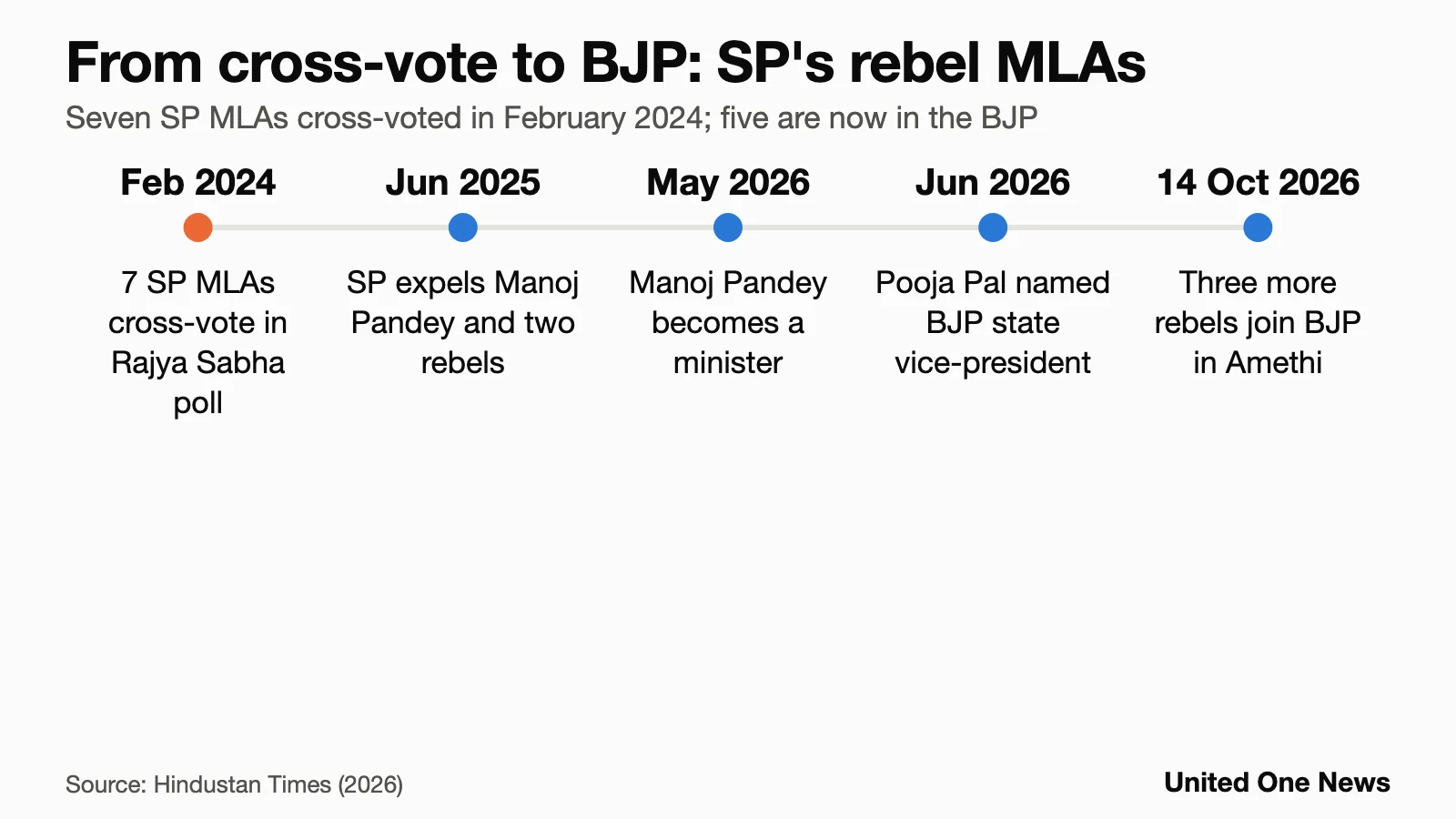
The split began with a 2024 cross-vote
Seven SP MLAs cross-voted for BJP candidates in the February 2024 Rajya Sabha election, and the SP's third nominee, Alok Ranjan, lost, Hindustan Times reported (Hindustan Times, 2026).
- June 2025: the SP expelled Manoj Kumar Pandey, Rakesh Pratap Singh and Abhay Singh. Vinod Chaturvedi is not among those the report names as expelled (Hindustan Times, 2026).
- May 2026: Manoj Pandey became a minister (Hindustan Times, 2026).
- June 2026: Pooja Pal became BJP state vice-president (Hindustan Times, 2026).
- 14 October 2026: the remaining three joined the BJP (Hindustan Times, 2026).
That makes five of the seven cross-voters now in the BJP. Whether the three can keep their seats turns on one part of the Constitution.
What the Tenth Schedule says about switching parties
A legislator is deemed to have defected in two cases, according to the PRS Legislative Research explainer on the law: if he voluntarily gives up membership of his party, or if he defies the party whip on a vote (PRS Legislative Research, 2017).
The Supreme Court has read "voluntarily gives up membership" widely. It can be inferred from conduct, such as publicly backing another party, PRS notes (PRS Legislative Research, 2017).
The only protection for a switch is a merger, which needs at least two-thirds of a party's legislators in favour (PRS Legislative Research, 2017). None of the reports we read describes a merger of the SP's legislators with the BJP.
The law also names who decides, and that is where the timing question begins.
The Speaker decides, within limits set by the Supreme Court
Disqualification is decided by the presiding officer, on a petition from another member of the House (PRS Legislative Research, 2017). In Uttar Pradesh that is the Speaker, Satish Mahana.
In its 2020 ruling in Keisham Meghachandra Singh v Speaker, Manipur Legislative Assembly, the Supreme Court set an outer limit of three months from filing for a Speaker to decide such petitions, LiveLaw reported (LiveLaw, 2020).
Uttar Pradesh has tested that before. In 2020 the Allahabad High Court issued notice to the UP Speaker on a plea about disqualification petitions against Congress MLAs that had been pending since May and November 2019 (LiveLaw, 2020).
Even with that rule, three questions are open for these MLAs.
What the reports do not settle
- No petition reported: none of the reports we read says the SP has filed disqualification petitions against the three, so the three-month clock has not visibly started (Hindustan Times, 2026; The Hindu, 2026).
- Expulsion first: two of the three were expelled by the SP in June 2025 (Hindustan Times, 2026). The sources we read do not say how that expulsion affects a petition under the Tenth Schedule.
- Vinod Chaturvedi: he is not reported as expelled, so his position may differ from the other two (Hindustan Times, 2026).
- Their seats: no report says whether any of the three plans to resign or to keep the seat.
Questions people are asking
Will the three SP MLAs lose their seats after joining the BJP?
Only if the Speaker disqualifies them under the Tenth Schedule on a petition. Joining another party can be treated as voluntarily giving up membership (PRS Legislative Research, 2017).
Who decides on disqualification?
The Speaker of the Uttar Pradesh Assembly, on a petition from another member (PRS Legislative Research, 2017).
How long can the Speaker take?
The Supreme Court set an outer limit of three months from filing in 2020 (LiveLaw, 2020).
How many seats are in the UP Assembly?
403, elected in 2022 (Wikipedia, 2026).
What happens next
No date is set for any step. The next UP Assembly election is due in 2027 (Hindustan Times, 2026). If the SP files a petition, the Supreme Court's three-month outer limit would run from that filing (LiveLaw, 2020).
References
- Hindustan Times (2026) Three rebel SP MLAs join BJP; Smriti Irani targets SP, Cong. Hindustan Times. Available at: Three rebel SP MLAs join BJP; Smriti Irani targets SP, Cong (Accessed: 15 October 2026).
- LiveLaw (2020) Allahabad HC issues notice to UP Assembly Speaker in plea seeking disposal of disqualification proceedings against Congress MLAs. LiveLaw. Available at: Allahabad HC issues notice to UP Assembly Speaker (Accessed: 15 October 2026).
- PRS Legislative Research (2017) The Anti-Defection Law explained. PRS. Available at: The Anti-Defection Law explained (Accessed: 15 October 2026).
- The Hindu (2026) Three rebel SP MLAs join BJP at event in Uttar Pradesh's Amethi. The Hindu. Available at: Three rebel SP MLAs join BJP at event in Uttar Pradesh's Amethi (Accessed: 15 October 2026).
- Wikipedia (2026) 2022 Uttar Pradesh Legislative Assembly election. Wikipedia. Available at: 2022 Uttar Pradesh Legislative Assembly election (Accessed: 15 October 2026).
How we did this
We compared three reports on the induction published on 14 and 15 October 2026, from Hindustan Times, The Hindu and The Indian Express. They covered who joined, the speeches and the 2024 background; none set out the law that decides the MLAs' seats. We added that from the PRS Legislative Research explainer on the anti-defection law and the LiveLaw report on the Supreme Court's three-month limit and the 2020 Uttar Pradesh case, and built the timeline of the seven 2024 cross-voters. We did not read the court judgments themselves.
This story was produced, reviewed, edited and verified by the reporter before publication, with AI assistance where required.
Covered by 5 outlets across the spectrum: 20% left, 80% center, 0% right.
Who is covering this story
- Left-leaning (1): The Hindu
- Center (4): Wikipedia, PRS Legislative Research, Hindustan Times, Livelaw
Sources
- 2022 Uttar Pradesh Legislative Assembly election - Wikipedia — Wikipedia (center) ·
- The Anti-Defection Law Explained — PRS Legislative Research (center) ·
- Three rebel SP MLAs join BJP; Smriti Irani targets SP, Cong — Hindustan Times (center) ·
- Allahabad HC Issues Notice To UP Assembly Speaker In Plea Seeking Disposal Of Disqualification Proceedings Pending Against Congress MLAs [Read Order] — Livelaw (center) ·
- Three rebel SP MLAs join BJP in U.P. — The Hindu (left-leaning) ·