AP municipal elections 2026 date: 28 October, run by the State Election Commission
Published
The Supreme Court on 21 October refused to move polling day but held back the final candidates' list, and sent the YSRCP's complaints to Andhra Pradesh's State Election Commission, not the ECI. How the two commissions differ, Article by Article.
Original report · Explained
Andhra Pradesh's municipal elections 2026 are on 28 October, and on 21 October the Supreme Court refused to move that date while holding back the final list of candidates until 25 October (LawChakra, 2026). It left the dispute with Andhra Pradesh's State Election Commission (SEC), not the Election Commission of India (ECI), and asked the SEC to examine by 22 October the YSR Congress Party's (YSRCP) complaints that violence and obstruction stopped its candidates from filing nominations.
That split answers the question students search for. The SEC runs panchayat and municipal elections under Articles 243K and 243ZA of the Constitution; the ECI runs elections to Parliament, the state legislatures and the offices of President and Vice-President under Article 324 (Ministry of Law and Justice, 2024).
The violence claims are the parties' and have not been tested. The YSRCP says 63.5%, about two-thirds, of its candidates were blocked; the bench noted that the data before it covered 272 nominations in 19 wards, against about 100 urban local bodies (ULBs) going to the polls (LawChakra, 2026).
What it is
The SEC and the ECI are separate constitutional bodies: one for local government, the other for Parliament, the state legislatures and the two highest offices. Side by side, from the text of the Constitution (Ministry of Law and Justice, 2024):
- Elections it runs: the SEC, panchayats (Article 243K) and municipalities (Article 243ZA); the ECI, Parliament, state legislatures, President and Vice-President (Article 324).
- Who leads it: the SEC is a single State Election Commissioner; the ECI is led by the Chief Election Commissioner (CEC).
- Who appoints: the Governor appoints the State Election Commissioner; the President appoints the CEC.
- Removal: the State Election Commissioner can be removed only in the manner and on the grounds of a High Court judge; the CEC, only like a Supreme Court judge.
- Staff: the Governor provides the SEC with staff when it asks (Article 243K(3)).
- Laws on the polls: the state legislature may make laws on panchayat and municipal elections (Articles 243K(4) and 243ZA).
Article 243ZA does not create a second body. The same SEC that runs a state's panchayat polls runs its municipal polls too (Ministry of Law and Justice, 2024). For a recent example of the ECI's own work, read Electoral roll revision: ECI's searchable rolls go to parties and candidates, not voters.
That division of labour shaped every step of the Andhra Pradesh dispute.
Background and timeline
State Election Commissions date from the constitutional amendments of 1992; the Andhra Pradesh case is this week's example of how they work.
- 1992: the 73rd and 74th Constitutional Amendments create Part IX (panchayats) and Part IXA (municipalities), and with them the SECs (Vajiram and Ravi, 2026).
- March 2008: Maharashtra's State Election Commissioner, Nand Lal, is jailed for two days for breach of privilege (Insights on India, n.d.).
- 2020: the Andhra Pradesh government takes its own SEC to court over the postponement of local polls on COVID-19 grounds (Insights on India, n.d.).
- 2021: the Supreme Court says serving government officials should not be appointed State Election Commissioners (Vajiram and Ravi, 2026).
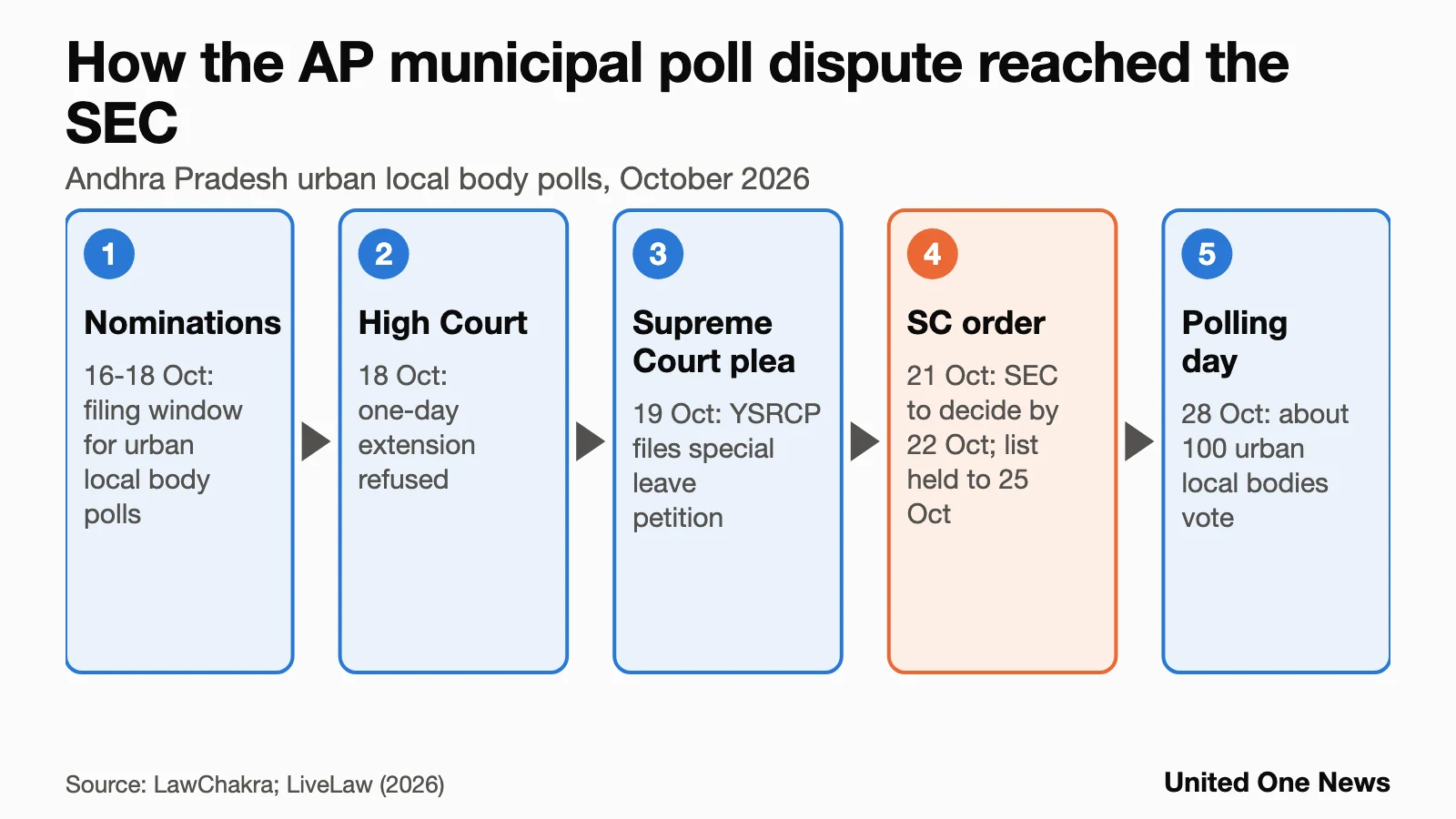
- 16-18 October 2026: the nomination window for Andhra Pradesh's urban local body polls (LiveLaw, 2026).
- 18 October 2026: the Andhra Pradesh High Court refuses a one-day extension of the nomination deadline (LiveLaw, 2026).
- 19 October 2026: the YSRCP files a special leave petition in the Supreme Court (LiveLaw, 2026).
- 21 October 2026: the Supreme Court sends the complaints to the SEC and holds back the final list (LawChakra, 2026).
The bench's reasoning rests on a handful of articles.
What the law says
Four groups of articles decide who runs an election and how it can be challenged (Ministry of Law and Justice, 2024).
- Article 243K(1): the superintendence, direction and control of electoral rolls and of panchayat elections vests in a State Election Commission, made up of a State Election Commissioner appointed by the Governor.
- Article 243K(2): the Commissioner's conditions of service are set by rules the Governor makes. The Commissioner can be removed only like a High Court judge, and service conditions cannot be varied to the Commissioner's disadvantage after appointment.
- Article 243K(3): the Governor shall provide staff when the SEC asks for them.
- Article 243K(4): the state legislature may make laws on panchayat elections.
- Article 243ZA: the same arrangement, and the same SEC, for municipal elections; the legislature may make laws here too.
- Article 324(1), (2) and (5): the ECI's superintendence of elections to Parliament, the state legislatures and the offices of President and Vice-President; the President appoints, and the CEC can be removed only like a Supreme Court judge.
- Articles 243-O, 243ZG(b) and 329(b): an election can be challenged only through an election petition, for panchayats, municipalities, and Parliament or the state legislatures respectively.
That last bar is why the bench spoke of election petitions. Justice Joymalya Bagchi said the SEC should decide "case by case" on the material each candidate gives, that a rejected case can go to an election petition, and that a person stopped from filing could be treated as a "deemed rejection" (LawChakra, 2026).
Institutions, committees and judgments
Courts have said state governments must obey SEC orders; reform panels have proposed ways to make SECs more independent.
- Kishan Singh Tomar v Ahmedabad Municipal Corporation: the Supreme Court held that states must obey SEC orders as they would the ECI's (Insights on India, n.d.).
- 2021: the Supreme Court said serving officials should not hold the post (Vajiram and Ravi, 2026).
- Second Administrative Reforms Commission: proposed that SECs be appointed by a collegium of the Chief Minister, the Speaker and the Leader of the Opposition (Vajiram and Ravi, 2026).
- 255th Law Commission report: proposed an independent secretariat (Vajiram and Ravi, 2026).
- The Andhra Pradesh bench: Justices Joymalya Bagchi and V. Mohana, with the next hearing on 27 October (LawChakra, 2026).
The case itself turns on a few numbers.
The numbers
Most of the figures in the Andhra Pradesh case come from the court hearing, and one is disputed.
- 28 October 2026: polling day (LawChakra, 2026).
- About 100: urban local bodies going to the polls (LawChakra, 2026).
- 3 days: the nomination window, 16 to 18 October (LiveLaw, 2026).
- 63.5%: the share of its candidates the YSRCP says were blocked, a party claim (LawChakra, 2026).
- 272 nominations in 19 wards: what the bench said the YSRCP's data covered (LawChakra, 2026).
- 25 or 26 October: the date until which the final list is held. Headlines from The Hindu, India Today and LawChakra say 25 October; a Law Trend headline says 26 October (Google News listing, 2026).
- 2 days: how long Maharashtra's State Election Commissioner was jailed for breach of privilege in 2008 (Insights on India, n.d.).
What those figures mean for SEC independence is where the arguments start.
Arguments for and against
The wider debate is whether SECs are independent enough; the Andhra Pradesh case adds a narrower one about deadlines. Each point is attributed.
On SEC independence:
- For: the Constitution gives the State Election Commissioner the same removal protection as a High Court judge, and bars changing service conditions to the Commissioner's disadvantage (Ministry of Law and Justice, 2024).
- Against: Vajiram and Ravi's summary says SECs depend on the state for staff and funds, are often bureaucrat appointees, and have seen delays, citing Madhya Pradesh's OBC dispute (Vajiram and Ravi, 2026).
On the Andhra Pradesh deadline:
- The YSRCP says violence and obstruction kept its candidates from filing, and sought more time (LiveLaw, 2026; LawChakra, 2026).
- The bench declined a blanket extension and left each case to the SEC. "We will not pass a blanket order shifting the date," Justice Bagchi said (LawChakra, 2026).
- An Indian Express headline said police must protect YSRCP candidates (Google News listing, 2026).
- The SEC's own response and the state government's view were not in the reports we read.
What happens next
Four dates in one week decide the outcome (LawChakra, 2026).
- 22 October: the SEC examines the YSRCP's complaints.
- 25 October: the final candidates' list is held until this date (one headline says 26 October).
- 27 October: the Supreme Court hears the case again.
- 28 October: polling.
For the longer term, the reform ideas on record are a collegium to appoint SECs (Second Administrative Reforms Commission), the 2021 bar on serving officials (Supreme Court) and a permanent secretariat (255th Law Commission), as summarised by Vajiram and Ravi (Vajiram and Ravi, 2026).
Questions people are asking
Who conducts municipal elections in India?
The State Election Commission, under Article 243ZA of the Constitution (Ministry of Law and Justice, 2024).
Can the Election Commission of India conduct panchayat elections?
No. Article 243K vests panchayat elections in the State Election Commission (Ministry of Law and Justice, 2024).
Who appoints the State Election Commissioner?
The Governor. The President appoints the Chief Election Commissioner (Ministry of Law and Justice, 2024).
When are the AP municipal elections in 2026?
Polling is on 28 October 2026, in about 100 urban local bodies (LawChakra, 2026).
What did the Supreme Court say about the AP municipal polls?
On 21 October 2026 it refused a blanket extension of the nomination deadline, asked the SEC to examine the YSRCP's complaints by 22 October, and held the final list until 25 October (LawChakra, 2026).
For students
Syllabus link
GS Paper II: Polity, constitutional bodies and local government.
Key terms
- State Election Commission (SEC): the body that runs panchayat polls under Article 243K and municipal polls under Article 243ZA.
- Election Commission of India (ECI): the Article 324 body for elections to Parliament, state legislatures, President and Vice-President.
- Election petition: the only route to challenge a local poll once it is under way (Article 243ZG(b) for municipalities).
- Special leave petition (SLP): an appeal to the Supreme Court by its special leave.
- Deemed rejection: the bench's phrase for a nomination a candidate was stopped from filing.
- Urban local body (ULB): a municipality, the unit going to the polls in Andhra Pradesh.
- Part IXA: the part of the Constitution on municipalities, added in 1992.
Prelims facts
- Article 243K sets up SECs for panchayats; Article 243ZA extends them to municipalities.
- The Governor appoints the State Election Commissioner; the President appoints the CEC.
- The State Election Commissioner is removed like a High Court judge; the CEC like a Supreme Court judge.
- Articles 243-O and 243ZG bar courts from interfering in local polls except through election petitions.
- The 73rd and 74th Amendments of 1992 created Parts IX and IXA.
- The ECI's powers come from Article 324.
(Ministry of Law and Justice, 2024; Vajiram and Ravi, 2026)
Mains practice question (250 words)
State Election Commissions are constitutional bodies, but critics say they depend on state governments for staff and funds. In the light of the Supreme Court's October 2026 order on Andhra Pradesh's municipal polls, compare the constitutional position of State Election Commissions with that of the Election Commission of India, and suggest reforms to strengthen them.
Prelims practice question
Consider the following statements: (1) The State Election Commissioner is appointed by the President. (2) Article 243ZA vests the conduct of municipal elections in the State Election Commission. (3) The State Election Commissioner can be removed only in the manner and on the grounds of a High Court judge. Which of the statements given above are correct? (a) 1 and 2 only (b) 2 and 3 only (c) 1 and 3 only (d) 1, 2 and 3. Answer: (b). The Governor, not the President, appoints the State Election Commissioner.
How we did this
On 21 October 2026 we read Articles 243K, 243ZA, 243-O, 243ZG, 324 and 329 in the Constitution of India published by the Legislative Department, and set the two commissions side by side. We took the Andhra Pradesh case from LawChakra and LiveLaw, and compared headlines from The Hindu, Indian Express, LiveLaw and Law Trend in a Google News listing: The Hindu led on the deferred list, Indian Express on police protection, and LiveLaw on the SEC deciding the plea. The headlines disagree on whether the list is held to 25 or 26 October, so we give both.
The judgments and reform proposals are described from the summaries of Insights on India and Vajiram and Ravi. We found no previous-year UPSC question we could verify, so none is listed. The hero image is a flow chart we drew from the case dates; upload it with the story.
References
- Google News (2026) Headlines of The Hindu, Indian Express, LiveLaw and Law Trend, 21 October 2026. Google News. Available at: Google News listing (Accessed: 21 October 2026).
- Insights IAS (n.d.) State Election Commission. Insights on India. Available at: State Election Commission (Accessed: 21 October 2026).
- LawChakra (2026) Supreme Court Grants YSRCP Relief, Defers Final Candidates' List. LawChakra. Available at: Supreme Court Grants YSRCP Relief (Accessed: 21 October 2026).
- LiveLaw (2026) YSRCP Moves Supreme Court Alleging Violence Prevented Its Candidates From Filing Nominations For AP Municipal Polls. LiveLaw. Available at: YSRCP Moves Supreme Court (Accessed: 21 October 2026).
- Ministry of Law and Justice (2024) The Constitution of India (as on 1 May 2024). Government of India. Available at: The Constitution of India (Accessed: 21 October 2026).
- Vajiram and Ravi (2026) State Election Commission. Vajiram and Ravi. Available at: State Election Commission (Accessed: 21 October 2026).
This story was produced, reviewed, edited and verified by the reporter before publication, with AI assistance where required.
Covered by 6 outlets across the spectrum: 17% left, 50% center, 17% right.
Who is covering this story
- Left-leaning (1): Insights on India
- Center (3): LawChakra, Google News IPL, Livelaw
- Right-leaning (1): Legislative Department, Government of India
- Not yet rated (1): Vajiram and Ravi
Sources
- Article from Legislative Department — Legislative Department, Government of India (right-leaning) ·
- Andhra Municipal Polls: Supreme Court Grants YSRCP Relief, Defers Final Candidates' List — LawChakra (center) ·
- Article from Google News listing — Google News IPL (center, AI-estimated) ·
- State Election Commission, Provisions, Powers, Functions, Reforms — Vajiram and Ravi (not yet rated) ·
- State Election Commission — Insights on India (left-leaning) ·
- YSRCP Moves Supreme Court Alleging Violence Prevented Its Candidates From Filing Nominations For AP Municipal Polls — Livelaw (center) ·