How to find unbiased news in India: five checks that take a minute
Published
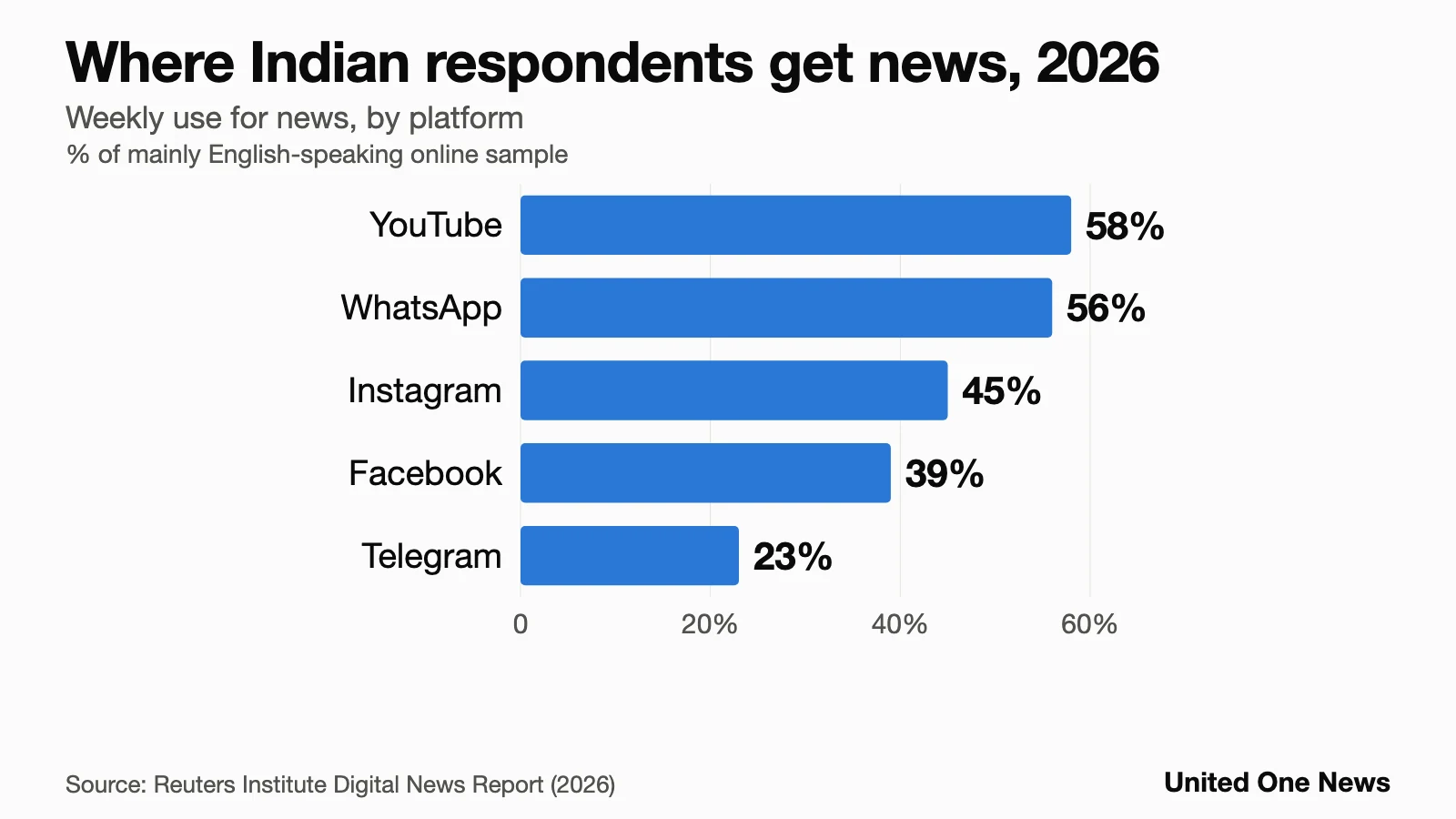
56% of Indian respondents get news on WhatsApp each week, says the Reuters Institute's 2026 survey. Five free checks: compare three outlets, read the document, search a fact-checker, check ownership and reverse-search images.
Original report
Guide checked on 15 October 2026. Platform figures from the Reuters Institute Digital News Report 2026.
How to find unbiased news in India starts with a change of goal: instead of hunting for one perfectly neutral outlet, check each story that matters. As of October 2026 that is urgent, because the Reuters Institute's 2026 survey found 56% of Indian respondents used WhatsApp for news each week, up 10 points, and 58% used YouTube (Reuters Institute, 2026).
Forwards and clips arrive without an outlet's name, a date or a source. The five checks below are free, need only a phone, and take about a minute each.
Check 1: read the same story in three different outlets
Pick three outlets with different owners and different reputations, and read their reports of the same event. Facts that all three state are likely to be solid. A detail that only one reports needs a second source before it is believed.
Watch the words as well as the facts. One outlet's "protest" is another's "unrest"; one leads with the government's statement, another with the people affected. Neither is necessarily false, but together they show what each chose to stress.
United One News, which publishes this guide, does this step in one place: its story pages group Indian outlets' coverage of one event and show how outlets labelled left, centre and right covered it. Most of those labels are still automated estimates, as its methodology page says (United One News, 2026).
Check 2: go to the primary document
Many stories rest on one document: a court order, a gazette notification, a budget table, a company filing or an official press release. Find it, usually on the court's, ministry's or regulator's own website, and check that the numbers and quotes in the report match it.
If a report gives no document and no named source for a big claim, treat the claim as unconfirmed.
Check 3: search a fact-checker
India has many professional fact-checkers. On 15 October 2026 the International Fact-Checking Network (IFCN) listed 17 Indian organisations among its active signatories, including BOOM, Factly, Newschecker, Vishvas News, India Today Fact Check, The Quint and the Press Trust of India (IFCN, 2026). Signatories are assessed for nonpartisanship and fairness, transparency of sources, funding and methods, and open corrections.
- BOOM says it was among the first two Indian fact-checkers certified by the IFCN, and publishes a seven-step method that ends with correcting mistakes openly (BOOM, n.d.).
- Factly is on the IFCN's active list and focuses on public data and claims about it (IFCN, 2026).
- Alt News describes itself as a non-profit fact-checking website run by the Pravda Media Foundation and funded by donations and grants (Alt News, n.d.). It is not on the IFCN's current active list.
- PIB Fact Check is the government's own unit, set up by the Press Information Bureau in November 2019 to check claims about the Government of India, its ministries and public sector bodies. It takes queries on WhatsApp at +91 8799711259 (Vikaspedia, n.d.).
Because PIB Fact Check is part of the government, it is most useful for questions such as whether a circular or scheme notice is genuine. On disputed claims about government performance, an independent fact-checker gives a second view.
Check 4: look for corrections and ownership pages
Before trusting an unfamiliar outlet, open its "About", corrections and ownership pages. A named editor, a published corrections policy and corrections noted on stories are signs it is willing to be held to account.
For larger outlets, the Media Ownership Monitor India maps who owns which TV channels, newspapers, radio stations and websites (Global Media Registry and Data Leads, n.d.). Ownership is not proof of slant, but it tells readers whose interests to keep in mind.
Check 5: reverse-search the image or video
Old photos and clips are often recycled as new. Upload the image, or a screenshot of a video frame, to a reverse-image search such as Google Lens or TinEye, and look for its earliest appearance online.
If the same picture was published years earlier, or in another country, the forward is wrong about what it shows, whatever the caption says.
Why the checks matter more on platforms
The Reuters Institute's 2026 India data shows news reaching respondents mostly through platforms: 58% used YouTube, 56% WhatsApp, 45% Instagram, 39% Facebook and 23% Telegram for news each week (Reuters Institute, 2026). The Institute notes its India sample is mainly English-speaking online users and is not nationally representative.
On those platforms, outlets, creators and anonymous accounts share one feed. The five checks work the same way on all of them.
Questions people are asking
How to get unbiased news for free?
Compare free reports of the same story from three outlets with different owners, then check the primary document and a fact-checker. All five checks in this guide cost nothing.
How to find neutral news sources?
Look for outlets that name their sources, publish corrections, label opinion and disclose their owners. No outlet can prove it is neutral, but these signals show whether its work can be checked.
Is there a fake news check app?
No single app can rule on every claim. PIB Fact Check takes queries about the Government of India on WhatsApp, and IFCN signatories such as BOOM and Factly publish fact-checks on their own sites.
What is a media bias chart for India?
A media bias chart places outlets on a left-to-right scale. Any such chart reflects its makers' method and judgement, so check how its labels were set before relying on it.
References
- Alt News (n.d.) About. Alt News. Available at: About Alt News (Accessed: 15 October 2026).
- BOOM (n.d.) Methodology. BOOM. Available at: BOOM methodology (Accessed: 15 October 2026).
- Global Media Registry and Data Leads (n.d.) Media Ownership Monitor India. Available at: Media Ownership Monitor India (Accessed: 15 October 2026).
- International Fact-Checking Network (2026) Signatories. Poynter Institute. Available at: IFCN signatories (Accessed: 15 October 2026).
- Reuters Institute for the Study of Journalism (2026) Digital News Report 2026. Oxford: Reuters Institute. Available at: Digital News Report 2026 (Accessed: 15 October 2026).
- United One News (2026) How we rate Indian news outlets. United One News. Available at: How we rate Indian news outlets (Accessed: 15 October 2026).
- Vikaspedia (n.d.) PIB Fact Check. Government of India. Available at: PIB Fact Check (Accessed: 15 October 2026).
How we did this
We checked each fact-checker's status against the IFCN's list of active signatories on 15 October 2026, read BOOM's methodology page and Alt News's about page, and took PIB Fact Check's remit from the government's Vikaspedia page. Platform figures come from the India data page of the Reuters Institute's Digital News Report 2026.
United One News compares news coverage, so this guide is about our own field and we have an interest in it. We mention our product once, in check 1, and the other four checks need no tool of ours.
This story was produced, reviewed, edited and verified by the reporter before publication, with AI assistance where required.
Covered by 5 outlets across the spectrum: 0% left, 40% center, 0% right.
Who is covering this story
- Center (2): Reuters Institute for the Study of Journalism, International Fact-Checking Network
- Not yet rated (3): Vikaspedia, Alt News, BOOM
Sources
- PIB Fact Check — Vikaspedia (not yet rated) ·
- Article from Reuters Institute for the Study of Journalism — Reuters Institute for the Study of Journalism (center, AI-estimated) ·
- Article from Alt News — Alt News (not yet rated) ·
- BOOM Fact‑Check Methodology | How Boom Checks News & Claims — BOOM (not yet rated) ·
- Article from International Fact-Checking Network — International Fact-Checking Network (center) ·